
Blog

Jingle Tales: Sarah’s Story

My story starts, as all good Christmas stories do, with a divorce.

Specifically, the divorce of my parents, who split up when I was six when my mom fell in love with another woman. In 1982 small-town Ontario this was a bit of a scandal, and when the homophobia proved to be too much, Mom moved to Toronto to be with her new girlfriend.

My brother and I would hop on the greyhound bus every other weekend to visit her, swapping our big house for her tiny co-op apartment in the city. I loved taking the subway, going to art exhibits, visiting the big library with books I’d never find at home. We were introduced to interesting new things like the lesbian softball league, Take Back the Night marches, and drag shows.

Mom was a vibrant, passionate woman who threw herself into this new life. I hated leaving her at the end of the weekend, and I hated that at home her gayness was still largely a secret.

Under her charismatic exterior mom was also insecure, and sometimes sad. Her new relationship was chaotic, with undercurrents and breakups I didn’t understand. As a kid, I watched helplessly as her moods rose and fell.

My story takes place during one of these break-ups, and it’s low. I was about eight, that my brother and I went to Toronto to spend the holidays with Mom. It was her first Christmas without a partner in years. In our family, Christmas had always been a bustling, cheerful affair, with turkey dinner, grandparents, cousins, the fancy silverware, tablecloths.

But that year, mom surprised us by announcing we’d be going out to a restaurant for dinner on Christmas day, just the three of us. She wanted us to be excited, but I felt disappointed that we weren’t doing our regular things.

Maybe she was trying to make new traditions, or maybe she didn’t have the energy to cook a holiday meal. I don’t know, but whatever the reason, there we were on that brutally cold Christmas day, bundling up to walk to the restaurant she’d chosen. I remember zipping our coats up to our noses and pulling our toques down almost over our eyes for the walk over.

The streets were empty – I imagined everyone else gathered around big tables with big, happy families. As the snow crunched under our feet, I missed home, my dad, my dog, the feeling of being part of something bigger. This didn’t feel like Christmas.  

Once I saw the restaurant she’d chosen, I was even more disappointed. It was a stark, low budget kind of place with metal tables and fluorescent lights. A chalkboard outside said Turkey Dinner in a messy scrawl. Inside, several sad-looking people ate alone. The smell of grease hung thick in the air. Even the Christmas music playing through the tinny speakers didn’t make it feel festive.

I nudged my brother and pointed to one of the diners – a large man with a big round belly and a long white beard, though it was kind of yellowed and dirty. He wore a thick, moth-eaten blue sweater.  “It’s Santa,” I whispered jokingly. My brother rolled his eyes. The waitress brought the guy another beer and a plate of fries. His weathered hands shook as he ate.

No question, this place was depressing. 

Still, I knew that my mom was trying to make Christmas special, and I wanted her to be happy. She said we could order whatever we wanted, which was unheard of – mom was always on a budget.

The waitress came by – an older woman with a greying ponytail. “What a special night!” she said.

We were trying.

I ordered a milkshake, then wondered if I shouldn’t have because of the cost. I built towers out of the little jam and peanut butter packets that were still on the table from breakfast.

Mom put on a smile, but behind it, she looked tired. I kept talking, telling her everything I could think of about school and my friends. My brother was quiet as usual, looking like he’d rather be anywhere else.

Mom lit a cigarette and smoked while we waited for the food to come. She kept opening the menu – I could see her scanning the prices, doing the math in her head.  

We drank our milkshakes, then ate our dry turkey with lumpy mashed potatoes.

Mom asked if we wanted dessert, but we both said no, not wanting to stress her out any more.

The bell over the door jingled, and I looked up to see Santa leaving, pulling his ratty plaid jacket on as he went out into the cold.

Not even Santa wants to have Christmas here, I thought.

Finally, after what felt like the longest meal of my life, mom pulled out her wallet and motioned for the check.

The waitress came over to our table and smiled. “Don’t worry,” she said. “It’s been taken care of.”

Mom blinked “What?”  

The server pointed to where Santa had just been sitting. “That gentleman asked if he could buy you dinner.”

Mom blinked again, tears in her eyes, still unsure of what was happening.

The server patted her hand, said “Merry Christmas hon. There’s pie on the way.”

The smile that slowly filled mom’s face brightened to a thousand watts. And with that we had her back, laughing as we devoured our pie with whipped cream.

We left the diner giddy, talking over each other about how we’d seen the real Santa that night. It was still cold, but now I noticed the holiday lights twinkling from people’s apartment balconies.

We may not have had tablecloths, or extended family, or fancy silverware, but Santa bought us dinner!

I’ve returned to the memory of that night so many times over the years. It’s like I’m looking in through the diner’s fogged-up window to see two sad blonde kids with messy hair and a mom in a thrifted red sweatshirt trying her best to make Christmas merry. And a guy with a white beard – and probably not a lot of money himself – who sees them.  

This story is a love letter to that man and his unexpected kindness.  

But it’s also a love letter to parents going through hard times.

See I feel a kinship with my mom, with who she was back then, now that I’ve spent quite a few Christmases on my own, trying to conjure magic for my kids, sometimes when I was barely holding on myself. I’ve watched my kids negotiate lost traditions and adjust to new normals. And honestly it’s been hard at times.

I wish I could tell that young version of my mom, she’s doing a great job. That it’s okay to be sad at Christmas. I wish I could tell her thank you for taking us to a restaurant, even if it’s not what I wanted at the time. Thank you for trying something new. And thank you for being brave enough to follow your heart, for falling in love and coming out, even though it wasn’t all sunshine and rainbows.  

You gave me the courage to do the same.

 I want to tell her it all works out in the end – her queer daughter will grow up knowing the beauty of chosen family and evolving traditions.

That her daughter will be grateful for that night, and how it reminded her to believe in miracles.

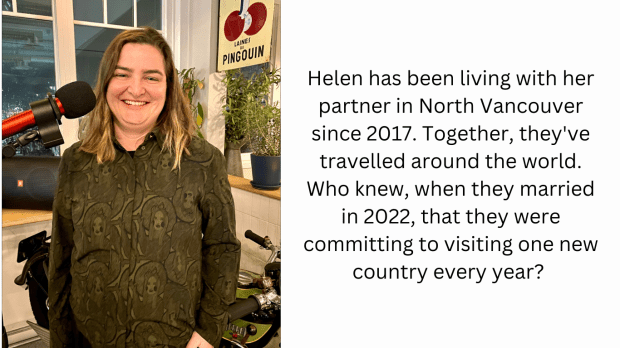
Jingle Tales: Helen’s Story

I still remember when my sister broke the news. We were downstairs in the basement of our childhood home, watching the Simpsons. During a commercial break, my sister leaned over and said, “There’s something I need to tell you.” 

I looked at her, seriously. 

“Santa isn’t real,” she said. “It’s just mom and dad bringing down the presents.”

I said nothing, turning back to the TV. The commercial break ended, and we returned to watching The Simpsons. It was the episode where Homer is downhill skiing. He starts losing control as he picks up speed. He tries to recall what the ski instructor taught him earlier that day, but his thoughts quickly turn to having seen his neighbour Ned Flanders in a skin-tight ski suit. As he flaunts the new suit, Flanders famously says to Homer, “It feels like I’m wearing nothing at all!” 

As Homer continues to pick up speed, he can’t get the image of Flanders’ perfectly sculpted ass out of his head. He grimaces.

“Stupid sexy Flanders.”

When I looked up that episode to see when it aired, it was the year 2000, which means I was 12 years old when my sister revealed the cataclysmic life-changing news about Santa. I think we can agree that 12 is probably a little old to be believing in Santa Claus, but also that it’s kind of beautiful that my parents and my sister let me go on believing for as long as they possibly could before it became, like, really socially unacceptable.

Like, you would probably assume that having received said news, any reasonable 12 year-old would spend a few days mourning the inevitable loss of their childhood and then move on. Dear reader, this was not the case. I continued believing in Santa until I was 17 years old. 

With every passing year, I insisted that we keep the tradition alive: demanding that all of us kids sleep under the tree to see if we could catch Santa in the act, even going so far as to leave him cookies and a glass of milk (though by that time, my parents had gently suggested that Santa might enjoy a splash of Bailey’s).

I imagine that psychologists would have a field day with this particular childhood obsession, which, when I look back, feels a little embarrassing. But, then, I consider why it was I stopped at the age of 17 believing in Santa. What was happening at that time?

When I was 17, I decided to pursue a career as a pastor in a conservative Evangelical Christian denomination. While most girls my age were getting high and sneaking out to have sex with their boyfriends, I rebelled against my parents by becoming a raging fundamentalist. 

When I announced to my church friends that I wanted to become a pastor, they told me women pastors just didn’t exist. For a lot of people this lack of support and outright discrimination might kill your dreams, setting you on a different path, maybe even turn you against the career you’d been hoping to pursue. But, what my fundy friends didn’t know was that I had 17 years under my proverbial chastity belt believing in “something that didn’t exist.” I just blinked and went ahead and applied to become a pastor anyway. 

It turns out that believing in something that really probably doesn’t exist, well it turns out this is a critical skill for anyone wanting to go to seminary. After four years, I graduated from the Canadian prairie bible college known as “Bridalquest”. I was unmarried (spoiler alert, I never really had a problem with the girls dorms being separate from the boys). I went on to pursue a master’s in theology at a much more reputable and accredited university. I was ordained an Anglican priest and a year into my first parish, I came out. 

Once again, friends and mentors from my fundy days wrote to tell me being gay was nothing more than make-believe. This time, I realized that between believing in Santa Claus and believing in the God of white Chrisitan Evangelicals, that I actually had a combined 34 years of believing in “something that didn’t exist,” that is, a mythical old white man with a beard who keeps a running list of your bad behaviour. 

There’s a line from the Christmas carol, “Santa Claus is coming to town.” It goes, “He knows when you’ve been sleeping, he knows when you’re awake, he knows when you’ve been bad or good, so be good for goodness sake!” 

Is it Santa? Is it God? I mean . . . 6/7.

By sharing this story tonight, I don’t in any way want to underplay the very real discrimination that we experience as queer people both as we seek out career paths and as we make ourselves known in the world. I was blissfully naive for a lot of those years, and there were still some really shitty things that happened that I wouldn’t wish on anyone. 

I want to say, though, that there is something beautiful, something queer about believing in Santa Claus or whatever mythical story it was for you in your childhood. That something beautiful, that something queer is the ability to imagine a world, an existence for ourselves that others might not be able to or might not be willing to picture for themselves. This is our holiday magic. 

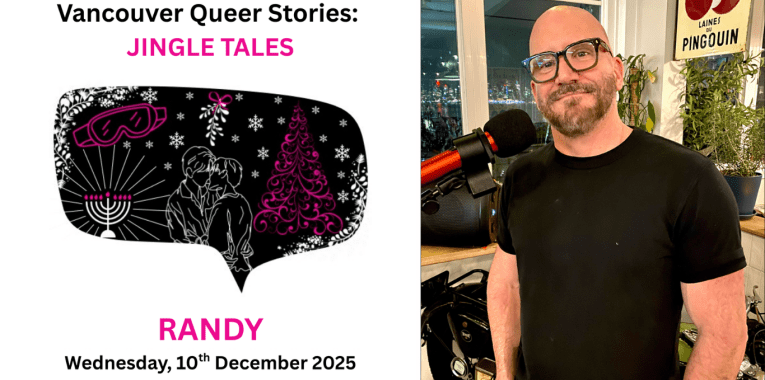
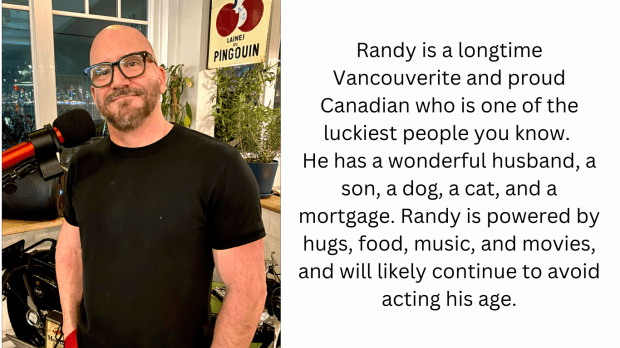
Jingle Tales: Randy’s Story

I have often said that no one loves the Xmas season as much as I do. That may or may not be true, but I definitely give other competitors a run for their money.

I am a confirmed atheist, so it’s never been about the religious aspects of the holiday, but the things that colour the season – the lights, decorated trees, the ever-present holiday music, the parties and gatherings, the customs and traditions: Charlie Brown, multiple iterations of the Grinch, Frosty, Rudolph, Ebenezer Scrooge, George Bailey & his wonderful life, Ralphie and his beebee gun, Will Ferrell as the most sincere elf in existence, and the Clark Griswold family Xmas disaster. Did you notice that I never said gifts and shopping?  I participate in that and do take pleasure in finding someone a great gift, but I truly would enjoy the entire season just as much if I never received a gift or had to buy one. Anytime I hear someone complain about how commercial the season is, I suggest they spend less time shopping in stores and on-line. There are at least 150 ways that someone can enjoy the season if they are compelled to, and most of these do not involve standing in line in a store.

In our house, we love Halloween. But honestly, once the decorations are put away and the jack-o-lanterns are composting, my lovely husband understands that there exists a chance that I might be playing occasional holiday music. It evokes so much happiness for me, that I have always found the expectation that Xmas music only be played within a week or two of December 25 to be really limiting. What I find amusing is that, because so much of the holiday music we listen to is rooted in childhood traditions, the musical artists involved can be so very random. This can truly be the only time that Glen Campbell, Charlie Brown, Don Ho, The Muppets, New Kids On The Block, Sia, Ella Fitzgerald, Run DMC, and the Mormon Tabernacle Choir can be heard side-by-side, and no one really finds it odd.

Xmas traditions come and go, but one that is key for me is giving back. I’m a big fan of outreach and charity work. When my son was just 4 years old, Drew and I felt strongly that he should have a sense of perspective about how much we have, our place in the world, and how we should never take any of that for granted. About 17 years ago, I joined a grassroots outreach group called Potatoheads that serves fully-dressed baked potatoes and other food at Pigeon Park in Vancouver’s Downtown Eastside, one day per month. I would bring Jack with me each time, and he stuck with it until the pre-teen years kicked in, around the time that I took over the group’s coordinator role.  To this day, Potatoheads go down to Pigeon Park in the heart of the DTES every month to serve food and give out second-hand clothing and other essentials. At Xmas, we fundraise to buy items for gift bags that include food, socks, hats, and toiletry items, and are usually able to make and give out well over a hundred of these bags.

When I first started going to the DTES on a regular basis, I had some concerns. Obviously, my son’s safety was the primary one. But I came to realize over a brief period of time that, while it’s a very surreal atmosphere, and I am always keeping my eyes open, the residents are generally kind, appreciative, and open to chatting and jokes. Many seemed particularly impressed that my son was there, and they told him so. One day, someone gave him a Loonie for his efforts, and I told the gentleman that while it was a much-appreciated gesture, he likely needed the money much more than Jack did. He told me in no uncertain terms that he was giving it to my son, and not me. I understood at that moment that he probably felt great to show my son his appreciation this way, so of course, I left it at that. Over the years that Jack came with me, he ended up with further funds, a few Hot Wheels cars, and advice like, “listen to your parents!” and “stay in school!”

It’s deeply satisfying to be able to give food and supplies directly to end users. Over time, I occasionally become skeptical and wonder what difference is truly being made. But it always comes down to two things:  1) people need and 2) I have. And during the holidays, when so many of us are swimming in abundance, the motivation to give feels like the right thing to do. So, we keep doing it.

This extends to our annual holiday party that we throw at the beginning of each December. At our front door, we will have two donation boxes – one for the Vancouver Food Bank and one for the BC SPCA. People are allowed in even if they don’t contribute, and we will treat them just as kindly as the people who do. We promise.

In summary, I love the holiday season for a bunch of reasons. It’s amazing how sensory it all is. The smell of a mandarin orange or a cut Xmas tree can connect me so easily with how blissed out I was every December when I was a kid. Or the first 20 seconds of my favourite Xmas TV special. Or an incredible light display. Or track one/side one of the cheesiest vinyl holiday album that has ever existed, which still manages to make me almost as blissed out as I was when I was little.

I love socializing with family, friends, and neighbours on the 24th and 25th, and opening the doors of our house on Boxing Day to whoever wants to join us for leftovers and further hospitality. When I say that everyone here is invited, I’m quite serious. Talk to me after for our address.

Every December, I’m reminded of how lucky I am, not just in what I have, but in what I’m able to share with others. What makes the holidays meaningful for me are: the joy, the socializing, the nostalgia, and simple acts of giving. All that wrapped together with the soundtrack of Charlie Brown Xmas playing in the background can somehow make the world feel a little kinder.

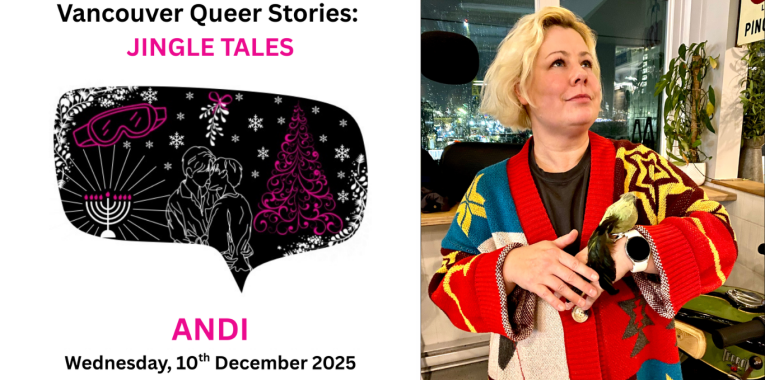
Jingle Tales: Andi’s Story

When I travel home for the holidays, I typically fly into Winnipeg. My family picks us up and we drive two hours to an acreage in the middle of nowhere. Icy roads, snow drifts, the smell of diesel in the early mornings, curling bonspiels, New Year’s socials, and having the breath knocked out of you when you open the door to go outside. No, these are not ‘a few of my favourite things,’ but the elements that make up a typical Christmas season out in the Prairies.

But this is not that story. This story begins in a rented Villa in sunny Cabo, Mexico after my parents decided we should all meet up for Christmas somewhere warm. What we thought would be a relaxing holiday getaway didn’t exactly turn out as expected.

On the day we arrived, my parents and brother had flown in a few hours earlier, and thus, my wife and I were left with the smallest, street-facing room, while everyone else sprawled out into their king-sized pool-view rooms. “Sucks to suck!” As Graeme, my brother, would say. But we were happy to see everyone and grateful that our schedules aligned. We caught up and began planning our excursions. My dad mentioned how we should all avoid one of the bathrooms for the time being, as my mom shouted, “Because your dad plugged it up!” Awesome.

The home owner, “Rita,” would send over her handyman/boyfriend to fix the situation dad had created. “Ooof, wouldn’t wanna mess with that guy!” My Dad said. “Why?” Chalking it up to some kind of prairie ignorance. “His name, it sounds like he’s in a gang.” Graeme and I just rolled our eyes. Turns out – let’s call him “Diablo” and Rita – owned two properties and were residing in the villa next door.

Throughout the trip, my mother, a retired nurse, would warn us of ingesting unbottled water. We reminded her that we had all been to Mexico before and knew the risk. I guess it was a helpful reminder, but for the most part, I generally stick to beers on holidays. Plus, I’m a tough farm kid with a gut of steel, right?

Well, one night we decided to go out for a fancier dinner to celebrate the holiday season. We dressed in our finest travel shorts and headed down to an Italian-style restaurant. I figured that I should try to eat at least one healthy meal on vacation so while everyone else chose pasta, I opted for the salad.

Later that night I began to feel the intensity of my gut in distress. At 3 am I ran to bathroom and was reintroduced to that $45 salad. I thought “at least I’ll feel better after this, I’m probably just hungover!” I did not, in fact, feel better and by 8am I realized I was in pretty rough shape.

“Mom, do you have anything for nausea?” “No, I don’t. You don’t look too good.”

“I’ll be alright, I’m just waiting for this to pass.”

By 2pm, my mother was putting a cool cloth on my head and my wife was urging me to take a sip of some sprite. As I did, I could tell my stomach was about to reject it and within a minute I was back in the bathroom. At this point I was severely dehydrated. I leaned over the porcelain throne and everything faded to black.

Wwweeeeeeeeooooooooo

Here came the ambulance, letting everyone and their dog know that some dumb tourist had to be transported to the hospital!! But this was no ordinary ambulance! It was the beach ambulance labeled “Bay Watch!” The paramedics helped me into the back as I noticed Rita and Diablo stepping out of their house towards my Dad, likely to ask what was happening.

I told myself “everything’s going to be okay. I’ll be back in a few hours.”

The wheels started moving and as they began to turn faster I was made aware of how uneven the cobble stone streets were. “Give me a bucket!” I yelled as I bounced from side to side on the stretcher. As we turned on to the main road it was clear that the back window of the ambulance made my performance quite visible to the traffic behind us, but at this point I no longer cared.

At the hospital, my wife proceeded with the paper work. I was able to see a doctor immediately. After about 4 different scans I was wheeled into a state of the art hotel room… I mean hospital room. Despite feeling like death was knocking, I couldn’t help but notice how new and fancy the room was! “If I’m gonna die, at least it’ll be in luxury!”

I was given IV fluids, which made a world of difference; however, as my wife would describe it, it did not stop the extremely rigid exorcist-style dry heaving. I was getting used to the routine, but I would have preferred to be in a better state for all the blood tests I was about to be put through. I have a really hard time with needles, so we’ll skip over that part!

Of course this also meant that I would have to stay the night in the hospital to wait for the results. While I was enduring this bodily punishment I was very much aware that I was supposed to be flying out the very next day and that check out from the villa was at 11am.

The next morning I felt a bit better, I had been prescribed 3 medications and the initial scans were clear of any serious issues. A nurse brought me a lovely breakfast of which I tasted some porridge and drank a bit of water. Enough energy for me to intensly stare down the ticking clock.

Finally, at about 10:20am I was discharged. I felt like I had been hit by a train, but at least I was going home! I couldn’t wait to fall into my own bed and sleep for three days straight. Back at the villa, we rush-packed. I threw everything into my suitcase and jumped into our Uber. The 45-minute drive to the airport was very hazy, and upon arrival, I felt distracted and still very much out of it. I walked up to the check-in counter and realized I didn’t have my phone. I left it in the Uber.

Ever try to log-in to your email on a different device for it to ask for a verification code that was sent to the phone you don’t have? Well, that’s how I spent the remaining two hours in Cabo. You see, I had recently started a new phone contract, which included the phone itself. If I lost it, I’d still have to pay for it. Now, both exhausted and panicked, we boarded our flight back to Vancouver.

Five hours is a long time without a screen or a book. At 30,000 feet, all I had was my wife and my restless leg. However, she had gone to the bathroom, and I hadn’t seen her in some time… I stood up and noticed a long queue for the bathroom.

“Oh no….”

The nightmare continues. Eventually I see her slumped into the very back row. When I reached her she tells me shes very ill, but not quite in the same way I was.

The flight attendant was aware my wife was coming down with something, so when I explained that I had just come from the hospital with a similar illness, the cart service was immediately halted, and all staff began donning their masks.

“Hello ladies and gentlemen, due to an onboard emergency we will ask that you remain seated on the aircraft until the paramedics have assisted one of the passengers off the plane.”

My wife whispers to me “I don’t think I can stand.”

“Don’t worry, I’ll help you.”

“No, I think if I stand, I’m gonna pass out. Love, can you promise me something? If I pass out and happen to shit my pants can you cover me up so no one sees?”

“Yes, of course.”

I should have put that in my vows.

When the airport paramedic greeted us and I explained she couldn’t walk, we all collectively learned how to set up the aisle-sized wheelchair, as no one had ever set it up before. My wife recalls this part as the wheel of shame, as she was pushed from the back of the plane to the front for all the curious passengers to observe.

At 1am, after touching down at approximately 7pm, my wife was discharged from Richmond Hospital. We patiently waited for our Uber to take us home to the North Shore. Without my phone, without our bags, and without our dignity, we collapsed into our home and stayed in bed for the following few days.

I wish I could say the story ends here, but it does not. I ended up connecting the Uber driver with Rita to figure out a plan to get my phone back. Not only did it require a lot of translating, but due to certain laws, it could not be shipped to Canada. Eventually, a friend of Rita’s who lived in BC offered to bring it back to me. When I finally got my phone a month later, I had another big surprise! Someone had been using my phone and had synced their Google account to it. The name? Diablo.

My Dad’s instincts about Diablo would soon be proven correct as I came across multiple inappropriate messages he had been sending to random young women, photos of other people’s IDs, videos – or should I say evidence – of his affairs that I wish I could unsee. I immediately confronted Rita over text, and her response was:

“I don’t know who you’re talking about and honestly, I have no more time for this”

I felt a hot surge radiate across my face. Multiple message logs would not only prove the level of their relationship, but also the schemes they ran, the thread their financial situation was held by, and the toxicity between them. Before blocking both of them, I made sure to send her a few images of “proof” of their affiliation as well as her boyfriend’s extracurricular activities.

The following days entailed resetting and taking apart my phone to scrub it both literally and figuratively of any trace of tampering.

This all happened exactly one year ago, and only last month did I receive communication from the travel insurance company. As they often do, the company is attempting to refute my claim, stating I owe them $22,000 (it really was a fancy hospital!) As shocking as it may sound, it only comes down to a bit of missing paperwork.

This year we’re very much looking forward to a less eventful Christmas, because sometimes sticking to the familiar rhythms of the holidays and weathering the cold is a walk in the park compared to the never ending Cabo story!

And folks, I’m very proud to say that my wife successfully did not shit her pants!

Jingle Tales: Catrina’s Story

I found my voice in an unexpected place: along my uncle’s bar counter on Christmas Eve, 12 years ago.

Our annual Christmas Eve gathering is often shrouded in hilarious, wine-fuelled chaos: think melted chocolate flying onto walls, ceilings, and holiday sweaters, and elbows knocking for space on the meat-lined hot plates in the centre of the table.

And most recently, TikTok-inspired Christmas games like the one where you waddle around with a candy cane dangling between your legs, as you try to collect other candy canes out of a cup—which has proven to be far more engaging than the yearly new multiplayer story-based boardgame addition that my cousin insists we play, which takes a minimum of 20 minutes to explain. You can hear his sighs of frustration growing louder with each pour of wine as we all become more distracted and difficult to wrangle. Yet, he keeps trying! Our family is nothing if not tenacious!

I’ve brought each of my partners to this night over the years—a test of sorts—to see how they can hang with the family. Will they be a willing participant in the chocolate fondue frenzy? How will they act when my aunt has a couple of glasses too many and starts licking her plate?
Will they show interest in my uncle’s lengthy description of the (many?) notes of his aged scotch?
Can they keep up with the quips that fly across the table between my cousins, my mom and any unsuspecting victim? Will they jump to extinguish the small fire that lights up the front of my mom’s shirt and humour her when she brings it up every year thereafter?!

All of these moments have become the colours that paint a night that we have each grown to love and look forward to as a family.
But not every year was jolly—particularly the first one.

We started this tradition in 2013. My mom, older brother, boyfriend at the time, and I packed up my mom’s famous broccoli and cheese dish—lovingly nicknamed “broccoli thing,” and made our way to my aunt and uncle’s home.
No matter the occasion, going there felt special. I was enamoured by the house and all it contained; their grand piano, the big yard, and of course, the Martha Stewart-worthy holiday spreads my aunt would prepare.

That night, we were greeted by Christmas tree lights and the scent of honeyed carrots and turkey roasting in the oven.
Ever the hosts, boards of fancy cheese, crackers and jams lined the bar counter with a couple of $50 Pinot noirs open and decanting.
The chocolate was slowly melting in its little pot, surrounded by fresh strawberries and raspberries.
And the night took off as it would for years to come: Christmas tunes playing in the background amid crackers crunching and the belly laughter of cousins sitting along the bar counter with a beer or a wine glass in hand.

The adults lingered around us in the kitchen, eager to hear the latest:
“It’s been ages! Too long!”
“How’s school been going?”
“What about work?”
“What have you been up to?”
“Are you dating anyone?”

Mmm. That last one.

My aunt and uncle like to drink. They are big wine people—the kind that have monthly memberships to their favourite wineries and always have a bottle open and ready to share. So when my uncle directed this last question at my brother, he was certainly a few glasses deep: his face a little red, his voice a little louder.

My brother had been single for a while after a devastating breakup. A fairly private and non-confrontational person, he brushed off the question with a casual, “I’m not looking for anything right now.”
My uncle pressed him further. “What do you mean, a strapping guy like you? No girlfriend?”
“Nope, no girlfriend.”
“Well, I think we know what’s really happening then.”
Silence, around the bar table.
My uncle laughed boisterously, “Well, it’s obvious, you must be gay, right?”
My brother, very straight and clearly uncomfortable, just said, “No, I’m not. I’m just single right now.”
But my uncle kept pressing. The tension in the room was a living thing that seemed to grow with each passing second. Eyes shifted but no one uttered a word, giving all the air to my uncle as he laughed, his scotch tilting in its cup, while he continued on this completely inappropriate and brazen tirade he started and couldn’t seem to stop, he sounded off like an unreachable stove top kettle screeching on its red hot element as proceeded to list all of the supposed signs and reasons why my brother must be—

THAT’S ENOUGH.

Each head and neck darted to my seat at the island bar. My small, 21-year-old frame quivered with anger, and I joined their wide-eyed surprise that those deep, guttural two words had come from me.

“Can’t you see that you are making him—and everyone else—uncomfortable? That’s enough now. Stop.”
My uncle stared at me, jaw slack in disbelief, as he seemed to almost come-to—or rather, come back down onto planet earth where the rest of us were living.
“Wow, I didn’t know you had that in you,” he said to me.
“Yeah, well…” (Truthfully, neither did I).

The subject changed, the night continued on, but that interaction cut all of us. A wound, surely, but it also cut us open—it eventually forced us to reflect in a way that became healing. And looking back, I know how truly important that night was.

Families are swollen with untalked-about power dynamics and histories, aren’t they?
And although our dynamic was inherent and conditioned, both my uncle and I (and likely everyone else in the room) were surprised that night by the forced assessment of our roles in the family. I didn’t think of myself as a role-breaker, but saying those two words gave me confidence that I could be. I don’t actually have to fit myself uncomfortably inside other people’s expectations of me. If I stand up for what’s right, I might be heard. If I speak up, someone might listen.

In the end, my uncle did.

He apologized then, and has apologized since. That incident was the catalyst for years of deeper conversations in our family—and I believe laid the foundation for the support, understanding and care that those same family members, including my uncle, have given me since I came out and married my soulmate (who just happens to be gender non-conforming—turns out, unbeknownst to me at the time, that I was the gay one in the room!).

Although uncomfortable, I am grateful for that night being part of my story. It taught me that finding your voice doesn’t always happen in grand moments; sometimes it happens in smaller ones, in the middle of a crowded kitchen, uttering two words aloud that surprises even you.

I didn’t know it then, but that moment was the beginning of something much bigger. It was the first time I realized that care and love sound like courage—not silence. That it’s not enough to simply know the difference between right and wrong; love lives in saying the truth out loud, with your whole chest—and often to the biggest person in the room.

That lesson has followed me into many more dinners and many more hard conversations with people I love and strangers alike. Speaking up with compassion for those who haven’t found their voice quite yet, or whose voice often goes ignored or dismissed.

So finding my voice didn’t end in that one moment—it began there. And now that I’ve found it? Good luck trying to shut me up.

Season of the Witch: JJ’s Story

If half of the snake oil remedies my mom believed in were real, the average life expectancy would skyrocket to a thousand years. Minimum.

Her bold statements were frequent  in the Gibb household, always followed by a “I guess we’ll seeeeee,” as if she knew more about oil of oregano than she was letting on; as if she’d been given a top-secret briefing on the all-powerful benefits of celery juicing, to which none of the world’s health authorities had been privy to.

We never know how unique our upbringings were until we’re comparing notes as adults. Like, what do you mean you didn’t come home from school to find large amethysts on the doorstep, charging in the sunlight? Where did your family charge their amethysts?

Okay, but before every meal, you all said grace, right? And then you followed that by three long hums, meant to charge the food with positive energy? You didn’t? So you just ate uncharged food like a bunch of schmucks?! 

How—to this day—she refused to have Wi-Fi in her home because of the negative ions or some wild shit like that. During every visit home, my limited data plan engaged in a Herculean effort to let me browse Instagram on my parents’ couch. Refusing to have Wi-Fi in your home while simultaneously being addicted to your cell phone is a rich combination, but if you pointed it out, all you got in return was the “I guess we’ll seeeeee.”

Well, here’s what I saw: 

The water pitcher on our kitchen table, filled with rose quartzes and other “healing” stones, so anytime you went to pour yourself a glass of water, you were treated to a clink-clanking of gems sliding against the pitcher.

How I confided in my mom that I was self-conscious about the amount that I sweat, and she took me to a naturopath, who told her that she was unloading too much negative energy onto me—though in retrospect, it was more likely a generalized anxiety disorder.

There were appointments with a Nucca doctor, who claimed that re-aligning your neck cures basically everything from fibromyalgia to—in my case—low foot arches. Water bottles filled with homeopaths, YouTube videos playing “healing vibrations,” crystals, mystic channelings in the basement, throwing out the microwave because of the toxicity, naturopath visits, daily supplements from a company named Juice+ (which in my adulthood, I learned is an MLM), enrolling us in weekend-long seminars about the power of attraction, psychic readings where they told her my wife’s name would start with a J.

How she regularly boasted about her three sons being “Indigo Children,” a supposed new evolution of the human race with greater emotional capacity and intelligence, but when you looked up the term Indigo Child as an adult, you learn this was a pseudoscientific term often used by parents to describe neurodivergent children, so they can avoid pursuing a proper diagnosis for their kid.

“Mom, do you think that you labeled us as Indigo Children so you could avoid the reality that all three of your sons had raging ADHD?”

“Oh, I guess we’ll seeeee.”

Yes, my mother, Particia Gibb was essentially the resident witch doctor of Sturgeon Country, Alberta. She grew up on a small farm outside of Barrhead, with my dad’s family on an adjacent farm. They were high school sweethearts, which I think used to be a romantic term. I find it kinda horrifying, the idea of marrying the first guy I kissed. She went to university for teaching, and spent almost two decades as a Home Economics teacher, though after having three Gibb boys–myself being the last, when she was 41—she gave up teaching to stay at home with us.

Her love for us burned as bright as her anger. The kind of mom who pulled an all-nighter working on a model of Uranus for my grade six science project and sewed us homemade Halloween costumes every year. She was also the mom who frequently “canceled” Christmas, or one time, when the dishes had piled up in the sinks over a week and everyone refused to wash them, she packed all of the dishes into storage bins and hid them from us. Having dishes was a privilege, not a right.

It’s impossible to pinpoint when my mom’s descent into alternative medicine began. It truly wasn’t until well into my 20s that I realized how deep her wellness rabbit hole went, or even that the rabbit hole existed in the first place.

My mom’s belief in the alternative hasn’t always been a harmless secret punchline for my friends. Recently, when one of my brothers struggled with an ongoing psychosis, mom started taking him to an energy healer, convinced it was trauma from a past-life causing these episodes., Ultimately, he needed proper medications. 

Or how my parents always seemed on the brink of financial ruin, yet my mom always had enough money to blanket the kitchen table in bottles of pills and supplements. My mom lets me use her Amazon Prime account, and I see the hundreds of dollars she spends every week on supplements. She’s apparently really into colloidal silver and kelp right now. But I’m a guest on her Prime account, so I honour our unspoken agreement. I don’t ask about the kelp capsules, and she doesn’t ask about my inflatable sumo suits. 

An unintended benefit to having a parent steeped in the alternative health community is I’ve had a front-row seat to the latest conspiracies. For years, my mom has told me she’s going to become a billionaire soon because of this thing called NESARA. Look it up online. It’s this conspiracy theory that’s been around for decades, some people call it a cult. All I know is she’s signed a bunch of NDAs and funneled an unknown amount of money into this. Which is why I don’t feel bad about what I did in the spring of 2021.

During lockdown, when rumblings of a COVID vaccine began emerging, I encouraged my parents—both in their 70s, and in relatively poor health—to get vaccinated as soon as possible

When front-line workers (including teachers) were announced to be some of the first vaccinated in BC, my mom had a grave tone to her. “You’re… you’re not going to get vaccinated, are you?”

“Of course I am, and you all should too.”

“But JJ, it’s so dangerous. It could kill you,” her voice quivered.

A week later, she texted me asking how much the upcoming semester of my graduate program cost, and offered to pay for it as long as I promised not to get vaccinated. 

“Absolutely not,” I said immediately, refusing to give her theories any credibility.

After our phone call, I talked to my friend who worked at the CDC and had been redeployed to the COVID task force. My friend had also been on the frontlines of hearing me complain about my family’s anti-vaxxer shenanigans, and she was naturally my first stop after my mom’s ridiculous offer.

“My mom just tried to bribe me into not getting vaccinated. She said she’d pay for my next semester of school if I didn’t.”

“So you’re just going to lie and take the money, right?”

Despite being in the closet for the first 30 years of my life, lying isn’t something that comes naturally to me. It never even occurred to me I could lie about this; I’d been dead-set on making a stand and leading by example, hoping to inspire the rest of my family.

“How will she ever know? It’s not like she would ever ask for a blood sample or anything, would she?”

So lie I did. I came back with a pseudo counter-offer that I would “delay” getting vaccinated until next year.

“Good,” she said, “by then they’ll know how dangerous that vaccine is.”

“What difference will a few months make on knowing the long-term effects of something like this?!”

“I guess we’ll see…”

She sent me an e-transfer for $1,800, and two weeks later, I got a COVID vaccine.

Writing this story, I set out to highlight all the zany shit my mom practiced and peddled over my life. A borderline cathartic practice of retracing the Gibb timeline, but instead of milestones, they’re snake oil treatments for real problems my family endured over the years.

And as medically disputed as all these practices were, and as frustrating as her parade of “I guess we’ll see”s throughout life have been, I realized something else: that they ultimately come from an earnest place of love. She believed the rose quartzes in our water pitcher helped us, just like she believed that paying a person to perform reiki on me from a province away helped me as well.

Like a new-age pseudoscience miracle drug, we don’t pretend to understand how a mother’s love works, but we believe in it all the same. And how will it all play out in the end?

I guess we’ll see.

Season of the Witch: Jenie’s Story

Let’s rewind to 2012. I was working front desk at a luxury hotel in North Vancouver, you know, the kind where people demand a refund because the rain ruined their ocean view.

It was late October, and North Van had that misty, gothic mood: fog rolling in off the harbour, trees shedding leaves like secrets, and me, in my early twenties, just trying to figure out who the hell I was.
Back then, I wasn’t out yet. I knew I was queer, I’d known since I was twelve, but when you grow up Indian, Catholic, and female, “coming out” wasn’t even in the vocabulary. You just quietly fold that truth away and date boys like it’s your job.

So one day, the COO of the hotel, very corporate, very blonde, probably owns crystals, tells us her psychic is coming to town and staying in the hotel. She says, “She’s doing readings! One hour for $100!”
And the front desk girls all gasped like it was Beyoncé tickets.
I thought, why not? A hundred bucks to find out if my life was going anywhere sounded like a good deal. But I didn’t tell my parents. My mom, especially, she’s religious and would’ve said, “That’s how the devil gets you!”
Which is funny, because she also used to tell me ghost stories when I was a kid. All the time. Indian-style horror bedtime stories, spirits in the trees, footsteps on the roof, shadows that followed you home.
So yeah. I grew up terrified of ghosts. I still can’t watch scary movies; I’ll have nightmares for days.

Anyway, it’s my turn for the reading. I knock on the hotel room door. She opens it.
She’s this older white woman with wild curly hair and about fourteen scarves. The room smelled like incense and something vaguely floral, like Bath & Body Works met a séance.
She invites me to sit down and immediately says “Your grandmother is here.”
And I froze. Because one, I hate ghosts. And two, I didn’t even like my grandmother.
So I ask, “Which grandmother?” And when she says it’s my paternal grandmother, I’m like, “Oh crap.”
My grandmother was this cold, iron-fisted lady who always made me feel small. The kind of woman who could peel you with a look.
The psychic smiles softly, like she’s listening to someone invisible. “She says she likes your hairstyle,” she tells me.
And I’m like, “Okay, thanks?”
Apparently, the dead are into bangs now.

I’m trying to stay calm, but my heart’s racing. The air in the room feels heavy, like it’s watching me.
Then she moves on. She looks at me with these piercing blue eyes and says, “You’re dating someone just like your father.”
And that one hit me like a punch. My dad and I have always had a complicated relationship. He’s a narcissist, emotionally abusive, unpredictable. My mom and I learned to walk on eggshells around his moods.
And suddenly I saw what she meant. My boyfriend at the time, two years in, had the same energy. I was always chasing approval, tiptoeing around disappointment, trying to earn love that never felt safe.
It took me eight years to finally walk away. Eight years to break the spell.
It was like the psychic peeled back my life and said, “Look. You’re reliving the ghost of your father through this man.” That was spookier than any ghost.

She said other things too, that I’d travel, that I’d eventually end up with a white man. And, you know, I was twenty-something and eager to believe. So I made it my personal mission to fall in love with a white guy. Like it was fate.
Which, looking back now, is hilarious. Because, well, she wasn’t wrong that I’d end up with someone white. She just got the gender wrong.

After the reading, I found out I was her last appointment of the day, and she mentioned she was eating dinner alone. So I said, “Well, I can join you!”
We sat in the hotel restaurant, dim lighting, rain tapping on the windows. She kept glancing around, distracted.
At one point she sighed and said, “It’s hard for me to turn it off, the voices, the spirits. They don’t stop just because I’m tired.”
And I remember thinking, God, that sounds exhausting.
Now, years later, I realize I knew what that felt like. To not be able to turn off the voices in your head.
Not ghosts, exactly. But that constant whisper of you can’t be who you are. The haunting of expectations. The echo of your parents’ fears, my mom always thought a lesbian was going to steal me away in college.
I carried those voices for years. They followed me through relationships that weren’t right, through the polite small talk of hotel lobbies, through every time I laughed at jokes that weren’t funny just to fit in.
It took me a long time to exorcize those ghosts.

When I finally came out, I thought about that psychic. How she told me I was dating someone like my father. And how she said my grandmother was watching over me.
Back then, I didn’t believe in spirits, still don’t, not really. But sometimes, when I think about that moment, the air thick, the quiet between us, I wonder if maybe what she really saw wasn’t a ghost. Maybe she saw the version of me that was trying to break free.
Maybe she wasn’t channelling the dead, maybe she was channelling me.
And that’s the thing about witches, right? They don’t always ride brooms or wear black hats. Sometimes they’re women who hand you a mirror you didn’t know you needed.
Sometimes they say something that sounds like a curse, “You’re dating your father,” but it turns out to be the spell that wakes you up.

So now, every October, when the air smells like rain and cedar and possibility, I think about that night. About the woman who couldn’t turn off the spirits. About the grandmother I swore I’d never forgive, who maybe just wanted to say she liked my hair. And about the girl I used to be, scared of ghosts, scared of the dark, scared of herself.
Maybe we’re all haunted, in our own way.
But the older I get, the more I realize, not all ghosts want to scare you. Some just want you to see them.

And maybe that’s the most witchy thing of all.

Season of the Witch: M.’s Story

Where I’m from, the first drag queen I ever heard about was a saint.

In Lebanon, our Halloween is St. Barbara: a young woman fleeing a controlling pagan father who, legend says, disguised herself as a man to escape and devote her life to Jesus Christ. Holy drag in the name of survival.
To remember her, kids dress up in Halloween costumes, knock on doors, sing a little song about her, and people hand out money or candy, or tell you to go away. 
It’s our Halloween, but the origin story is about a woman who beat patriarchy by cutting her hair, smearing mud on her face, and throwing on some farmer’s clothes.

I was around ten the year I decided I was going to be a witch. 
Not a wizard, a witch. Wizards feel like homework. Witches have more flair.

The plan was simple: repurpose my brother’s Zorro cape as a black dress.
I walked into the living room where my mom and aunt were talking and pitched it like I was on Project Runway: “so I’ll be wearing a dress, the belt in the middle, I can pin it here, with a pointy hat, done.”
My aunt didn’t giggle. Didn’t even try to soften it with a different idea. She went straight to mocking, sharp, voice raised. “A dress? For you? Absolutely not.”
I can still feel the heat in my face, that hot, swallowed-your-voice feeling when you didn’t think you were doing anything wrong. 
Five minutes later the cape was back in the closet, and so was I.
I told my friends I felt sick. I didn’t go out that night.

It took a long time to understand what that moment did. 
Not just “no costume this year,” but a message that landed somewhere deep: 
There are ways you’re allowed to exist, and ways you’re not. 
Not because you want to be someone else, 
but because people panic when you look like you might.

In my family, masculinity came with a manual, enforced by catchphrases. 
My dad’s favorite, شد براغي تمك or in English “Tighten your mouth screws.” 
Don’t talk like that. Don’t sit like that. Don’t say those words.
Great way to teach a kid to make himself smaller.

Cut to middle school, catechism class, religious studies. A Catholic priest gave a Very Serious Talk about “the problem of effeminate boys,” (apparently, top five on the Vatican threat list). 
His solution, and I kid you not, was to send them to work with “real men” on construction sites for the summer, so they would come back “macho.”
Even as a kid I thought, Father, that is literally the plot of half of gay porn.
Part of me was like, “Maybe I should be more femme.”

A few years later came my first real Halloween party as a teenager. 
I was old enough to make my own choices, young enough to still want a mask to cover my face.
The kid who didn’t get to be a witch remembered. So I did it properly. 
First accessory: fake tits. Big ones. Two balloons and a silky robe. 
When I walked in that party, something in my body unclenched. People kept asking, “Who is she?” and honestly, I didn’t know.
But whoever she was, she was thriving.
It wasn’t a kink. It was a relief. 
Proof that wearing a dress and fake tits doesn’t threaten who I am.

As is grow older. I collect small rebellions. 
A few summers ago, on vacation in Rome, I walked into a piercing studio right by the Vatican walls and got my earlobes done, just the lobes. 
I almost fainted from the pain; I did not expect that, LOL… but stepping back out onto that street so close to where the pope is, felt deliciously on theme, and a little poetic. 
There was a small residual sting in my ears and it made me happy, like my body had a tiny built-in reminder: you did a thing just for you.
A small spark of self-expression I could feel with my fingertips.
Every time I touched them, I felt that small pulse of yes.

Then last year I tried a few more things. 
A couple of drag nights with friends, which was so much fun.
I experimented with some Dollarama makeup. Got my nails done at a salon a few times, even paid extra for Gelish! Sky blue looks amazing, by the way, and Gelish ruins your nails.
I also changed my Instagram profile photo, nothing wild, just me flaunting my nails. Not a post. Not a story. Just the tiny little circle.
And a few days later, my phone buzzes. A DM from my aunt, the same one.
“Hi Malek, how are you sweetie? I hope you’re good and work is going well. I miss you a lot. Habibi, this is not a good picture on your profile. I do hope you can change it. I know you will say that this is not my business, but I am still your only aunt who cares too much about you and loves you dearly, and I am, after all, your godmother. I doubted for a while, I don’t know what to say to you (dot, dot, dot).”
I wrote back, “Why? What’s wrong with the pic?”

We both knew what she meant. 
Same living room message as when I was ten, this time wrapped in “I care about you” and “I’m your godmother,” with “that’s not for boys” tucked inside.
And here’s the part that surprised me: I didn’t spiral. I didn’t write a defense essay. I didn’t change the photo. I just let the message sit there and went on with my day. Not because I’m brave, but because the scale finally tipped. The joy outweighed the fear.
And that’s the part I wish I could tell my ten-year-old self:  
You’re not broken for wanting what’s fun. 
You’re not dangerous for wanting to be different. 
You can try a thing, decide you like how it feels, and that can be the whole story.

And here’s the plot twist, the pushback doesn’t only come from family. 
I hooked up with a couple from L.A. who were visiting Vancouver eariler this year. After a short while, they saw a picture of me with nail polish and texted out of nowhere, “nail polish doesn’t suit you.”
Which, first, literally no one asked for your opinion.
Second, it’s wild how fast masc4masc energy turns into policing. Like, babe, I don’t even remember your first name. 
Even inside the gay community, a little color on a nail can make internalized homophobia jump out and wave.

But Somewhere along the way, masculinity stopped feeling like rules and started looking like options. A menu, not a manual. 
Some days I want plain jeans and a T-shirt. Some days I want a little swish. Neither day needs permission.
Do I still hear the old lines? Sure. 
They pop up in a joke at a family dinner or in a DM about a photo I chose because I liked myself in it, from a relative who confuses worry with love. 
But my perception shifted. Those reactions aren’t commandments; they are just data. They tell me who can walk with me comfortably, who needs time, and where my boundaries should live.

Every Halloween season, I still think about the year I didn’t go. How quickly excitement turned into shame. How one reaction canceled an entire night.
I don’t hate anyone in that memory. I just wish someone had looked at that cape and said, “Okay. If it wants to be a dress tonight, just let it.”

And that brings me back to St. Barbara, probably one of the very first drag kings. 
She cross-dressed to survive, and all I wanted was to cross-dress to have fun. 
If a saint can do drag to get free, surely a kid can do it to feel free for one night.
So that’s what I do now, in small ways that add up. 
I keep the earrings. I wear nail polish sometimes. I say yes to the version of me that feels most like me that day. 
And when someone tries to hand me a manual for how I should look or present, I hand it back and say:
“Keep the manual. I’m ordering the whole menu.”

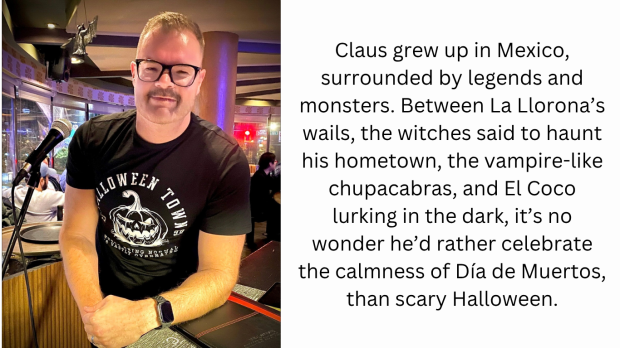
Season of the Witch: Claus’ Story

The shadows never waited for me to fall asleep. They watched me from the moment I got into bed and the light was turned off. There were always two of them: one slightly taller than the other, both standing by the door in my room, as if to make sure there was no way for me to escape. The shadows simply stood there, watching. They never moved… at least not while I was awake.

I was seven years old when my middle brother, whom I previously shared a room with, graduated to his own bedroom. I should’ve been happy then, as I got my own space too. But the truth is: I HATED the dark. 

We lived in a big house on the grounds of an old ranch that was developing too slowly, so all the plots around our house were empty fields, and our closest neighbours lived far down the street. Being so secluded, we had the most amazing views when I lay on the lawn with my brothers, looking out into the star-speckled night sky. However, that same solitude meant that my room was enveloped in an impenetrable darkness when I went to bed.

In that deep darkness, I shouldn’t have been able to see the shadows, but there they were. Always two. Always watching me.
I would lie on my stomach with my arms crossed under my body, and hold on to the opposite sides of my blanket, with the naive impression that my bedsheets could protect me from whatever these beings that stood in my doorway were. I held on so tightly that my hands would sweat, and my arms would go numb under the weight of my body, but I wouldn’t let go until I eventually fell asleep.

The house I lived in was beautiful. A spacious two-story with more rooms than we needed for a family of five, and a massive backyard. My parents had built it, so there was no history for the house to be haunted. But my overactive imagination was always on alert. Whether it was the weight I felt in the air when going up the stairs, the flickering figures I saw out of the corner of my eye, or the voices that escaped from the concrete walls at random intervals, there was always an energy I couldn’t quite put my finger on.
The stories our housekeeper told us probably didn’t help: tales about witches flying through the sky as fireballs, or appearing in mirrors with bloodied faces. El Coco, coming to take away misbehaving children, or La Llorona, who wandered the streets at night in search of her children, whom she had killed in a moment of madness, before taking her own life.

Sometimes I’d wake up in the middle of the night and have to pee, but I would hold it until the next morning (which embarrassingly meant I peed my bed more than once). But mostly, I just lay in the dark, the silence in my room so quiet that it pressed into my ears like a scream. I held my blanket tightly, with my arms crossed under my body, imagining the witches and El Coco, and La Llorona. Knowing that the shadows were there, even when I didn’t look towards the door.

My family moved to the coast when I was 10 years old, to a beachside apartment, where I once again had to share a room with my middle brother. From there, we moved to Canada, and although I had my own room again, I didn’t fear the dark the same way. The shadows had been left behind in the old ranch, maybe to haunt the next family, or maybe to die as the area developed. 

But at some point in my late teenage years, I had my first episode of sleep paralysis.

I wake up suddenly, lying in bed. It is the middle of the night, so the room is swallowed in darkness when I open my eyes. I try to raise my head, or move my arms and legs… but I’m completely paralyzed. Panic begins to build inside me, and I try calling out for help, but I’m unable to make a sound.
And then, I see it: standing by my door, there it is. A single shadow now, but this time it doesn’t just watch me, but begins to move slowly in my direction. I try to scream, so my parents or one of my brothers will come to my aid, but I still can’t make a sound. I can’t move my hands to turn the bedside table on, or knock it to the ground to attract someone’s attention. I can only lie there, frozen with fear, looking at the shadow as it drifts to my side. It leans over me, stretching its hands towards my paralyzed body. The moment it touches me, my body shakes violently, and I wake up – for real this time.

Apparently, 1 in every 3 people will experience at least one episode of sleep paralysis at some point in their life, although it’s not always accompanied by the wonderful addition of hallucinations of the so-called “sleep demon.” Lucky me, for I got the paralysis AND the demon: my wonderful shadow-friend from childhood coming back to haunt me in my dreams. And I got to see it more than once, too!
Over the next decade and a half, my sleep paralysis became so regular that I learned to anticipate it, for see, it was always preceded by a nightmare related to darkness. I walked into a room at night, locked the door, and flicked the light switch, but the light wouldn’t turn on. I tried again and again with no result, and the more I tried, the more fearful I became. It was always a different variation of the same dream; always a losing battle against the dark. I would then wake up in bed, only to realize I was paralyzed, with the shadow slowly moving towards me. And when it reached out to grab me, my body convulsed, and I woke up again.

As an adult, I have a complicated relationship with the dark, and the terrors (real and imaginary) that hide within it.
To this day, I don’t like confined dark spaces… but I once went exploring a flooded cave in Guatemala, with only a candle for light (and this was after watching The Descent movie, by the way).
I sometimes feel anxious when I walk down a dark, empty street alone… But I also have been cruising at night – and I’m not talking about the relative safety of a dark room or a sauna. I’m talking about wandering around the trails of Stanley Park (just how La Llorona wandered the streets of Mexico in search of her dead children, but sexier). I guess there is a certain thrill now, when the shadow walking towards you has an equal chance of being your next trick, a nightmarish ghoul, or someone who’s going to stab you to death.

Today, if I need to pee in the middle of the night, I can make my way to the bathroom without turning on the lights… that is, of course, when my husband is at home. When I’m alone, I still turn my bedside table lamp on (but we’ll keep that between us, because it is kind of embarrassing). I also still never look at mirrors in the dark.

It has now been at least five or six years since I experienced sleep paralysis. But sometimes, when I wake up in the middle of the night, I raise my arm or move my leg, just to make sure I can. And then I look towards the door, half expecting to see a shadow or two there. 

But I am 42 years old, so I know these shadows aren’t real.
Or, are they?

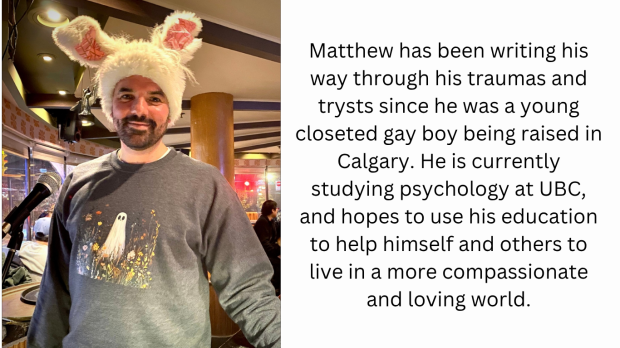
Season of the Witch: Matthew’s Story

The first Halloween costume I can ever remember wanting to wear, but which I thankfully never got the opportunity to wear, was Mr. Mistoffelees: the magical cat from the 1988 Andrew Lloyd Webber musical, Cats. Something tells me that for a wee gay boy only starting to figure out how different he was from all the people around him, and who was trying desperately to hide that fact, a one-piece black leotard and top hat probably wouldn’t have been the best choice. Not to mention the magic wand.

The next Halloween costume I remember is a nerd, a “couple’s” costume with my best friend Brayden, that I can only imagine was both the last costume in the world I probably wanted to wear, and also, being that my 10-year-old self was madly in love with Brayden, was simultaneously the best costume in the world. If I had to guess, I was probably having dreams about dressing up as Michelle Pfeifer’s Catwoman and waking up in tears that I couldn’t make that happen. I assume my decision to dress up as Brandon Lee from The Crow the following year, complete with black hockey tape wrapped around my torso and black makeup around my eyes, was my way of trying to render that. I really just needed the ears and a whip, and it would have been Catwoman all the way. I remember something feeling so off about dressing as an ass-kicking dude from an action flick. I was already failing desperately at that role in my real life; the last thing I needed was to highlight that fact on my favourite night of the year.

It’s slightly ironic that Halloween is my favourite holiday, since I don’t think I have ever really felt comfortable in any costume I’ve worn. In my younger years, I almost always wanted to be something I couldn’t. Whether it was Catwoman, or Winona Ryder in Beetlejuice, or Winona Ryder in Heathers, or Bette Midler, things never really went the way I wanted. Luckily, costumes aren’t my favourite part of Halloween. It was never even the candy, although who doesn’t love a giant pillowcase filled with candy?
My love of Halloween has always been my lifelong passion for the macabre. I love Ouija boards, and seances, and witches, and horror movies. I read somewhere that the reason so many gay men love horror movies so much is because we somehow primally identify with the villains.
Freddy Krueger, Michael Myers, Jason Vorhees, all outcasts who take revenge on the ones who wronged them. I’m not too sure that theory tracks, or maybe I’m just scared to think too deeply about it. However, I will admit that in elementary school I invented a game called ‘Murder’, where all my friends (all girls, of course) and I would pretend to be guests on a luxury cruise ship, a role perfectly played by our school playground. All the girls would check-in to different rooms, then venture out to enjoy their fabulous vacations. And then I would slowly stalk around the ship and kill each one of them. Make of that what you will.

Anyway, back to costumes. As we all know, there comes a time when Halloween suddenly shifts from being about dressing up fun and scary, and becomes entirely about dressing up hot and slutty. Especially, and some might say necessarily, if you plan on ending up at the clerb.
Which is probably why I started throwing annual Halloween parties so that I didn’t ever have to end up at the club, since a strong mix of shame and body dysmorphia mixed with just a twist of toxic culturist kept me from ever wanting to try to be sexy on Halloween. Unfortunately, in my 20s, I still wasn’t comfortable dressing as Winona or Bette, and usually found myself scrambling to figure something out.
The one year I was convinced to go to the gay bar with my new boyfriend, I decided I’d be what I imagined would be some version of a Disney Prince, thinking it could still be funny while, maybe, hopefully, being slightly hot. What we ended up with was yellow tights, shiny pink bloomers, a puffy pirate shirt, and a terrible wig. And a tiara. Don’t ask me how it happened, but also maybe don’t decide to accessorize after you’ve already started drinking. All I know is I found myself wasted on a dance floor surrounded by hot cops and cowboys, wondering how long my lovely new relationship was going to last.
Another year, my bestie Amber and I decided to be Sweeney Todd and Mrs. Lovett. These costumes were actually great. But my one stipulation for wearing them was that we did not end up anywhere close to the club, especially not the gay club. Cut to us wasted at midnight waiting in a freezing cold line (this was Calgary, by the way), surrounded by half-naked twinks in angel wings. There are numerous pictures of the two of us from that night in the club, but something about wildly teased wigs and white makeup dripping down our drunken, sweaty faces in the flash of a camera didn’t really do anything for us. Especially while swimming in a sea of abs. Trust me. There are pictures that somehow simultaneously catch the glow of perfectly sculpted abdominal muscles next to the gaunt, ghostly face of sweaty 2am Sweeney Todd. At least the miserable look on my face perfectly matched the character. I went home alone that night.

I’ve always and will always love Halloween. But dressing up in costumes almost always kills me. Like a few years ago, when I had finally, for the first time, dedicated enough solid hours at the gym that I was starting to feel ok about my body for maybe the first time in my life. This was going to be my year. And I had the perfect costume idea that would show just a bit of skin and, maybe, finally get me in on slutty Halloween: Jesus Christ Superstar. So hot, right? (I’m not going to lie, the largely Broadway theme to many of my costumes didn’t really occur to me until I was writing this essay.) It was great. I had a gold glittered crown of thorns. I had glitter all over my beautiful, flowing Jesus wig. And I had a tiny slutty sheet draped around my body. I was feeling good. So good that it seemed like a great idea to smoke a big fat joint outside the big gay party before going in.
I apologize again to my boyfriend and friends who were there with me, since it was barely half an hour before I had a slight panic attack on the dancefloor after ruthlessly comparing myself to the countless ripped torsos around me. Sometimes the ghosts we thought we’d finally exorcised come back to haunt us at the worst times. Half an hour later, I was home on the couch eating poutine as glitter tears rolled down my face.
I guess if I look hard enough, I could find some sort of deeper truth to all of this. The way so much of my life has felt like wearing a costume that I don’t quite fully belong in. How much of my life I spent trying to hide myself behind masks that never really did their job the way I needed them to.
I spent years trying to be anything other than who I really was. Wanting to be fitter than I was. Butcher than I was. Constantly warring with my body and the way it didn’t conform to the standards of my culture, and the way that made me feel like an alien even amongst all the other aliens. And while it might seem like wearing a costume could be a great way of escaping all of this, spending one fabulous night a year getting the chance to be somebody else, ironically, somehow, it has always felt like wearing costumes only ever exposed the parts of myself I was trying to hide.

Luckily one of the gifts of getting older is that the feeling of needing to be something other than me has started to ease up, the edges of my self-criticism slowly wilting away. Finally, it feels like all the roles I’ve played and costumes I’ve tried on in my life have started mattering much less than the fabulous little gay boy buried underneath it all.
So, maybe this year I’ll do something different for Halloween. Maybe this year I’ll be courageous and finally be the one thing I’ve always been the most scared to be… Mr. Mistoffelees.