Season of the Witch: M.’s Story

Where I’m from, the first drag queen I ever heard about was a saint.

In Lebanon, our Halloween is St. Barbara: a young woman fleeing a controlling pagan father who, legend says, disguised herself as a man to escape and devote her life to Jesus Christ. Holy drag in the name of survival.
To remember her, kids dress up in Halloween costumes, knock on doors, sing a little song about her, and people hand out money or candy, or tell you to go away. 
It’s our Halloween, but the origin story is about a woman who beat patriarchy by cutting her hair, smearing mud on her face, and throwing on some farmer’s clothes.

I was around ten the year I decided I was going to be a witch. 
Not a wizard, a witch. Wizards feel like homework. Witches have more flair.

The plan was simple: repurpose my brother’s Zorro cape as a black dress.
I walked into the living room where my mom and aunt were talking and pitched it like I was on Project Runway: “so I’ll be wearing a dress, the belt in the middle, I can pin it here, with a pointy hat, done.”
My aunt didn’t giggle. Didn’t even try to soften it with a different idea. She went straight to mocking, sharp, voice raised. “A dress? For you? Absolutely not.”
I can still feel the heat in my face, that hot, swallowed-your-voice feeling when you didn’t think you were doing anything wrong. 
Five minutes later the cape was back in the closet, and so was I.
I told my friends I felt sick. I didn’t go out that night.

It took a long time to understand what that moment did. 
Not just “no costume this year,” but a message that landed somewhere deep: 
There are ways you’re allowed to exist, and ways you’re not. 
Not because you want to be someone else, 
but because people panic when you look like you might.

In my family, masculinity came with a manual, enforced by catchphrases. 
My dad’s favorite, شد براغي تمك or in English “Tighten your mouth screws.” 
Don’t talk like that. Don’t sit like that. Don’t say those words.
Great way to teach a kid to make himself smaller.

Cut to middle school, catechism class, religious studies. A Catholic priest gave a Very Serious Talk about “the problem of effeminate boys,” (apparently, top five on the Vatican threat list). 
His solution, and I kid you not, was to send them to work with “real men” on construction sites for the summer, so they would come back “macho.”
Even as a kid I thought, Father, that is literally the plot of half of gay porn.
Part of me was like, “Maybe I should be more femme.”

A few years later came my first real Halloween party as a teenager. 
I was old enough to make my own choices, young enough to still want a mask to cover my face.
The kid who didn’t get to be a witch remembered. So I did it properly. 
First accessory: fake tits. Big ones. Two balloons and a silky robe. 
When I walked in that party, something in my body unclenched. People kept asking, “Who is she?” and honestly, I didn’t know.
But whoever she was, she was thriving.
It wasn’t a kink. It was a relief. 
Proof that wearing a dress and fake tits doesn’t threaten who I am.

As is grow older. I collect small rebellions. 
A few summers ago, on vacation in Rome, I walked into a piercing studio right by the Vatican walls and got my earlobes done, just the lobes. 
I almost fainted from the pain; I did not expect that, LOL… but stepping back out onto that street so close to where the pope is, felt deliciously on theme, and a little poetic. 
There was a small residual sting in my ears and it made me happy, like my body had a tiny built-in reminder: you did a thing just for you.
A small spark of self-expression I could feel with my fingertips.
Every time I touched them, I felt that small pulse of yes.

Then last year I tried a few more things. 
A couple of drag nights with friends, which was so much fun.
I experimented with some Dollarama makeup. Got my nails done at a salon a few times, even paid extra for Gelish! Sky blue looks amazing, by the way, and Gelish ruins your nails.
I also changed my Instagram profile photo, nothing wild, just me flaunting my nails. Not a post. Not a story. Just the tiny little circle.
And a few days later, my phone buzzes. A DM from my aunt, the same one.
“Hi Malek, how are you sweetie? I hope you’re good and work is going well. I miss you a lot. Habibi, this is not a good picture on your profile. I do hope you can change it. I know you will say that this is not my business, but I am still your only aunt who cares too much about you and loves you dearly, and I am, after all, your godmother. I doubted for a while, I don’t know what to say to you (dot, dot, dot).”
I wrote back, “Why? What’s wrong with the pic?”

We both knew what she meant. 
Same living room message as when I was ten, this time wrapped in “I care about you” and “I’m your godmother,” with “that’s not for boys” tucked inside.
And here’s the part that surprised me: I didn’t spiral. I didn’t write a defense essay. I didn’t change the photo. I just let the message sit there and went on with my day. Not because I’m brave, but because the scale finally tipped. The joy outweighed the fear.
And that’s the part I wish I could tell my ten-year-old self:  
You’re not broken for wanting what’s fun. 
You’re not dangerous for wanting to be different. 
You can try a thing, decide you like how it feels, and that can be the whole story.

And here’s the plot twist, the pushback doesn’t only come from family. 
I hooked up with a couple from L.A. who were visiting Vancouver eariler this year. After a short while, they saw a picture of me with nail polish and texted out of nowhere, “nail polish doesn’t suit you.”
Which, first, literally no one asked for your opinion.
Second, it’s wild how fast masc4masc energy turns into policing. Like, babe, I don’t even remember your first name. 
Even inside the gay community, a little color on a nail can make internalized homophobia jump out and wave.

But Somewhere along the way, masculinity stopped feeling like rules and started looking like options. A menu, not a manual. 
Some days I want plain jeans and a T-shirt. Some days I want a little swish. Neither day needs permission.
Do I still hear the old lines? Sure. 
They pop up in a joke at a family dinner or in a DM about a photo I chose because I liked myself in it, from a relative who confuses worry with love. 
But my perception shifted. Those reactions aren’t commandments; they are just data. They tell me who can walk with me comfortably, who needs time, and where my boundaries should live.

Every Halloween season, I still think about the year I didn’t go. How quickly excitement turned into shame. How one reaction canceled an entire night.
I don’t hate anyone in that memory. I just wish someone had looked at that cape and said, “Okay. If it wants to be a dress tonight, just let it.”

And that brings me back to St. Barbara, probably one of the very first drag kings. 
She cross-dressed to survive, and all I wanted was to cross-dress to have fun. 
If a saint can do drag to get free, surely a kid can do it to feel free for one night.
So that’s what I do now, in small ways that add up. 
I keep the earrings. I wear nail polish sometimes. I say yes to the version of me that feels most like me that day. 
And when someone tries to hand me a manual for how I should look or present, I hand it back and say:
“Keep the manual. I’m ordering the whole menu.”
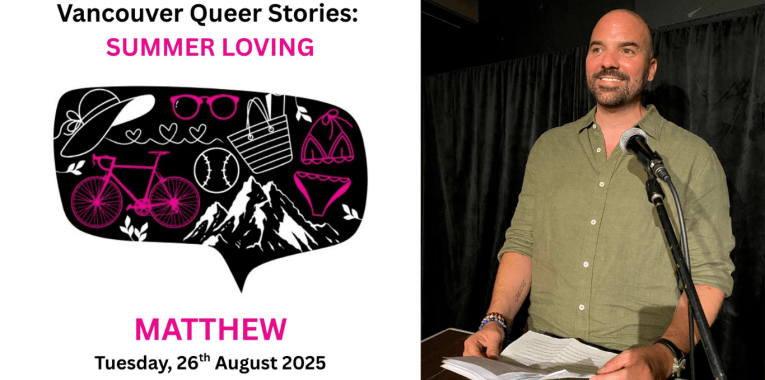
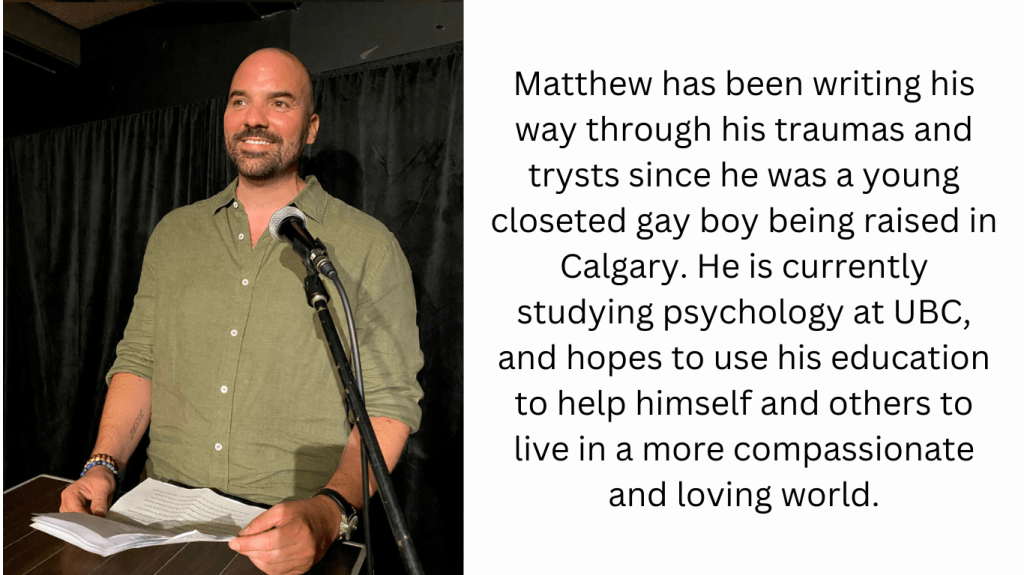
Summer Loving: Matthew’s Story

My closet was made of tinted glass. So you’d think a Caribbean cruise would be the perfect place to hide, given all that bright, glaring sun. But not even my oversized orange hoodie, perfectly covering my awkward 17-year-old body, or the baggie raver pants that flared out to the ground could shield me from the look in his eyes as he tilted his sunglasses onto his nose and gazed me up and down.
“Nice pipe,” He said, in his thick southern drawl.
I stared down at my hands, nervously turning the small wooden bowl over as I did my best to avoid looking up, the large bulge protruding through his bright blue Speedos at almost the exact height of my face practically begging me to stare at it. I thought if I ignored him long enough, he would go away, but he didn’t.
“Are you planning to put something in it”? He asked, pulsing his groin towards me. I finally looked up and met his eyes, my cheeks flushed red.
“It’s for a friend. I bought it on the island yesterday,” I said, nervously looking around the deck to see if any of my family was around. Even though I told my sister I was “bisexual” in a hotel room in Miami the night before we boarded the ship, I was still playing the all too familiar game of hide and seek with the rest of my family. The hardest part about coming out isn’t actually coming out, it’s having to expose something about yourself that isn’t really exposing anything at all. Thankfully, the coast was clear.
“Lucky friend”. He said and winked.
The truth was, he was the first person I noticed when I came up to the pool deck an hour before and found a shaded corner to hide in. That all too familiar game I always played as I scanned every room for signs of others that might be like me. Not because I found safety in numbers. More to protect myself from being around someone with the power to reveal my secrets. All it takes is a look. But as much as I tried to ignore him, my eyes kept wandering back, his body sprawled out flamboyantly on a lounger, sipping on some fruity cocktail as he laughed and screeched with the two women framing him. He made my stomach squirm. The way his wrist flicked back and forth as he talked too loudly. The way he threw his head back when he laughed. The way his tanned orange belly hung over his Speedo. A direct affront to my idea that all gay men in the world but me had 6 packs and bulging biceps.
“Hey, aren’t you a little overdressed for the occasion? You do know it’s over 90 degrees up here?” He teased.
“I don’t like the sun”, I lied.
“Did you forget your swimsuit?” He asked. “Because I have an extra Speedo in my room. If you want to come try it on.”
A rush of heat flushed through my body as my eyes flicked back to his bulge. Oh god, please tell me he didn’t see that. Of course he saw that. My eyes darted around. Were those people staring at us? Suddenly, I felt myself start to move. Automatic shifting of awkward limbs, gathering up my backpack on the floor beside me, the towel under me. But before I could stand, he took a step forward and leaned down, his fried blonde hair falling into his freckled face.
“I might even have something to put into that pipe if you want.” I froze.
“You mean like, pot?” I asked, looking up and directly into his eyes. They were crystal blue. He smiled.
“Yup. I’ve got a whole bunch of it. You wanna go smoke?”
Oh God, how badly I wanted to. How much I missed the sweet comfort of marijuana, tragically deprived of it since my parents forced me onto the plane for this stupid family vacation almost a week ago. But I couldn’t do it. As much as the lure his bulge and the prospect of getting high put their powers of seduction into overdrive, fear and disgust tightened their tendrils around my lungs, and I jumped up, spinning around to make sure I had everything before stumbling away, turning back quickly and awkwardly apologizing. I went back to my room and jerked off, then curled up like a baby and cried.

When I found myself back in the same spot the next day, I would have sworn to you it wasn’t on purpose.
“So you do own a swimsuit.” He said as I lowered the book from my face to see him back, standing in front of me in another, albeit equally revealing Speedo. “What a relief.”
My heart pounded. I looked around, then leaned forward and looked right at him. “Do you really have pot in your room?”
He smiled.
The room was tiny, the door closing behind me as my backpack dropped to the floor. He took the pipe from me and sat on the edge of the bed, filling it with weed from a plastic bag.
“My name is Calvin, by the way.”
“I’m Matthew,” I said as I sat down on the bed, taking the pipe and inhaling a long, slow hit. He moved his leg so it was touching mine, then reached his hand onto my thigh and started sliding it up towards my crotch. He leaned his face towards me, his chapped lips puckered and his eyes closed tight.
“I can’t do this,” I said, standing abruptly.
“What are you talking about?” He said, his eyes popping.
“I’m sorry. I can’t.” I turned and stepped towards the door.
“So what, you just used me for my drugs? Please. Typical fag.” The word hit like a knife, and I stopped, my hand gripping the door handle as I turned back to him, our eyes locking. And there it was. That look. That look in his eyes that said, I see you. I see right through you. I know you. I am you.
I turned and barreled out the door.

Over the next few days I stayed far away from the pool deck, but even that didn’t stop me from seeing him everywhere. I was so terrified at the thought of running into him that I didn’t even realize my siblings dragging me straight from dinner to the disco one hot, humid night. It wasn’t until I saw the crowded dance floor that it hit me. If there was one place you could guarantee you’ll find gays on a boat, it’s at the disco. I tried my best not to think about it, downing a boozy pina colada as the sweet sound of Kylie Minogue blared through the speakers. I finally started to relax, moving my body on the dance floor with my sister, doing shots at the table with my brothers. For the first time in days I wasn’t even thinking about big fat blunts and bulging speedos when suddenly the waitress appeared at our table, a large, fruity cocktail in her hand. She set it down in front of me.
“I don’t think we ordered that”, my brother said. She looked at me.
“It’s for you. From him.” She turned and pointed across the room as our entire table followed along together with their gaze. I leaned over to see around my brother, and it all came into view. Calvin, four tables away, with a harem of women surrounding him, all turned towards us. His head was tilted and his arm was straight up in the air with his wrist bent, his fingers flapping up and down, waving at me. I sank down into my seat as the entire weight of the cruise ship piled onto my chest. Everyone’s eyes turned from him and back to me.
“Who is that?” my brother Jesse asked. I looked over at my sister, our eyes locking for a single second.
“Oh my God”. I said, years of practice kicking into high gear. “That guy is such a fucking creep. He was stalking me all over the pool deck the other day.”
Everyone was silent.
“I’m pretty sure that he’s gay,” I said, and my brothers started to laugh.
“You think?” They said in unison.
“I don’t know why he sent me this. We hardly even talked to each other. He’s disgusting.” I spat the words out and shoved my trembling hands down onto my lap.
“Well, he obviously thinks you’re cute,” My sister said, trying to help.
“Whatever”. I said, looking over at her again, desperately.
“Well, you should just take it as a compliment. Nothing wrong with someone buying you a drink, right?” She turned back to him and waved. My brothers’ eyes stayed on me. I looked from one to the other.
“Yeah, I guess you’re right,” I said, picking up the drink and downing it all at once, lifting the empty glass into the air and gesturing it towards Calvin’s table.
“Attaboy,” My brother Darcy said, hitting me playfully on the arm.
Everyone cheered. Everyone moved on. And I did my best to follow suit. It wasn’t until we were all downing a final glass of water, getting ready to leave, when suddenly he was there.
“Well, hello there everyone.” He said, leaning his arm onto our table. “I’m Calvin.”
Everyone said hi except me; my voice caught in my throat, and my body frozen in place. The silence seemed to stretch on forever.
“Nice to meet you, Calvin,” I said awkwardly.
He laughed, running his hand through his hair, turning to me and reaching his finger out through the air and bopping me on the nose.
“You left your pipe in my room.” He said, loud enough for the whole table to hear. My stomach dropped.
“You can feel free to come by and grab it anytime.” He said, winking at me as he turned and stumbled away.
I watched him go, my body paralyzed. I wanted to disappear. To vanish into thin air. But when I didn’t, I slowly turned back to face the table. My sister’s hand was on her heart, her eyes wide. My brothers and their girlfriends’ mouths all hung open as they stared at me in total and utter… belief.

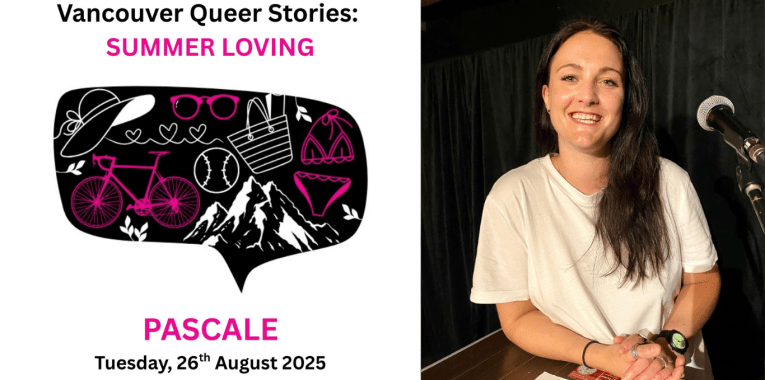
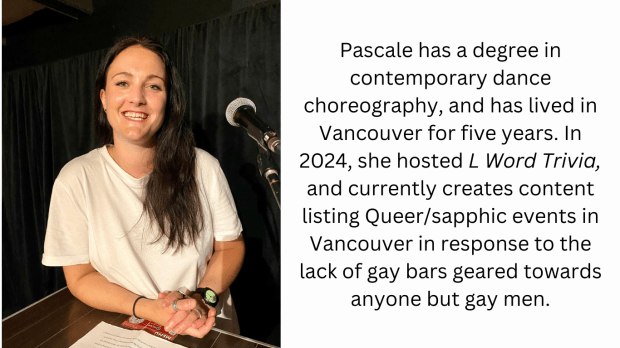
Summer Loving: Pascale’s Story

Some things about me: 
– I was born in 1989. Thus, I love 90s/early 2000s rom coms… which is why I’m a hopeless romantic who dreams of moving to NYC and falling in love.
– I’m a millennial, so I really need you to like me! 
– I’m also really, really good at talking to people, making new friends, and subsequently… shooting my shot with girls.

Not to be overly confident, and not to say that I think I’m god’s gift to the queers; I’m just not scared to walk up to a stranger that I like and talk to them.
Does my heart pound in my chest and right before I do it? 100%. But I know that if I didn’t talk to them, I would feel worse. So, I shoot my shot. Partly because no one really hits on me, not sure why. Possibly because of my huge personality — I’m a lot for some people, I know!
But hey, at least no one has ever called me boring, so there’s that! 

But Pascale what do you mean when you say you “shoot your shot?”  Well…
A few years ago, I was working as a server at a very busy outdoor restaurant in the Old Port of Montreal. I was 27 and finally about to move to NYC in a few weeks: AKA, my dream come true. 

It’s a hot July Saturday night, and we’ve got a lineup around the block. Just as I’m walking towards the bar, I freeze. That’s when I see her: tall, dark skin, short hair, fresh fade. Blue polka dot, short-sleeve shirt buttoned to the top, and army green pants. If I were to compare her to a celebrity, it would be David Beckham.
She walks in, and I stop dead in my tracks. Everything about her takes my breath away. She is so hot, I immediately start blushing. I walk away with a stupid smile on my face. 
At the bar, the bartender says, “Pascale, what’s going on? You look different?”
“Umm…I’ve just laid eyes on the hottest girl I’ve ever seen in my life!” 
I subtly ask the hostess to seat her near my section, but not IN it, ‘cause OMG, I couldn’t actually serve her. So she’s seated in my friend’s section, and I ask him, “Max, that girl at table 38, what’s the deal?” 
“She’s with two girls, I think they’re a couple, and she’s on her own,” he says. 

I keep serving my tables, trying to make eye contact with Bechkam, but it doesn’t happen. Then, Max says, “Hey they’re getting the bill, what are you gonna do?” 
I panic. The bus boy says, “why are you so obsessed with this girl?” 
I say “Shut up and take notes.” 
Right then, I see the lovely lady who sells roses to tables. It clicks. Done.
I run up to her and buy a rose. I write down my name and number on a piece of paper. I put it inside a billfold, and ask Max to give that girl the rose and my note and say, “That server thinks you’re stunning.”
My pulse is racing as I head back into my section, trying to look busy, taking extra time with my tables, and then get lost in work. Finally, I meet up with Max and he hands me the bill fold back. There is a note from her, “I’m Ada, thanks for the rose. We’re going out for drinks later, you should join us,” and below that, is her phone number…WITH A NEW YORK AREA CODE!
Are you kidding me?! I’m about to move to NYC: we could walk through Central Park in big cozy sweaters, while the leaves fall, drinking chai lattes, holding hands… and we could fall in love in the fall in New York! It’s perfect! — You know, the usual thought process. 
My very interested server friends want to know what happened, so I show them the note with the phone number as the mouthy, jaw-dropped bus boy slowly raises his hand for a high-five. 

As Ada and her friends leave, we cross paths for a second. With a big smile on my face, I tell her I would love to see them later. She smirks and says, “I hope so.”
Once I’m done work, I text Ada and head to the bar down the street. I can’t stop losing it that I am on my way to have a drink with this girl. You know when you’re just like, “Is this actually happening?!” 
I take a deep breath as I walk in, and spot Ada right away. She looks at me with her gorgeous smile, asks me, “can I get you a drink?” 
I say yes, of course and while she’s gone, one of her friends says, “by the way, very well played.” 
We have a few drinks, play some pool, and then her friends decide to head out as they’re all going back to New York the next day. Ada and I want to stay out, so we walk over to another bar. We order two Jonny Walker Black, on the rocks, just before last call. 
The lights are low, the music is loud.
We’re staring at each other, smirking, as I take a sip of my drink. Ada puts her glass down, takes mine from my hand, and places it on the bar. She puts her arm around my waist and stands tall above me.She slowly pulls me close, so her face is just an inch from mine. Ada looks deep into my eyes and finally our lips meet in a soft, still kiss, as the world around me seems to blur and fall away. 
If this were a movie, the camera would be doing a 360 slowly, with the crowd dancing around us in slow motion. Right as the term “French kiss” would be used, the lights come on, and the moment is over. We both pull back, stare into each other’s eyes with a smirk… “Should we get out of here?”

We take a cab home and the next morning, I wake up in her arms. We lay there in that perfect little morning-after bed-bubble until it’s time to get up.
I drop Ada off at her hotel on my way to teach a very hungover spin class. Before she gets out of the car, the leans in to kiss me and says “I’ll text you later.”
I figure she will never text me: I was a girl she met on that Montreal trip. Just a name in a story. But still, the smile I have on my face walking into the spin studio is unprecedented!
Against all odds, Ada did text me later that day. We started talking every day for two months — spending hours on FaceTime and making plans… you’ve heard of lesbians, right?
September comes and… I would love to tell you that when I went to New York, we met up for coffee, went for a walk in Central Park, and fell in love. But really, she just led me on for a few months, and then ghosted me.
I never saw Ada again. 

I often find that I chase people who don’t want to be caught.
I’ve now been single for about six months, after my longest and most serious relationship. I tell myself I need some time for me, but I keep going after people who give me crumbs when I give it my all. I’m not sure I know how to date casually. Because, honestly, either I like you or I don’t. If not, what are we doing?
Not to say I’m not happy with who I am, but maybe I should take the time I put into chasing someone who won’t text me back, and spend that time on what I want and who I want to be.
The girl who will go up to a stranger to shoot her shot will always be there, inside. But maybe we can sit with her for a minute. Maybe ask her how she’s doing, or take her out on a date… because I’ve never taken the time to get to know her — know me, without chasing after some crazy idea of a love story. 

Maybe, for this summer, I stop chasing those who don’t want to get caught.
Maybe, I fall in love with myself instead. 

Summer Loving: Ben’s Story

Back in July 2019, pre-pandemic, pre-twink death, I met you, Lloyd. (Lloyd is a pseudonym, for you dear, my favourite Welshman.) Edinburgh – Edd-in-berg, if you want to be ridiculed. I was crashing on my sister’s couch in Marchmont. Bored, cramped, a little horny; friends going to a party I wasn’t interested in that night, I open an app.

Sniffies didn’t exist back then, so we did our business on Grindr like gentlemen. 

I don’t know what it is about Edinburgh, but I do extremely well there. So, I casually shoot my shot. And, you reply. Truthfully, I was surprised. You are too pretty. Your singular dangling earring (because those were in style then), the white button-up shirt so open to your chest. Too pretty. You, Lloyd with brown eyes. 

I steal away some weed brownies that my sister made. Keep in mind, this is Scotland, the UK (at least for now). Weed is rare goods. We are both excited to indulge. Even though European weed is shite, I tell you, including the stuff in Amsterdam compared to BC bud. We walk the Meadows, QU’EST-CE QUE C’EST in modern terms, ‘yapping.’ You tell me about cartography, and the archives you work in, poetry, and the jewelry you wear. I tell you about linguistics, the archives I work in, the dread of renting in Vancouver, the jewelry I wear. 

You live just up the road from my sister’s, so we go to yours. We don’t jump to sex – no – I want to show you the Canadian Cat Show Circuit documentary I saw earlier, while the brownies take full effect. You are enamoured by the cats. Eventually, we do find ourselves in bed.

This is the first time I ever had you on top of me. It might have been the weed brownies, maybe the amber lighting, and the bedroom’s high ceiling, your cheeky smile, the smoothness of your stomach, your nose, deep in my neck. Kissing and laughing at each other.

I wake up late; we wake up late. I need to meet some friends for brunch, now. I dash out the door, forgetting my wallet, and keys, but not my phone. Thank god. You are waiting for me at your flat’s entrance as I scamper back. I see you; you see me. We look terrible. Hickies abound. Hair disheveled. What I hope is toothpaste. We chuckle boyishly and kiss. It is not our last meeting that week.

I learn Lloyd likes old, pretty things and fresh clotted cream. He is sentimental and hates low-rise socks. He pulls his knee highs all the way up. 

He graduates from university later with a master’s degree; I return to Vancouver long before then. We keep in touch on Instagram as oomfs. (I have a real life oomf!) 

July 2022. We are in the pandemic, but some restrictions begin to ease. My sister is having their wedding Ceilidh in Edinburgh. It is a Gaelic social event, with dancing, fiddles, and alcohol, of course.

Perhaps, you can make the trip up from London. Perhaps, we can find a place to stay away from my family for the week. Perhaps, you want to come, and see me, that guy with the weed brownies, and cat documentary, (and ass eating). Wow. You are coming. I am a bit scared now. What if, we’re just friends and not friends this time. Not that we have to be friends like that: no expectations. I’m cool. You are cool. But, we are sharing a bed for the week. 

Your train is early. I am rushing to Waverley. I wanted to have something for you. I am pleading in a flower shop along the way to see what measly trimmings I can get for seven quid. [Huff] I am late. I am late, and I have shitty signal here. Fuck you, Fido! What if he isn’t getting my messages… But there you are. I am holding back smiling to look nonchalant, but my face is fuzzy, warm, and my chest is tight, racing. I can’t stop myself. My smile does not look like yours, and I don’t look like you: pretty. Have you always been taller than me? Oh, it is your shoes. He has cool shoes. “Hi Lloyd! I got you these.” 

That is the first ‘gorgeous’ of the week. He calls things he likes ‘gorgeous’. Sicilian pizza, tart wine, eclectic thrifted goods, my flowing green pants, a flat white whilst hungover, train station posies. 

At the Ceilidh, we give each other bruises from the swing dancing, swirling each other on the rental hall’s floor, switching partners, fumbling, tearing away, and to each other. My new brother-in-law’s third stepfather’s girlfriend, named Squirrel, from north of Aberdeen, asks us if we are together. We give each other that look. “Oh, so you are fuck buddies,” she quips in a brough. We laugh and shrug. 

The rest of the week is gorgeous. Most afternoons, I nap while you read; Lloyd is not a napper. He smiles when I enter the room half awake. I don’t know why. All week, he gets to revisit haunts from his uni days. For him, his past is here in Scotland. For me, just a present together, which itself is a fantasy. And, I should know better. Playing house on Leith Walk? You are the cruelest to yourself for this.

The morning finally comes. Because the UK is (and continues to be) an absolute shitshow and the climate is boiling us alive, the train schedule has ‘been better’. The rail cables are melting now. Your train is maybe here, so we rush to the station at high noon. These moments are all –  frantic, frenetic, while my insides are slow and sinking deep within me. You are leaving in an instance.

We hug, one last hug. And then, you step back, keeping me in your arms, and kiss me. I am caught off guard. You have to go. I have no choice but to linger there while your railcar leaves. 

Instead of dinner, I go to bed with stomach aches. I can’t wait to get home. I want my dog, my routine, to be as far away as possible from this place. I know for a fact we can’t be together if I am an ocean and a continent away. That is what makes it impossible, not the impossibility of you reciprocating this longing. You are there; I am here.

Somewhere in 2023, you delete Instagram. I respect that. But, I lose you. Wait! I signed up for that infrequent poetry email newsletter you do. Sigh. Quarterly, sometimes, tri-annually, I still get a glimpse of your thoughts and whimsy. I reply once to the email address, but don’t hear back. You added your cellphone number to it recently. I am still too scared to send a message. It is too direct. It is too late. Too – too! 

You have your Instagram again, but are never on it. Do I slide into your DMs? No. Also, a terrible idea.

I hate it: Having these thoughts and aches since you surely do not feel the same way about me. Hate acting foolish and teasing myself. Hate being reminded of you by the viola, wool pants, and Coronation chicken salad. Hate how these memories are mine, ours, but just mine really, fallible and reliably rose-tinted to a degree.
But I don’t hate you. No, I love you, Lloyd.
For how you make me breathless. For how you grin and say, ‘look at you’, when I walk in a room. 

Maybe one day, I will be one of those old, pretty things you enjoy again.

Not now, and not soon. No, but one day, when my love is no longer this loathsome and restless thing but somehow braver and tempered, for you.

Summer Loving: M.’s Story

I’ve always been a hopeless romantic.
And I don’t mean that metaphorically, I literally used to choose Hopeless Romantic as my personality trait on The Sims. Back when I still thought that picking it would somehow make my characters have sex faster. Not in real life.
At the time, I didn’t fully get what it meant.
Hopeless? Romantic? Isn’t that a contradiction?
But over the years and one too many impulsive heart flings, I think I’ve finally started to understand.

Let me take you back to the summer of 2014.
I had just graduated from school and freshly 18. Queer. Closeted and Horny. 
And freshly added to a friend group headed to Ayia Napa, a beach town in Cyprus best known for two things: foam parties and straight British tourists throwing up in alleys. I unfortunately witnessed both.
It was my first time traveling without my parents.
Which basically meant: I could finally go fool around without anyone up my ass… except the man who was gonna be up my ass.

The night before the trip, I opened Growlr, it’s like Grindr, but for bears… and with a UI that looks like it was designed in 2003 and never updated (it probably was).
I changed my location to Ayia Napa, and within minutes, I found THE guy. Early 30s. Local. Cute smile. Med student.
We chatted. We vibed. We made plans to meet the day I landed. I didn’t know much, but I knew this trip was already a success.
I told my best friend, the only one in the group who knew I was gay. I expected a lecture. Maybe a “Don’t get murdered.” But instead, she saw his photo, read the texts, and said: “OMG, go get it, girl.”
It was the first time I’d ever told someone, in real time that I was about to meet a guy. And just having someone know made me feel more confident. More excited. More me.

On the flight over, I couldn’t think about anything else. This wasn’t just a hookup, it was a movie: A summer escape. A foreign local who’d show me around, give me great dick, and maybe, just maybe, become my European boyfriend with whom I’d live a Mediterranean gay fantasy. Hopeless Romantic mode activated.
When I arrived, he picked me up in a retro car, looking hotter than expected. And as fate would have it, we ran into two people from my group crossing the street. 
They stared. I waved. Later, I told them he was a “family friend.” 
And they shockingly believed it. 
He drove me to this beach bar that looked like a queer fever dream. It had a giant stone mermaid mosaic with the words “Once In a Lifetime Experience.” Which… felt dramatic for a beer on the beach.
But okay, Mama Mermaid, let me dream.
We got drinks, sat at a table by the water, barefoot on the sand, and talked for hours. We laughed. He told me about med school in Romania, coming home every summer, how he loved the sea. I was enchanted.
We couldn’t really flirt openly, it wasn’t the safest place. But at one point, our bare feet were near each other, and he reached out… and gently tangled his big toe with mine. Yes. Toe holding. Hand-holding, but gayer.
Now listen… I don’t have a foot fetish. But my dick… begged to differ.
Later, we made out behind a dumpster. (Summer loving, baby).

I went back to the hotel with the biggest grin on my face. I couldn’t stop smiling. I couldn’t stop imagining us. How we met by chance. How perfect the date was.
He’s in med school? Great, my parents will love him… only after they kill me when they find out im gay.
Gay marriage is legal in Europe? Done. We’re getting married.
The gay delusion was DELUSIONING.
But then the next day… we argued. Over text.
I was being clingy. He was pulling back. It wasn’t dramatic, it was just deflating.
I’d gone from mermaid mosaics to “I guess I’ll die alone” in under 24 hours.
That night, my friends decided to get tattoos. I, fresh off heartbreak,  told my best friend I wanted to get his name tattooed on my thigh.
To which, she said: “Only if I get to tattoo my hand slap on your face.”
She’s an Icon.

Still… we met again. We talked. We laughed. We shared a joint, my first. (I had no idea how to smoke it, so it didn’t really do much.)
He invited me to his family’s beach house. We made out on the kitchen counter. We had sex on a squeaky metal bed that sounded like it was cheering us on. We took selfies.
Then, he dropped me off. And that was the last time I saw him.

My phone died shortly after the trip, all the pictures, his number, everything: gone. And for a while, I felt this weird sense of grief. Not because I’d lost him.
But because it was one of those rare moments that felt good, and I wasn’t ready to let it go just yet.
That was my first real taste of gay romance. Before that, most of my experiences were secretive. Sexual. Transactional.
This one was different. Even if it was short-lived. Even if it ended in toe-holding and a missed connection.
Because over time, I’ve realized: Being a hopeless romantic isn’t about getting your fairytale ending. It’s about choosing to feel deeply, even when it’s messy. It’s about believing, even if only for one night, that love is possible, and that you are worthy of it. And with every little story like this one… I evolve.
Not into someone less romantic,  but someone more grounded. I still believe in soulmates… I just don’t expect them to show up in beach towns with retro cars and squeaky beds.

So NO, this wasn’t a once-in-a-lifetime experience. I’ve had a few more summers like this since. And if I’m lucky… I’ll have many more.
Because being a hopeless romantic doesn’t mean you’re doomed. It just means you keep showing up for the magic. Even if it only lasts a night, or a week, or a beer on the beach.
Maybe the real once-in-a-lifetime experience is simply being someone who still believes in those moments.
And I still do.

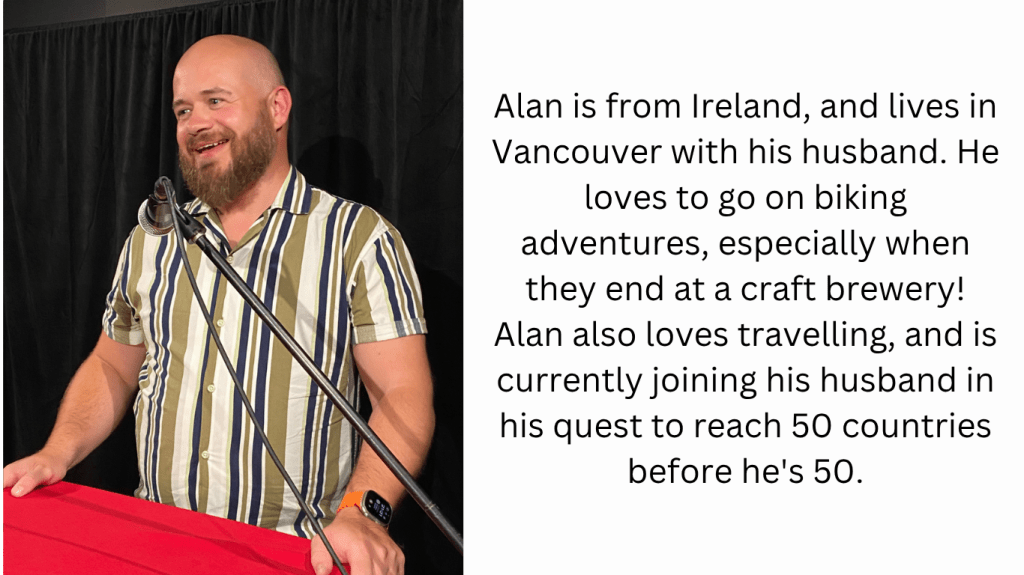
Pride!: Alan’s Story

I was born in Ireland in the eighties, raised in a catholic household, and educated in catholic schools. I was taught that pride was a sin – one of the seven deadly sins, in fact. 
It was painted as arrogance, as vanity. Something to be ashamed of. And shame? Shame was a virtue.
To be clear, I’m not even talking queer pride…we’ll get to that. I’m just talking about regular, good old pride in one’s own self. 

In Ireland, we were taught to reject compliments and diminish our accomplishments so as not to seem too proud. If you ever compliment an Irish person on their outfit, they’ll immediately tell you how cheap it was, or how old it is, and that they look like shit. 
We also judged people for being proud: growing up, discussions about someone else’s success were usually coupled with phrases like “he’s gotten too big for his boots” or “Miss high and mighty in the big city.”
So, before I was even sure I was gay, I was already afraid of being proud of anything. To baby gay Alan, the thought of being proud to be queer was impossible. Why would anyone be proud of that?

So, I learned to hide. I stayed quiet. I didn’t make friends often, and if I did, I didn’t let them get too close. I hid the way I wanted to express myself, the way I wanted to live. 
I was taught, in subtle and not-so-subtle ways, that my existence could make others uncomfortable. And so, I would shrink myself to make others feel safe. 

Pride is hard.

I eventually came out, of course; you can only hide for so long before something has to give. When I was 16, I told my parents and a select few friends that I was gay — and was met with just the right amount of fake surprise.
But if I am being honest with you, dear audience, I only really half came out. 
When I went to college, and when I got a job, I never talked about my boyfriend openly, or said the name of the bars I drank at on the weekend. 
Never talked about the hot guys on TV… but never talked about the hot girls, either. Never lying, but never really being fully truthful.
Even though people probably already knew, I still hid. 

The first time I went to a Pride parade, I was about 16 or 17. I didn’t tell anyone – I just showed up, alone, pulled there by a quiet curiosity I couldn’t ignore. I didn’t wear anything rainbow. I didn’t carry a flag. I stood at the edge of the crowd, heart pounding, scanning every face, terrified that someone I knew would spot me. That someone would recognize me and know… The irony of being ashamed to be seen at a celebration of pride isn’t lost on me. 

Pride is hard.

That moment at the parade stayed with me, even as life moved on. I immigrated to Vancouver about eight years ago. I came with my then-boyfriend. Here, we discovered an amazing queer community — something we’d never really had, back in Ireland. My then-boyfriend has since become my now–husband. We’ve made some of the closest friends we’ve ever had.

A couple of years ago, I joined the board of directors and became chair of the board of Vancouver Pride. 
If I thought pride was hard before,  I don’t think I was prepared for how hard Capital P pride is when you are at the helm of a struggling, underfunded not-for-profit organization, operating in a world with an ongoing genocide, during a time when trans and queer people are under attack globally.

For some people, Pride is impossible.

I had the privilege of being part of the Society and chairing the board through Canada Pride: Vancouver’s biggest pride celebration to date. A truly rewarding, exhausting experience that damn well nearly broke me. We had a record-breaking turnout, our largest parade ever, amazing performances… and threats of violence, budget cuts, and protests.

Friends, I know I’ve mentioned a couple of times now, but:

Pride. Is. Hard.

When I was a kid, and well into my twenties, the idea of wearing nail varnish, or anything even slightly effeminate, was unthinkable. Femininity was something to be feared or hidden.I would worry that I was walking or sitting too “girly” (whatever that means) , I would worry that I wasn’t talking like a “normal” man. All these small things that would consume my brain in an effort to suppress my difference.
But here I am, nearing my 40th birthday and A couple of weeks ago, I debuted as Lady Anal in my first-ever drag performance. I wore a corset, tutu, and 5-inch heels, and danced to Lady Gaga on a stage in front of around 600 people… and let me tell you – DRAG is hard!
I think baby gay Alan would be shocked to see me in a corset and heels—but I also think he’d be proud. Finally.

I often think back to that first parade. Hiding amongst the other spectators, heart racing. I was scared, but there was something else creeping in; something almost indescribable — queer joy. Queer joy isn’t always loud, or even obvious. Sometimes, it’s just the peace of being fully yourself, without apology. I didn’t know it then, but standing at the edge of that parade was the first step toward the centre of it.

Pride is hard… But it’s worth it.

Because every time someone steps up and says who they truly are, the world becomes a better, more interesting place.

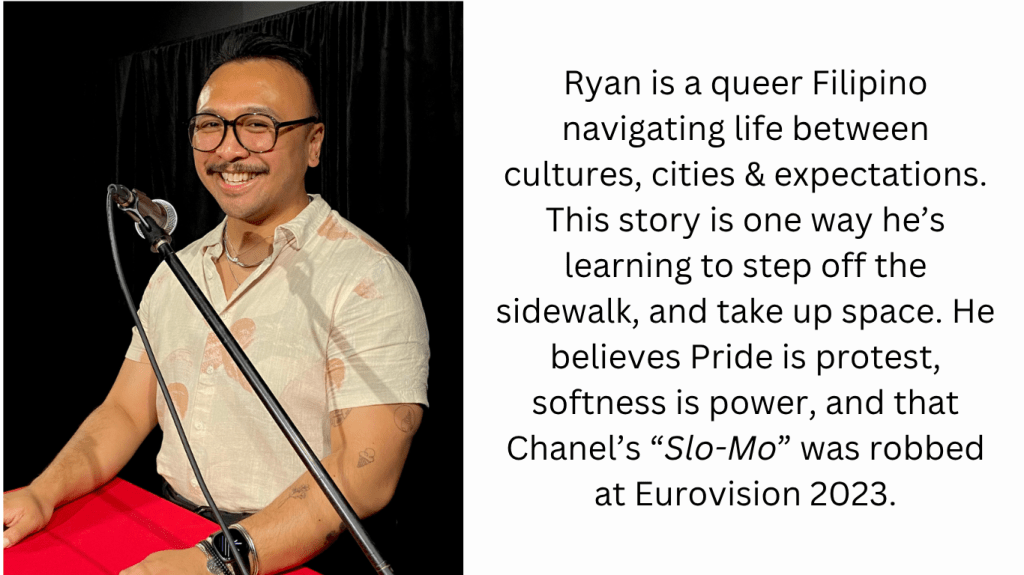
Pride!: Ryan’s Story

I grew up Filipino.
Which meant I also grew up Catholic, respectful, and quiet when it mattered.
You didn’t talk back. You didn’t question your elders. You didn’t come home too late. And you definitely didn’t talk about queerness.
In our community, you could suspect. You could joke. But no one ever said it.
Being gay was either a punchline or a shameful rumor that hovered around someone until it stuck. So I learned early: keep it tucked away. Smile. Be helpful. Be successful. And I was. Success became my armour. Good grades. Good manners. A carefully curated version of myself.
If I couldn’t belong by being me, maybe I could belong by being perfect.

It wasn’t that I didn’t know I was queer. I did.
I felt it in the way I watched certain people longer than I should—especially my sister’s guy friends. These boys were always around: loud, confident in that casual way boys are when they’ve never had to question their belonging.
They’d play basketball, all shoulders and jokes and zero personal space.
And there I was, always on the sidelines wondering what it would feel like not having to hide.
I wasn’t just crushing—I was studying.
How they existed around each other without fear. They were soft with each other in ways no one called soft. Their masculinity was never questioned. Mine was something I monitored constantly.
And I’d sit there wondering, Do I want to kiss them? Be them? Or just be allowed
near that kind of ease? Let’s be real—probably all of the above.

That’s why my first Pride felt… surreal. It was in Vancouver. I had just started letting myself live more openly—not just online or in whispers, but out loud. I didn’t know what to expect.
I just remember putting on this yellow polo shirt—something bright, safe, cheerful. I added a rainbow pin, maybe some beads I’d been handed by a volunteer. It felt like putting on armour, but softer. Like permission. I watched from the sidewalk as the parade moved past. Rainbow flags everywhere. Glitter. Music. People cheering and kissing and dancing in the street like the whole city had finally taken a deep breath.
And then I saw it—the TD float, blasting music with half-naked people dancing in the sun. Glistening bodies. Queer joy. Sweat and pride and freedom.

But here’s the thing: I didn’t feel like I was part of it. I felt like a spectator. Like I was watching someone else’s celebration, not mine.
I was smiling, clapping, even laughing—but I was still on the curb. Still unsure. Still asking myself, “Am I queer enough to belong here?
It wasn’t shame exactly. It was distance. Like I had stepped into the world of Pride, but I hadn’t quite arrived in myself yet.

It took me a few more years, and a move across the ocean, before I’d feel anything different. Brussels Pride caught me off guard. I hadn’t even planned to go, but I found myself in the middle of the city, swept up in the energy.
This wasn’t a hyper-produced parade with big floats and barricades. It felt open. Messy. Intimate.
People weren’t just watching—they were walking. The barriers were barely there. Anyone could step off the sidewalk and join the procession. And people did. People of different backgrounds, mingling, dancing and exuberantly celebrating.
Young people marching with their chosen family. Straight friends carrying signs that said, “I’m here because I love someone queer.”

And the soundtrack? Pure Eurovision chaos. From someone blasting “Tattoo” by Loreen like it was church, to a rhythmic chant to “Europapa,” it was enchanting.
Every corner had its own beat. Every queer had a flag. Every moment felt like home—if your home also occasionally served techno with a side of identity crisis.
Honestly, if you’re a Eurovision fan, hit me up, we clearly speak the same emotional language: high drama, bold fashion choices, and the occasional key change that saves lives and after some time I stepped off the sidewalk.
For the first time, I didn’t feel like I had to earn my place.
I wasn’t perfect. I wasn’t loud. I was just present. And that was enough.

When I think about Pride now, I don’t think about the floats or the glitter or the corporations with their rebranded logos. I think about that moment in Brussels—stepping off the sidewalk and into the street.
Because Pride isn’t a performance. It’s a process. It’s the slow unlearning of shame. It’s the decision to stop apologizing. It’s choosing joy even when the world has only taught you fear.

And yet even now, when I walk into certain spaces—queer or not—I still carry that quiet calculation: “Am I too much here? Or not enough?
Because queerness is not a monolith and the mainstream image of Pride still doesn’t always look like me.
There’s a kind of queerness that gets celebrated more easily.
Usually white. Usually cis. Often male. Lean. Loud.
Unapologetic in a way that feels less like protest and more like branding.
And sometimes, in those clubs, those professional events, those “inclusive” queer spaces, I still feel like I’m back on the sidewalk. Watching the parade.
I’ve been the only brown face in a meeting. I’ve had coworkers pull me aside to tell me I’m “so well-spoken,” as if it’s a surprise. I’ve had white queer people talk over me in meetings about diversity.
I’ve been fetishized for my brownness. Othered, even in intimacy.
And I’ve seen how people treat me differently when I show up femme—when I wear non-conforming garments, when my voice softens, when my wrists move too freely. Sometimes, being a queer person of colour means walking into rooms that claim to celebrate you, but only if you come in fragments.
Only if you leave the messiness, the accent, the ancestors, the softness, the trauma, and the realness at the door.

But that’s not who I am anymore. I don’t fragment myself for anyone now.
Because Pride isn’t just about who you love. It’s about how you insist on your wholeness in a world that keeps trying to carve you into pieces.
I once heard someone say:
“We don’t just want to be tolerated—we want to be accepted.” And that hit me.
Because for so long, I’d been satisfied with tolerance.
With not being bullied. With not being the punchline. With being allowed to exist.
But now? I want more. I want room to be joyful. To be complicated. To be brilliant and brown and queer and soft and taken seriously.
I want acceptance. Not as a concession, but as a given.
I’ve found power in taking up space—not always loudly, but fully. In speaking up at work when something feels off, even if I’m the only one who notices. In mentoring other queer folks of colour, so they don’t have to wait as long as I did to feel seen. In holding space for softness, for mess, for nuance.
In telling my story, especially the parts that aren’t tidy.

Because this is Pride, too. Not just rainbow floats and party weekends, but healing. Boundaries. Audacity. The choice to keep showing up, again and again, in rooms that weren’t designed for you, and remaking them in your image.
Now, when I think about my journey, from hiding behind grades in a Filipino household, to staring longingly at sweaty basketball boys, to watching the parade in Vancouver, to marching through a sea of techno and tears in Brussels—I realize I was never chasing a performance.
I was building a relationship with myself. One where I could love all of who I am.
Brown. Queer. Soft. Strategic. Sensual.
Not half of anything. Not apologizing anymore.

So if you’ve ever felt like Pride wasn’t made for you—too brown, too quiet, too complicated—I hope you know this:
You don’t have to wait for someone to invite you in. You belong here.
Even if you don’t wear glitter. Even if your pride looks like staying in.
Even if your anthem is Loreen and you cry to “Europapa” once a week.

Because Pride is not a moment.
It’s a practice. A rhythm. A reclamation.
And it’s yours.

Pride!: C.’s Story

When I was 30, I came out to my parents via Facebook Messenger. Not my finest moment, but it seemed like a good idea at the time. In my defense, my track record for coming out is pretty abysmal.

The first time I ever came out, I didn’t even realise I was doing it. I grew up in a very conservative town, went to youth group on Fridays and church on Sundays. The chaplain at my all-girls school regularly told us we were going to hell for some reason or other. Being queer simply wasn’t an option. But, there were signs. Like, developing instant, deep and intense “friendship” feelings for the first cool girl to pay you a lick of attention, and then lovebomb her with handwritten letters and super platonic mixtapes full of Death Cab for Cutie and Maps by the Yeah Yeah Yeahs. Yeah. Subtle. I also spent a lot of time lamenting the fact that I couldn’t go to the boy’s school because “their music program was better,” and backing that up by taking any chance I could to steal my brother’s uniform. For drama class. Or a costume party. Or, you know, just because.

It took me a few more years to identify what was going on there; I grew almost naturally into my understanding of self, and my little neurodivergent brain thought everyone else felt this way too. Shout out to Tumblr for the confirmation bias, turns out that everyone DOES just want to kiss pretty girls and wear dapper suits and experience the deeply intense yearning that comes from being in love with your best friend! Bolstered by this echo chamber of acceptance, I slowly became more open about my identity: subtly dropping easter eggs into sober conversations, and then aggressively shoehorning my horny gay ramblings into unrelated conversations while drunk. As a millennial bisexual in a straight-passing relationship, I was deeply uncomfortable with being perceived as heterosexual. It was like walking around with a rock in my shoe.

It wasn’t until nearly a decade later, after putting a hemisphere of distance between myself and my hometown, that I actually had the space to sit down, take a breath, and take off my shoe. When I shook it out, I was left with a pile of gravel. I began to realise that I was deeply uncomfortable with being perceived as a woman. When I told my spouse that I wasn’t a girl, in what was essentially a very dramatic, queer rendition of “would you still love me if I was a worm”, he said “I love you for who you are” and wiped my snot off his shoulder. What a guy. When I told my best friends, they were mostly relieved I wasn’t calling to say I was pregnant. I put my pronouns in my work email and that was that. I’ve only ever existed as myself in Vancouver. And then my parents came to visit.

We’d been settled here for almost a year, and I was still sifting through the gravel, but I decided that I couldn’t let my parents go back to Australia thinking how nice it was to see their daughter. I wanted to be open and honest about my identity and allow them to know the real me for the first time in my life. Put the ball in their court, so to speak. And we dropped plenty of hints, or so I thought. I mean, there was significantly more body hair and gender neutral language in our house than they’d come to expect.

I spent many sleepless nights planning my grand coming-out speech. I told myself I was waiting for the right moment. I’d know it when it came. And a couple did come, but I couldn’t do it. While they were visiting family in Quebec, my spouse and I ran various plays during dinner, considering all the angles and possible outcomes. My parents came back, we spent more time together, more moments came and went. And then all of a sudden, they were leaving.

As we drove down Granville Street, I tried to will the panic away while my knees bounced and my heart pounded in the front seat. At the drop-off area, we hopped out to help with their suitcases. They said I love you. I said I hope you can see how happy I am here. Then we got back in the car, drove around the corner, and I had a very dignified little breakdown.

Which brings us to the Facebook message, meticulously crafted with the help of a stiff gin and sent an hour before they were due to board a 16-hour flight. So, a little less ball in their court, a little more lobbing a grenade into their heteronormative worldview, and then forcing them to sit with it in a metal tube with no wifi for half a day. On reflection, I probably should’ve waited. I wanted them to know, but I wasn’t ready to talk about it.

Mum replied a little while later. She said they were surprised and confused, that they loved me, and they needed time to understand. A few days later, mum emailed with some reasonable questions which I tied myself in knots trying to answer. How could I put into words for others what I’d spent the better part of a year trying to explain to myself? I typed out some stream of consciousness, accompanied by some resources and recommended reading, hoping that they’d magically understand everything, or be willing to do the work. But in the moment, my mum’s response of “well, I was a tomboy in high school too” felt less like connection and more like dismissal. So I didn’t reply. And we haven’t really addressed it since. That was two years ago.

In those two years, I’ve never heard them use my pronouns. My dad still hasn’t acknowledged my identity at all. Not once. And it’s not like we haven’t spoken in that time. I’ve been back to Australia, we’ve seen each other in person. I’m writing my Masters thesis on nonbinary children’s literature. It’s not a secret. But, we don’t talk about it. They still refer to me as their daughter. For two years, we’ve been dancing around this big genderless elephant in the room. And I’m tired of dancing.

What they don’t know is that over the past two years, I’ve only become more certain of my identity. I’ve only become more proud, more loud, more outspoken. I spend each day trying to be who I needed to see back when I was 13 and didn’t have the words to explain myself, and I’ve seen the impact that my overt queerness has on others. I know who I am, and I love who I am. But, it’s also really hard. I’ve spent so long reshaping my own worldview that the thought of having to do that work all over again, for people who I know love a version of me, but I can’t guarantee love this version of me, it’s exhausting.

But I know that if I want to be seen, I have to let them see me. I’ve done enough therapy over the past two years to know that this is, unfortunately, the only way. So I think I’m gonna have to come out to my family again. Or maybe I’ll just send them this story. Maybe then they’ll see me, and maybe they could be as proud of me as I am.

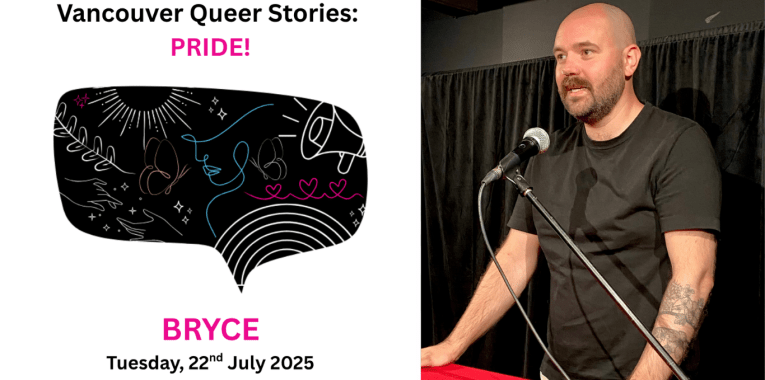
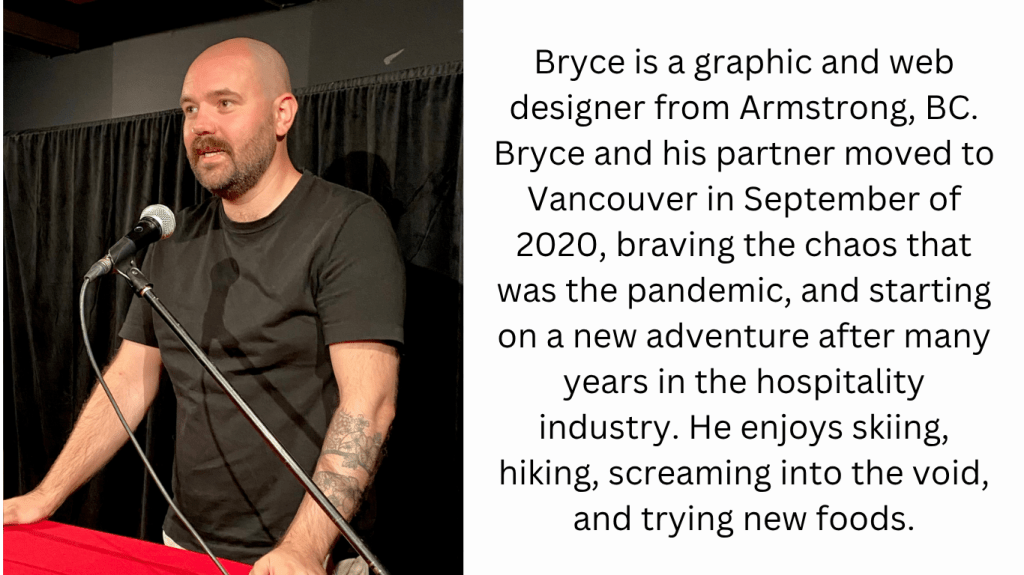
Pride!: Bryce’s Story

Growing up gay in a small town is like learning to whisper when all you want to do is sing. You get really good at editing yourself; at shrinking. I grew up in a town of 5,000 people, where most people knew each other, or at least thought they did. You learn quickly how to blend in, when the cost of standing out is being left out entirely. And so, I did what a lot of queer kids do: I said I wasn’t. I hid.

I knew I was different early on, but I didn’t have the language for it, or the confidence to claim it. In a place like that, being gay wasn’t something you admitted. It was something you denied, or joked about, before anyone else could weaponize it. I learned how to pass. How to act. How to keep one part of myself tucked away so well that sometimes even I forgot where I put it.

Then I met someone who had hidden just as well as I had. Someone from an even smaller town—500 people, if you can believe it! I used to joke that if I had it bad, he had it worse. But the truth is, we had something in common: we both grew up thinking we had to be less to be loved.

At first, being together was like finding a mirror. Not just in the obvious way—both of us boys, both of us figuring it out—but in how deeply we understood the effort it took to make ourselves palatable to the world. We didn’t just fall in love; we fell into safety. Into understanding. Into survival.

But we also fell into habits that mirrored our upbringing. We stayed quiet. We didn’t talk about our relationship in certain spaces. And even though our families knew we were gay, and knew we were together, we kept things toned down. We didn’t call each other “boyfriend” around them. We didn’t show affection. To them, I think we were just… neutral. Not hiding, exactly, but not fully seen either. We weren’t straight, but somehow, we still managed to look it.

For a long time, we didn’t feel like Pride was for us. It felt like something other people did: louder people, braver people. People who had figured it out. People with less to lose. It wasn’t shame, exactly. It was just… caution.

Then in 2019, we finally went to our first Pride event. Not in Canada. Not even in North America. It was in Manchester, England. And to be honest, one of the biggest reasons we went was because Ariana Grande was headlining the closing show. We had already seen her in April that same year… but Ariana at Pride? That felt like something different. It felt iconic. It felt like a good enough excuse to finally show up.
We booked the trip half for her, and half, I think, for ourselves, though we wouldn’t have admitted that then.

I remember walking down the street and hearing the music before we even saw the crowd. There were rainbow flags everywhere. Drag queens, couples holding hands, kids in rainbow tutus, protestors with signs, allies cheering. It was colourful and chaotic, and so beautifully alive. It was everything we weren’t used to. Everything we had quietly denied ourselves.

And for the first time, we didn’t feel like we were borrowing space. We felt seen. Not just tolerated. Not just allowed. Seen.

It was overwhelming, in the best way. We danced. We laughed. We kissed, even. Right there in the street, surrounded by strangers who clapped and cheered, and kept on dancing. I had never felt more free; or more aware of just how tightly I’d been holding myself.

That was the year Pride stopped being a word and became a feeling.

Since then, we’ve been to more Pride events, but not dozens. Just a few that mattered. Vancouver Pride has become a bit of a tradition for us. And this year, we went to Winnipeg Pride with the biggest group of gays I think I’ve ever travelled with. It was loud, joyful, chaotic, in the best way. A complete contrast to how we first learned to be gay: quietly, cautiously, carefully.

Every time, we let go a little more. Not just in public, but with ourselves. We let ourselves be soft. We let ourselves be loud. We remind ourselves that we don’t have to earn our space. We just get to be.

And here’s the thing: it’s not always perfect. Sometimes Pride is corporate. Sometimes it’s messy. Sometimes, it doesn’t represent everyone the way it should. But at its core, when you strip away the noise and the politics, Pride is about the right to exist fully. Without apology. Without compromise.

It’s a reminder that joy is resistance. That celebration is healing. That there is room for every kind of queer story, even the quiet ones. Even the ones like mine.

Because the truth is, I don’t have a dramatic coming out story. I didn’t run away. I didn’t get kicked out. I didn’t have to fight tooth and nail for acceptance. But I did fight. Quietly. Internally. For years, I fought for the right to be honest about who I am. I fought to believe that I didn’t have to shrink to be loved.

And that’s what Pride gave me. It gave me back the parts of myself I thought I had to hide. It showed me that visibility isn’t just about being seen by others. It’s about being seen by yourself.

So now, twelve years later, I get to stand next to the same man I met when we were both still scared. We’ve grown together. We’ve healed together. We’ve learned that the world is big enough for love like ours, and that we don’t have to water it down.

We still hold hands in some places, and not others. We still measure our surroundings before we kiss in public. The world isn’t perfect. But we are no longer pretending we’re something we’re not. And that matters.

Pride, to me, means hope.
Hope that someone else growing up in a small town—someone who’s hiding, someone who’s scared—can see people like us and feel just a little less alone.
Hope that the next generation won’t have to learn how to whisper.
Hope that one day, we won’t just be accepted—we’ll be celebrated.
Not because we’re exceptional, or brave, or resilient. But because we’re here.
And that’s enough.

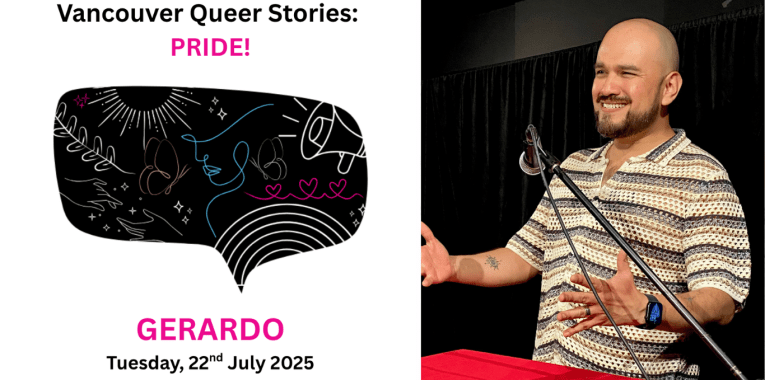
Pride!: Gerardo’s Story

I was 15
when I came out of the closet…
and ended up on the street.

No applause.
No rainbow confetti.
No RuPaul track playing in the background like a fabulous gay fairy tale.

Just me,
a garbage bag of clothes,
a slammed door,
and a silence that hummed like heartbreak.

That was my welcome to being gay.

I was raised Catholic.
Not “Christmas and Easter” Catholic,
I mean full-blown confess-your-thoughts-about-Ricky-Martin Catholic.
Church every Sunday.
Rosaries.
Guilt… lots of it.

They told me to love God…
but not like men.

So I prayed. Hard.
To be “normal.”
To wake up with a sudden interest in boobs and dirt bikes.

I prayed so much,
I could do the Hail Mary in under 10 seconds,
blindfolded, while crying, and brushing my teeth.

But when I finally said the words,
“I’m gay,”
those prayers didn’t soften anything.

No angels showed up.
Only a mother with heartbreak in her eyes
and a “pack your things” on her lips.So I did.

Here’s the twist though:
I used to play football.
Yeah… cleats, tackles, full-on jock life.
And so did my first boyfriend.

We were teammates…
and then roommates.
And then, well,
boyfriends with shared trauma and a twin mattress.

When both our parents kicked us out,
we moved in together.
Two 15-year-old boys,
figuring out rent, ramen,
and how to hide tears in public bathrooms.

I lied about where we were living.
Said I was “staying with friends.”
Showed up to school like everything was fine.
Even when I was starving.
Even when everything hurt.

And that…
was my first taste of Pride.

Not the parade.
Not the glitter.
Not the glam.
But the quiet, stubborn kind.
The “I’m still here” kind.
The “watch me survive” kind.

In school, I got bullied.
They whispered “faggot” like it was a spell meant to vanish me.
And for a while… I did disappear.
Into myself.

Until one day,
I cracked. I got loud.
Got mean.
Got funny.
And accidentally became… a bully.

Because if I made you the punchline,
then I couldn’t be one.

And honestly?
Therapist says: iconic trauma, villain era.

But broken kids wear armour however they can.

In my 20s, I was a mess with Internet.
(Yeah, that one with the horrible phone sound.)
Terrible jobs…
Worse taste in men…
A strict diet of frozen pizza, mezcal shots, and red flags.

But I kept going.
Finished two degrees.
Opened my own little restaurant.
Not Michelin-starred…
but hey, the health inspector only gave us one warning. (Just kidding. Kind of.)

Safe.
Stable.
Mine.

Then one day…
a message.

From her.
My mom.

“I miss you. Can we talk?”

So we did.
We cried.
We screamed (in Spanish… very healing).
We listened.

She apologized.
I told her I was still hurt.
But we tried.

Slowly,
we learned each other again.
Found love in the wreckage.

And now?
Now I’ve got something 15-year-old me never dreamed of…
I’m married.
To a man who makes me laugh,
makes me coffee,
and makes me feel safe in a way I didn’t know men could.

And yes…
my mother walked me down the aisle.
She cried.
I cried.
Even the DJ cried.
(It was Madonna’s “Like a Virgin…” who doesn’t cry at that?)

So yeah,
I’m proud.

Proud of the pain I survived.
Proud of the boy who didn’t disappear.
Proud of the man I became…
with jokes, scars, and a hell of a lot of glitter.

Pride isn’t just a parade.
It’s not just drag and disco (although… bless those queens).
It’s surviving.
It’s forgiving.
It’s calling your mom after coming out…
and knowing she’ll answer.

It’s saying,
“This is who I am,”
and not flinching anymore.

I used to kneel in church,
begging God to fix me.

Now I stand up tall,
husband by my side,
knowing there was never anything broken to begin with.

And bro…
no slammed door,
no whispered slur,
no prayer for “normal,”
will ever make me doubt my pride again.