Around the World: M.’s Story

Okay, so this story takes us back to 2015. I was just 18, still a student at AUB, which is basically the UBC of Beirut, where I’m from. But instead of being half an hour away from downtown, it’s literally in downtown. Picture a university inside Stanley Park.

Back then, I was still closeted — obviously living with my parents — and I used to drive to university every morning. And, like many gay men in the Middle East, I had Grindr. Because let’s be honest, that was the gay community. There were very few queer events or hangouts, just a bar or two… but mainly, a grid of torsos and chaos.

And that’s where I met Julien. French guy, blonde, older. In Beirut for a few days. Very much giving “European tourist with a tote bag and a mysterious backstory.” He told me he was travelling through French-speaking countries writing a book — which, at the time, sounded super fake; but he was still hot, so I didn’t question it.
I tapped him. He tapped me. We chatted. And we decided to meet up for coffee on campus, like respectable homosexuals. I picked him up, gave him a little tour of AUB, and also showed him around the city in my car, which honestly made me feel so cool. Like, I was 18! Driving this charming older French man around Beirut like it was nothing. I was glowing. Walking a little faster. Laughing a little louder. You know the vibe.

That night — the same night we met— he ran into a little problem. His iPhone locked him out. Completely. He kept saying, “I’m sure I’m typing the right code,” but his phone was like, “Nope. Try again in 3 days.” If you know, you know.
So now he’s in Lebanon, with no Google Maps, no contacts, no apps. Not even Grindr. Dark, dark times.
Buying a new phone? Too expensive. Renting one? Is that even a thing? And that’s when I saw my little gay moment to shine — not to impress, but to be useful. I told him, “I actually have a second phone; you can use it while you’re here. I’ll bring it tomorrow.”

It wasn’t a flex. It was just something I could do… so I did.

Now, everyone I told thought I was absolutely out of my mind.
“He’s going to disappear with your phone.” “It’s a scam.” “He does this in every country.” But honestly? I trusted him. I don’t know why. Maybe I was being naïve. Or maybe I just liked the way he said merci.

We saw each other a couple more times after that. Nothing major (okay, we fooled around a bit). One thing that I remember, that makes me cringe so hard, was this moment when I asked him, very stupidly, if he had downloaded Grindr on the phone. And of course, he had. And I was like, “…oh.
He explained that Grindr was how he met people when he travelled. At the time, I didn’t really get it. To me, Grindr was still this secret, shameful hookup thing. But now? I mean… most of my friends today? I met them on gay hookup apps.
So… yeah. Julien was ahead of his time; or at least ahead of mine.
Before he left, Julien gave me back the phone and thanked me. Said his trip would’ve been totally different if he hadn’t met me. And that meant something. It made me feel kinda special — like I had made a little mark on someone’s journey.

We kept in touch here and there. He only messaged me in French — partly because his English wasn’t great, and partly because he’d say, “tu dois pratiquer.” Little did I know, my French skills helped me get my PR in Canada 10 years later.
And for a long time, I really thought that was it. A sweet little story. I didn’t expect to see him again.

But then, seven years later, I visited France for the first time. I messaged him, just to say hi. “Hey… I’m coming to Paris.” And he replied immediately: “Let’s meet.”
And just like that, we did. He showed up on a bicycle — of course he did — looking older than I remembered. More silver in his hair. Definitely giving daddy energy. And if you know me, you know that’s very on-brand.

This time, it wasn’t flirty. It was just… really lovely. We spent a few days together, and it honestly felt like picking up a thread from a story I thought had ended. He showed me around Paris like a true local. We vibed, got a little drunk, had the best time. He took me to beautiful theatres, gay bars, this riverside queer spot called Rosa Bonheur — which is basically the Paris version of Birdhouse. If you ever visit, highly recommended.

And on my last day there, we took the train to Versailles to go to a theatre festival — because I’m a theatre gay, obviously. We wandered through the gardens with some strawberries and a bottle of bubbles, because in France, you can literally just crack open a bottle of wine in public, and it’s totally normal. We had this quiet, beautiful day, just the two of us. And I don’t know, there was such a strong connection between us. And if you’re wondering: no, nothing happened. He had a boyfriend, not that this ever stopped anyone. But honestly, nothing needed to. The vibe was there. That was enough.

And of course, the trains back got cancelled. So, we had to navigate this maze of night buses, switching lines, figuring it all out. I would never have made it back alone. So I guess we’re even now: I gave him a phone in Beirut, and he got me home in Paris.
On the way back to Paris — after running around trying to figure out which random village bus was actually going back to the city — we were both exhausted. Sitting there in silence, half-delirious, half-relieved that we even made it onto the right bus.
We both kind of knew this was the last time we’d see each other before I left. 

And somewhere between stops, Julien turned to me and said, “By the way… I mentioned you in my book.”
And I was like, “Wait — what book?” I had totally forgotten that he was even an author.
He smiled and said I was one of the memorable friendships he made along the journey of writing it. Just a small mention, nothing dramatic. But still — it really hit me. Like… damn. I actually meant something to this person.

We still talk sometimes. Send each other voice notes. He still corrects my French grammar like it’s his life mission.

And that’s my story. A little Grindr match in Beirut. A train ride from Versailles. A mention in a French linguistics book. Nothing dramatic. Just one of those rare, quiet connections that stick with you — even when you know you probably won’t cross paths again.
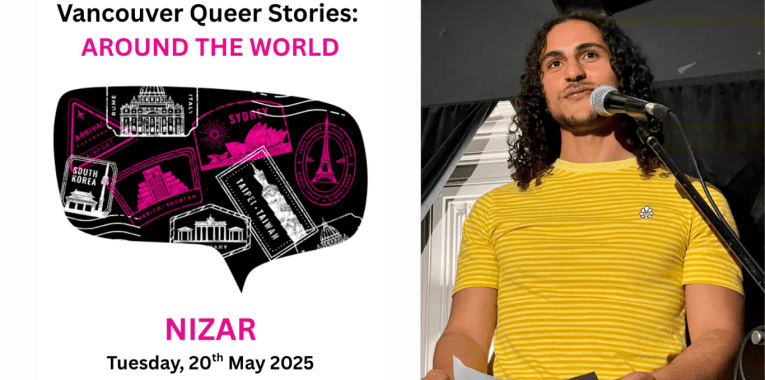
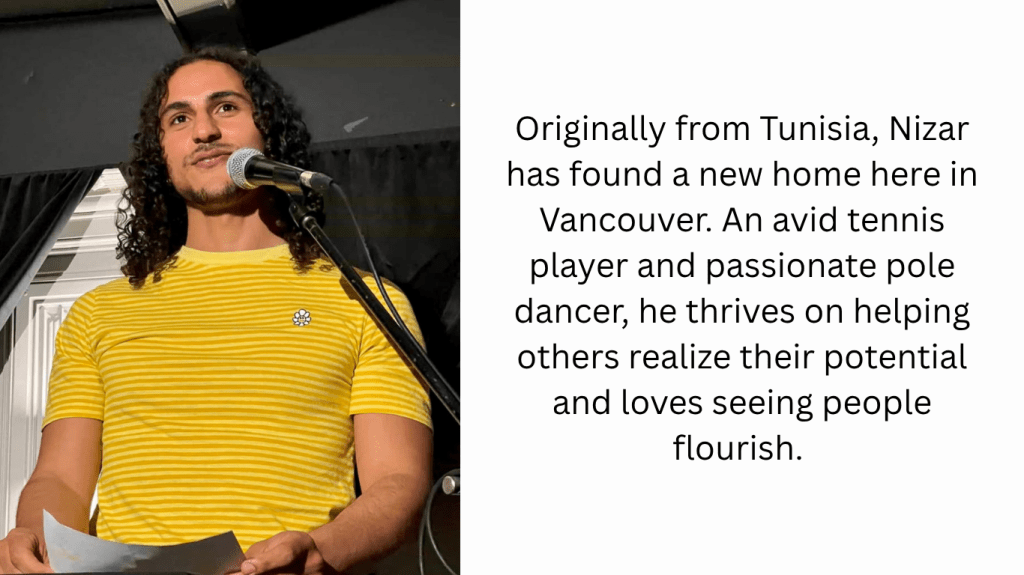
Around the World: Nizar’s Story

I grew up in a small town on the Mediterranean coast of Tunisia, a place where being different often meant being targeted. For those unfamiliar, Tunisia is a North African country with a rich and complex history. From the Phoenicians, Carthaginians, Romans, Vandals, Byzantines, Arabs, Berbers, Ottomans, to the French, many civilizations have left their mark. It’s a beautiful country with stunning landscapes and, if I may say so myself, a lot of beautiful men.

But despite its beauty, Tunisia’s laws are not as progressive. According to Article 230 of the penal code, same-sex relations are criminalized, with penalties of up to three years’ imprisonment. So, while the country is breathtaking, it’s not exactly a safe space for someone like me.

From as early as kindergarten, I knew I was different. My feminine manners and femme-presenting nature made me a target for relentless bullying. Before I even knew I was gay, people had already decided it for me. They called me “fag” and other slurs, and I couldn’t understand why. I felt trapped in a cycle of fear, confusion, and self-loathing.

Looking back now, I realize that people often fear what they don’t understand. In a place where traditional gender roles were set in stone, my existence challenged their norm. I didn’t know it then, but I was stronger than I thought simply for surviving that.

Every day, I’d walk down the street and brace myself for the insults, the rocks thrown my way, and sometimes even the beatings. I’d come home from school, bury my face in my pillow, and scream until I was exhausted. I couldn’t tell anyone, not my mom, not my dad, because I was terrified of judgment and ashamed of who I was. I contemplated ending my life more than once, but something within me, some spark, kept me going. Maybe it was hope or just pure stubbornness, but I wasn’t ready to give up.

As I approached my final year of high school, I knew I couldn’t stay in Tunisia any longer. I needed to escape. My parents couldn’t afford to send me abroad for school, but I was determined to find a way out. Here’s the funny thing about desperation: it makes you creative. I started browsing a website called GayCupid, it doesn’t exist anymore, but at the time, it felt like a lifeline. I reached out to countless men from around the world, Italy, France, Canada, the US, the UK, hoping one of them could help me leave. I convinced myself I was in love with one of them, a man named “Tom”. For two years, I stayed in touch with him, keeping that hope alive. Eventually, he helped me get a visa to Canada as an international student.

Moving to Canada was a huge relief, but living with “Tom” during those first two years was challenging. Even though I had set the boundary that we would just be friends, I often found myself doing things I wasn’t comfortable with to maintain stability. Eventually, I decided that I wanted better for myself. Leaving his place felt like reclaiming my own agency after years of feeling like I had to compromise to survive.

Not long after I moved out, I found myself on the phone with my mom. I wasn’t planning to come out to her that day, it just happened. The emotions overwhelmed me, and before I knew it, I was telling her everything I had kept bottled up since kindergarten; the bullying, the fear, the pain. I couldn’t stop the words from pouring out. It was raw, emotional, and something I didn’t know I needed. At first, she struggled to accept it, but I realized that I needed to accept her too, her background, her limited exposure to different perspectives. My dad’s reaction was different. He simply said, “I don’t care, be whatever you want.” Part of me wanted him to care more, to cry with me, but in time, I understood that his indifferent acceptance was a form of love.

One thing I’ve learned is that acceptance is a two-way street. I was asking my family to accept me, but I had to accept them too. When I let go of the need for my mom to fully understand and embraced her own struggle with my identity, a weight lifted off my shoulders. It wasn’t about them; it was about me, about learning to love myself despite the years of hatred and misunderstanding I had faced.

Living in North America has its own challenges, but it’s nothing compared to fighting for survival back home. Sometimes I feel like I’m going to be one of those people who say, “Back in my day…” but really, the contrast is stark. Back in Tunisia, just being myself was like trying to get a massage while stuck in a war zone. But here I am now, free, resilient, and finally at peace with who I am.

If there’s one thing I want you to take away from my story, it’s this: Sometimes, the journey to self-acceptance means accepting others, too. It’s about finding your own freedom without demanding that everyone understands it. The weight lifts when you let go of the need for validation and choose to live for yourself.

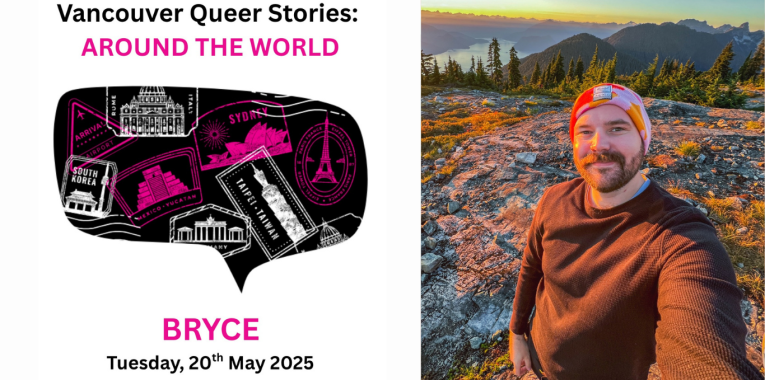
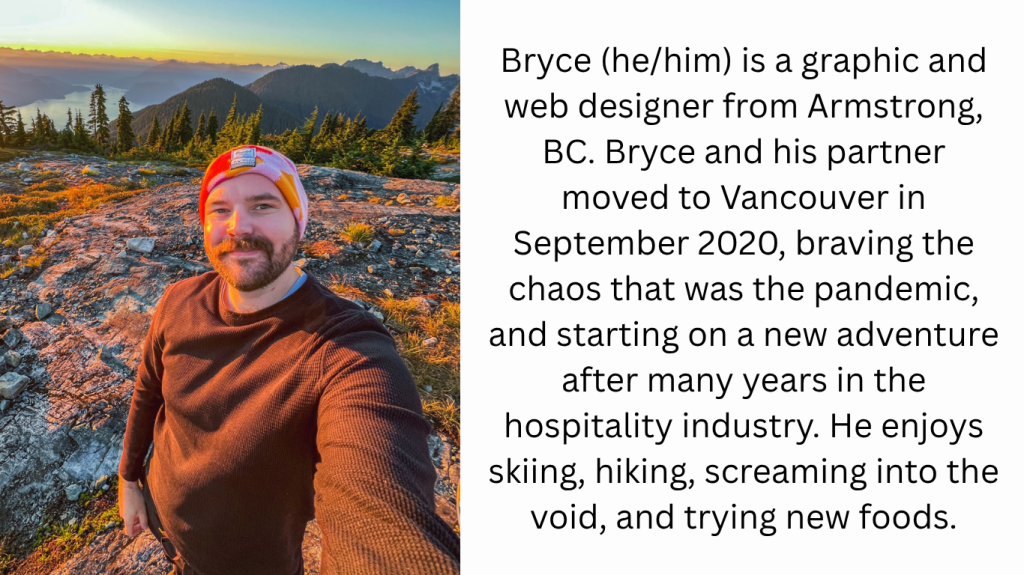
Around the World: Bryce’s Story

Let me take you back.

I was 18. That magical age where you think you’ve got it all figured out, but you still call your mom when your laundry turns pink. I had just hit that point in life where everything in my hometown felt too small. The streets, the routines, the same familiar faces. It was all closing in on me.
I needed space. Air. Maybe even some chaos. So, I packed up my car—if you could call it that. It was more of a metal box with an engine and a slight identity crisis. No GPS, no credit card, barely any cash, but a lot of heart.
I didn’t even tell many people I was leaving. I just drove west and decided I’d figure it out on the way.

When I got to Vancouver, I had exactly zero plans. Zero housing. Zero resources. But I had arrived, and that felt like… something?
I found myself driving around Stanley Park. I’d never seen anything like it. There were trees that made my little car look like a toy. Water that sparkled like it was auditioning for a movie. And people, jogging like they actually enjoyed it.
I parked and sat in silence for a bit, pretending this was all part of some Eat, Pray, Love moment. In reality, I was stalling because I had nowhere else to go.
That night, I curled up in the driver’s seat, hoodie rolled up as a pillow, trying to convince myself it was an adventure. The air was damp. The windows fogged up. But hey, I was free… right?

By morning, my back felt like it had aged 50 years, but I was still in one piece. I took that as a win. I stretched out, rubbed my eyes, looked out across the park and said, “Okay, day one in the big city—let’s do this.”
I drove into downtown. The city was buzzing: there were bikes, buses, beeping horns, neon signs. And somehow, every single person seemed like they had somewhere important to be.
Except for me, that is. But I didn’t want to look like an outsider, so I did what any self-respecting newcomer would do: I pretended. I adjusted my sunglasses. I leaned back like I knew where I was going. I even nodded at the people on the street, like I was one of them.

And then I saw it: a street that looked like it led somewhere cool. Brick buildings, people walking dogs, some artsy-looking cafés. Perfect. So I went for it.
Left-hand turn. No big deal.
Except, within seconds, I realized… big deal.
Because coming directly toward me, fast, was a silver Audi R8.
I froze. Like, full-body, “brain not working,” kind of frozen.

There are moments in life where time slows down. Where everything gets very clear, very fast. This was one of those moments.
I could see the grill of that car. The expression on the driver’s face (equal parts confusion and rage). And even the little sunglasses dangling from his rearview mirror. That man had money—and zero patience for a kid in a $2,000 car, going the wrong way.
I heard honking, shouting. I saw people on the sidewalk point at me like I was some kind of public safety demonstration. One guy just shook his head, like I’d personally disappointed him.

I did what my instincts told me to do: I cranked the wheel and swerved into the nearest side street—right past a massive green dumpster.
Parked—slammed my car into park. And just sat there.
I was shaking. My face was hot. I felt like I’d just survived an extreme sport, except the only thing I’d done was make a left turn.

And then the thoughts came, one by one, loud and clear:
Did I actually just do that?
Am I still alive?
Is it too late to move back home?

I slumped down in my seat, like hiding would help. I was parked beside literal garbage, and somehow it still felt like a step up from what had just happened.
I remember looking around to make sure no one had followed me; as if the Audi guy was going to chase me down, and hand me a bill for emotional damages.

Eventually, the adrenaline wore off, and something strange happened: I started laughing. Like, really laughing. The kind of laugh that starts as a nervous giggle and then snowballs until your stomach hurts. Because in the grand scheme of things… it was kind of hilarious.
I had survived my first real Vancouver experience. Not a sunset on the seawall. Not a cozy coffee shop moment. But a full-blown, wrong-way-down-a-one-way-street near-death experience.

Over time, I got better. I learned the roads. I found a place to live. I even got a credit card—with a limit so low, it was more symbolic than useful, but still. I figured it out. But I’ll never forget that feeling—of being completely out of place, completely lost. And somehow still okay.

And that, my friends, is how I learned about one-way streets.
Not from a sign. Not from a city tour. Not even from Google Maps.
No, I learned about one-way streets the old-fashioned way:
With fear. With adrenaline.
And with a luxury car speeding directly at my face.