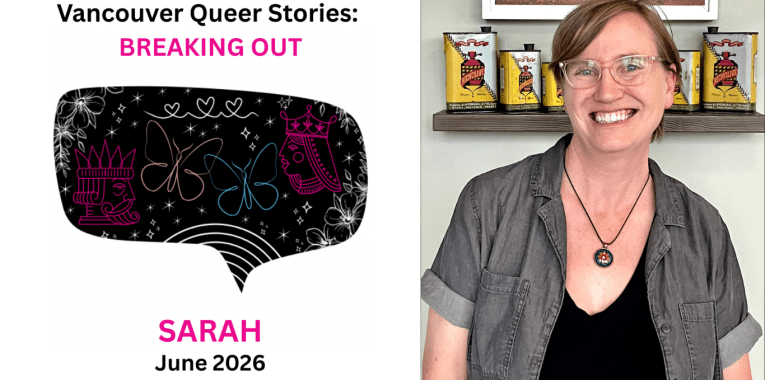
Breaking Out: Sarah’s Story

It’s six pm on a rainy Saturday in January and I’m driving alone up Mount Seymour in the dark. My heater is on full blast but even so my windows keep fogging up. My windshield wipers fight furiously against the rain that turns to wet snow as I drive higher. 

When I’d signed up for this event, I thought a full moon hike sounded like a lovely, romantic idea. It was my first outing with a hiking group I’d dared myself to join – an antidote to scrolling through dating apps or missing the ex who had recently broken my heart.

Immediately after signing up, panic washed over me. Willingly going out with a group of strangers is as far out of my comfort zone as, I don’t know, kissing an octopus. 

But I knew I needed something different. My life as a single mom in the suburbs felt small, limited, and I was starting to feel small with it. 

So I cobbled together a hiking outfit, packed a backpack with the things I thought I might need, and said yes.   

In the weeks leading up to the hike my anxiety came in waves. I almost cancelled a dozen times. I worried about pretty much everything – would my raincoat look cute? Would the other hikers be boring? What if I was stuck for hours with annoying people? What if they thought I was boring? I scrolled through their tiny photos looking for clues of compatibility.

I hadn’t even thought to consider practical things like, for example, the weather. 

So of course, the morning of the hike dawned rainy. With that Vancouver winter rain, ceaseless and daunting. It just kept coming down.

From my couch I alternated between refreshing the weather report and refreshing the event listing. As the day went on, the attendee list dropped from 12 to 8 to 6. I wondered if the hike would be cancelled, if I should pull out. 

The more it seemed like it might not happen, the more I realized I really wanted it to. 

“Fuck it,” I said, my backpack into the trunk.  

As I pull into the parking lot, there might as well not be a parking lot – it’s just a wall of fog. Doubt crowds my mind. Am I the only one stupid enough to actually show up? Why did I think this was a good idea? 

Finally, near the end of the lot I spot another vehicle. I pull up beside it and roll down my window. “I’m here for the full moon hike?” I say, cautiously, ridiculously, as wet snow pelts down. 

Three women climb out of the car. One, a few years older than me approaches with a welcoming smile and an outstretched hand. Cute braids stick out from under her toque. I like her already. 

“I’m Linda,” she says. “This is Joy, that’s Gina.” I recognized them from the photos, but here they were for real, organizing things in their backpacks, pulling on layers. 

“You’ve got your ten essentials?” she asks.

I smile and nod like I know what that means. 

I feel like such a fraud. Not knowing what to wear, I wore everything. A long sleeve shirt covered by a fleece covered by a down jacket with a raincoat over top.

I try to look like I know what I’m doing. I pull my Value Village rainpaints from the trunk and layer them over my sweatpants. 

These women seem effortlessly technical – they have those backpacks with the water hoses to drink from, and Gortex jackets, and carabiners that rattle from their bags like Christmas ornaments. I guess it takes a certain kind of person to come out in these conditions. 

I slide my feet into my old hiking boots, tighten the laces over two pairs of socks. 

We throw our backpacks on, adjust our headlamps, and head out into the dark night. For awhile there’s nothing but the crunch of our feet on the snow and the wind whistling through the tall trees.

They’ve all met before, chat easily together, and I feel the familiar self-consciousness creep over me. Do I have anything to say?  

A little way up the trail, we stop to put our microspikes on over our boots for traction. I pull mine out  – cheap ones I bought on Amazon, with little grippy dots. Theirs have big metal teeth. Where they walk, I slide. 

Have I mentioned that this is my first hike in months, if not years? That in all of my excitement to get out of my comfort zone and have an adventure, I forgot I’d be lugging my body along with me? You know that expression ‘your eyes were bigger than your stomach”, when you put more food on your plate than you can eat? 

This was that, but adventure was the food and the limit was my neglected muscles. 

Before long I am huffing and puffing, sweat pouring down inside my many layers. 

When they ask about me, it dawns on me that I’m meeting people who didn’t know me before I came out. People who haven’t witnessed my transition from being partnered with a man to becoming comfortable as a queer woman. 

I’ve gotten used to defining myself by what I felt I’d failed at – a marriage, keeping my family together. 

But here, and now, I can be whoever I want. 

The further we climb, the easier conversation flows. One of the women just got back from a trip to to Peru and tells us about her hikes there. I talk about the time I spent living in Chiang Mai in my twenties, and as I do memories come rushing back. Not just memories of tuktuks and pad thai, but of who I was then, independent, confident, curious. 

A woman with a taste for adventure. 

Near the top we stop in a sheltered valley to discuss our options. We’d planned to climb to Pump Peak to have our snack at the viewpoint. The snow is coming down hard now and visibility is next to nothing. Maybe we should turn back. “But we’re here,” I say, surprising even myself. “Let’s go for it.”  

So the four of us, like trekkers on the ascent to Mount Everest, set off up the icy bank for the climb towards the peak. There’s no path, just a sheet of white and shadow under the beam of our headlamps. We are comical, occasionally losing our balance and knocking each other over as we slip backwards.  

Finally we make it. The wind whips around us and we search in all directions for a glimpse of the elusive moon.

Instead, it’s almost as though the clouds thicken – we howl with laughter at this epic failure. 

I pull out my granola bar, thinking that will suffice as a hiking snack. Not with these ladies. Joy whips out a stove and manages to light it in spite of the wind and rain. She finds her pot and starts cooking gnocchi, of all things. Linda makes hot chocolate and someone produces a bottle of whiskey. Gina lays a tarp on the snow for us to sit on. 

I feel like a kid, giddy with the novelty, the make-your-own-fun of it. 

This is so much better than a mediocre first date on Commerical drive. 

I’ll be honest – originally I joined the group because thought I might meet a woman. 

Instead, I met women. Strong, independent women who climb mountains in the dark for fun. Women who see terrible weather not as a reason to stay home, but as part of the adventure.

On the way back down, certain sections of the trail are perfect for sliding and so we do – our feet up in the air like kids. Our screams and laughter echo across the valley, up to the dark sky. 

Driving home that night, I am soaked, exhausted, grinning and eager for more.

The moon never appeared that night. 

But I felt something else come into view: a version of myself that was still growing, still exploring, still willing to say yes to things that scared me. That night, somewhere between the parking lot and the summit, something had shifted. 

For the first time in a long time, my life felt bigger than the boundaries I’d been living inside.

A few months later we returned to Pump Peak for the Strawberry Moon – a larger group this time, the fairweather hikers – and we were treated to a spectacular moonrise over the mountains. This time I brought my newly purchased hiking stove, my backpack with a waterhose. This time I was the one greeting newcomers with a smile and an outstretched hand. 
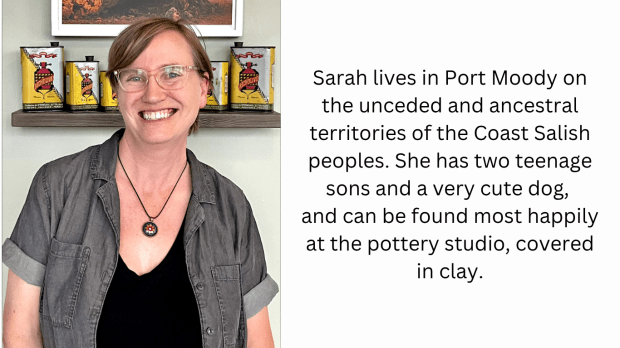
Summer Loving: Luis’ Story

This is a story about my on-and-off love affair with, metaphorically, the beach, open waters, and the sea. 

My first ever date was in the first post COVID summer, in coastal Victoria.
I ventured out to meet a guy I met online. Through text, he was emotionally available and aware he was avoidant. The hot beach day was the perfect environment to bring any incompatibilities to the surface; looking back, I realize how the sound of crashing waves was a beautiful, soothing sound, but being caught underwater as the currents break was not. Almost immediately, we were in an anxious-avoidant trap, and it would take me two years’ worth of poems, and counting, to learn how to love myself enough to not go into steep shorelines unprepared.

After that, my longest ever relationship, although it is best defined as a situationship, was here in Vancouver with a guy I used to say was the sea, Poseidon himself. If I went with the flow, I had a wonderful time; the best dates, though technically  hangouts, were trips to the beach. Blissful sunny happiness quickly clouded by my capacity to receive love that did not come with any strings attached, and unfortunately, without this clarity of what I needed, intention, I was once again in an anxious trap. A strong cycle manifesting itself like a lunar calendar. Fortunately, through poetry I was able to capture and reflect on the push and pull of the tide through this period of my life, and wonder where and why I was repeating it. Similar to the erred myth that the Aztec calendar was believed to foretell the end of the world, and not that the Aztecs were resetting their seasons, this loop of breakups and reconciliations revealed itself at the beach on January 1st: 

In 2012, my cousins and I went into the sea. 
Before we realized, the high tide took us away. 
We tried to swim as we screamed mayday,
I split from my cousins and tried to get help, 
We all got away, but not the fear that I felt.

I don’t trust the sea like before, 
my sandcastle falls when a wave knocks on the door. 
My comfort zone lays in more stable terrains
I even ask friends to play the water levels in videogames. 
So you could say I am afraid of the sea,
Because I wouldn’t be able to blame it for drowning me. 

The sea did not try to kill us, we ventured too far. 
The sea does not have a memory, we remember the scar. 
The sea will drown you if you let it be guide, 
The sea behaves in a pull and push of the tide. 
I compared you and the sea, and now I don’t know what to do with this commentary.
 

Let me offer my hand and help you down from the pedestal, 
Take a hammer to the columns and pipes and let the water flood my skeletal. 
I lean towards the synchronicity:
It’s the color blue that beacons to me. 
The blue in your eyes, or the blue in your name, 
Or the blue in the way you move.
 

I want to get out of the water, but I don’t know how.
Question the trail dripping from my body, 
Wonder:
If it was an emotionally aggressive father, no, 
If it’s how I process emotion and choose a path to follow, no, 
If it’s how my Mexican blood reacts like oil to Canadian waters, no,
else trying to heal every other part of me when the pipes in my sandcastle are spilling water, yes.

This life isn’t sustainable. 
You can’t heal personality. 
I’m never in reach of the perfect standard of healing every single part of me.
How many rooms do I split myself into before I forget where every part went initially?
 

In this new layout of my castle, where do I fit your memory?
The thought makes the tide in my mind go red, I’ve ventured too far. 
I can reason the sea’s behaviour but not a man’s vocabulary.
For that ethical ambiguity, I have no vacancy.
Not for the men I am unsure if I even “dated”, 
or whatever definition fits from your dictionary.
Not for those whose banter belittle me, 
Make a joke out of me and try to convince me it’s funny. 
Not for the men who cross my boundary, 
And dare to say the walls of my castle are imaginary. 

It’s through time, in each wave that hits the sand. 
That the sea and sand bank resemble each other’s hand.
I lose sight of what works for me and start becoming part of a narrative
That exists only in your mind and what I twist into poetry. 

Only when I focus on what I felt
not what you said does the tide relax.
I know I’ll put the memories, the good ones left,
Not in the sea or the places we spent time in, 
But in a brand new room.
Of people I rode the bus with, whom 
I flirted like we were strangers, 
driving away from Wreck beach, away from the currents and dangers.

Destined to get at different stops.
Dead calm waves, the high tide drops.

The idea that a place can have revealing properties is not a new one. In The Exterminating Angel, by Luis Bunuel, dinner party attendees become trapped in a sociological limbo that eventually reveals all their secrets and unravels their relationships. Robert Östlund’s Triangle of Sadness, Prime Video’s Yellowjackets, William Golding’s Lord of the Flies, break and rebuild social hierarchies after crew and travellers are castawayed. 

I’ve gone to the beach alone, with friends, family too, and have found similar results: an exposition of ideals and compatibility. Do you go to the beach with people who leave trash behind? Do you? How comfortable are they seeing their and other people’s bodies? How comfortable are you? Is their job really “beach” and are they qualified for it? Are you? Do they go to the beach only during summer? Do you?

I love that poetry, like the sandy coast, is as much an external as an internal space. Privacy shared publicly coexists with the secret agenda of knowing, being “in” on personal intimacy of a shared story. Being caught naked or seen in your underwear has a different moral weight than being seen at a beach wearing a range of birthday or bathing suits.

After spending the last day of Vancouver Pride weekend at Oasis in Wreck Beach with a diverse, safe, stable group of friends, I wrote about these conclusions in a poem called The beach:

I love the smell of sunscreen, sand, coconut oil;
Touch hungry, I’m picky as to who I ask for help. 
At a shy distance from the ocean, water, turmoil,
I’ve learnt going to the beach’s Reckoning itself,

Of what is not said but felt: interpersonal health.
Here, where there’s not much to do but connect
We watch, talk, listen, or that’s what I’d expect,
We wear our comfort levels, habits, our neglect:

Wreck/Jurassic/Oasis, SPF, over, under dressed.
By the coastline, waves flirt with the sandbank. 
A touch, a kiss here and there, a look at a chest,
A drift, a rip current wipes the shore prints blank,

Washed it away. Replaced by beautiful patterns.
The tide’s intention revealed in the rill and ripple:
It is Nature, to mix below the surface, “we” aren’t
But an undertow of elements chasing currents is.

As in, not ideal, life at the beach. I’m sunburnt
From a Sun’s hand, the Moon takes over control,
Rising and setting the pace of the ebb and soul.
I head home to myself, entirely made up of sand.

Today, as I visit familiar or new beaches, I am more aware of my qualities and needs, because I’ve been to the beach and continuously see how anxious, shy, body-dysmorphic, sexy, creative, secure I and others can be. 
Today, firstly, I know myself and get a life jacket for open waters, wear a speedo and SPF 50, and trust I am capable of swimming… for survival, probably not for recreation. 
Today, if I am curious about the health of my relationships, with myself or with somebody else, I go to the beach. 

Summer Loving: Claus’ Story

Day 1
The speedboat dropped us off on a deserted beach and drove away. Ahead of us was the West Coast Trail, a 75km trek in Vancouver Island. It was the end of summer 2018 when my friend Carly and I embarked on this adventure, with $5,000 worth of hiking gear and a shared sense that, maybe, we weren’t quite prepared for what lay ahead. (Carly is straight, btw, but we won’t hold that against her).

The first five kilometres took us an unbelievable six hours, climbing over tree roots, balancing on slippery logs, carrying 50lb backpacks.
“Do you think there is wifi at the camp?” Carly asked, shocked and dehydrated after hours of hiking, even though we both knew we’d have no cell service or electricity for a week. During our orientation that morning, we were told there was “running water” at the campsites; Carly thought they meant bathrooms. They were referring to rivers.

Reaching that first campsite at Thrasher Cove (KM 70) felt like a small miracle. The final stretch alone nearly did us in: steep, muddy switchbacks that seemed to go on forever, followed by ladders that dropped the equivalent of a fifty-story building to sea level. There, we used the remaining daylight to set up camp, and had to cook and eat our dinner (dehydrated space food that expires in 2099) in the dark. Two Advil for the pain. A hot chocolate spiked with bourbon to reward ourselves. Sleep. 

Day 2
We woke up cold and sore, and took a ridiculous four hours to pack up and eat breakfast. As we left camp, the skies opened up, and we quickly discovered that rain gear, even when it costs hundreds of dollars, isn’t fully waterproof. We would not be dry again for a week. 

When we hit the first of four cable cars (small metal boxes that fit two people and two backpacks, hanging from a rope and pulley system to help you cross swollen rivers), we were already trudging through ankle-deep mud, and knee-high water.

We ended the day at Camper Bay (KM 62), tucked between the forest and the sea. By our second night, we thought we were starting to settle into the rhythm of trail life: wake up sore, put on wet clothes, pack up, walk, set up camp, eat space food, take two Advil, drink a bourbon hot chocolate, sleep, repeat.

Day 3
We challenged ourselves to take down our camp, eat breakfast, and pack faster. We cut down our time in half… which means it still took us two full hours.

If the West Coast Trail is infamous for anything, is its ladders. There are around seventy of them along the trail, varying in length and inclination. Some of the ladders stretch the equivalent of a thirty-story climb. One ladder is completely vertical, and another is tilted slightly sideways. Most of them are slick with rain and moss. Every one is a test of courage; a slip can end up in disaster.

After hours of literal ups and downs on a ladder-heavy day, with hands and legs shaking from holding on to slippery rungs, we set up camp at Walbran Creek (KM 53), on a soft square of moss between two logs. Space food dinner, two Advil, hot chocolate — dammit, we emptied our bourbon flasks, meant to last the week! 

In the middle of the night, Carly shook me awake.
“Papi, there’s something outside the tent,” she whispered fearfully.
“A big something, or a little something?” I asked, alert. The West Coast Trail is home to bears, cougars, and wolves.
She thought about it for a while, then whispered, “A little something…”
“Carly, wake me up if you hear a big something.”

Day 4
We woke up that morning to a full downpour, so strong that we didn’t cook our usual hot oatmeal for breakfast. We tried to speed up our morning routine, but ended up taking two hours to pack up camp — again.

Shortly after leaving, we reached the longest cable car, stretched across an impossibly wide river. We loaded in and let gravity do its thing… except, the soaked rope sagged so badly that we stopped dead centre, dangling above the rapids, with rain blasting from every direction.
I began pulling at the rope with all my strength, attempting to pull us across to the other side, while Carly… well, while Carly cried. “I can’t do this,” she sobbed, broken by the elements.
Now, I’m not known for being patient. But Carly needed a pep talk, so I was honest with her. Yes, this was hard. Yes, I was broken too. But staying in that swaying metal box wasn’t an option. So, together, we hauled ourselves, inch by inch, to the other side.

Later that day, we came across “Chez Monique’s,” a legendary burger shack in the middle of nowhere. Except, Chez Monique had died the previous winter, so the place was closed. A man was there, and he let us sit under a tarp to cook a much-needed hot lunch away from the rain. He also sold us an outrageously expensive beer (which we paid for, gladly). And then he said we could set up our tent there for the night. Carly agreed cheerfully. I declined politely, convinced we’d end up in some sort of West Coast Chainsaw Massacre story.

So, we quickly escaped through rain that had gotten worse during our break. We walked along the sea (where Carly hilariously got taken down by a wave), then trekked through the forest.
The trail eventually spat us back out to the coast, and it felt like coming through to the other side of the looking glass. A path of tall grass led from the woods to an endless beach, bathed in beautiful golden light. The sea was deep blue, the pine trees a brighter green, the seagulls resplendent white.

The sun’s warmth seeped into our rain-soaked bones as we walked to Cribs Creek campsite (KM 41.5). We spent the evening on the beach until the sun set, giving way to a black sky speckled with glittering stars.

Day 5
After leaving camp, we walked along the ocean shelf at low tide, admiring sea creatures trapped in the tidal pools, and watching otters darting along the rocks — probably feasting on said sea creatures.

In the afternoon, we reached Nitinat Narrows (KM 32.5), where we enjoyed a BBQ salmon steak and baked potato at the Indigenous-owned Crab Shack. Sitting on the sunny deck, eating a real meal (not space food!), and sipping on a cold beer, we almost felt human again. 
After lunch, we took a boat across the narrows. On the other side, a thick, cold fog rolled in. We couldn’t see beyond 20 metres in any direction as we walked along a rocky beach, with barely an hour of daylight left. We both began to lose hope, thinking we’d have to set up camp on the uninhabited beach, but finally heard the rushing water of a fog-covered Tsusiat Falls, our next campsite (KM 25). 

Space Food. Two Advil. Virgin hot chocolate #sadface.

Day 6
A long, but easy day: flat, with well-kept trails. At Michigan Creek campsite that night (KM 12), someone started a campfire, the first and last of the entire trek. We gathered with a dozen other hikers around the fire, and for a night, it felt like a vacation: sharing stories, laughing, warmth soaking into our bones.
Absolute bliss.

Day 7
Our last morning began with another two-hour packing routine  — why can’t we get better at this?! The trail was once again easy, incomparable to what we had experienced the first five days. A few kilometres in, we got one last highlight: Sea Lion Rock (KM 9), where dozens of massive creatures barked and rolled atop a large reef. It was like nature’s grand finale.

We got back on our way, and suddenly, there it was: the one-kilometre marker. Euphoria surged through us, as we walked that last stretch to Pachena Bay, back to the real world.

***

Despite the challenges and bad weather, I’m grateful for the opportunity to have experienced such beautiful, untouched nature. And to appreciate the little things, like feeling joy every single time I saw a mustard-yellow banana slug, or a funky mushroom, or when I found my favourite lichen (old man’s beard) in the most unexpected places.

The West Coast Trail was breathtaking. It was brutal. It broke us down and built us up again. It made me closer to Carly than I ever expected to be to a woman. And I wouldn’t trade a single rain-soaked step of it for the world.