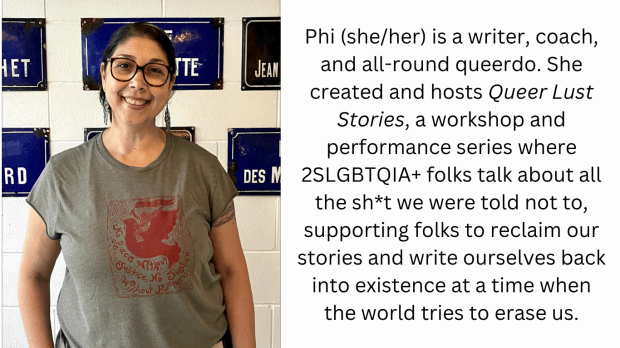
Breaking Out: Phi’s Story

Four months before my wedding, I was in full planning mode. Seating charts, handmade invitations, handmade ceremony programs, finalizing caterers and place settings, the works.

One evening, my fiancée, the man of my… parents’ dreams, was scrolling the TIVO, looking for the next show we should watch. He said, “Hey, what about this show? You heard of it? The L Word?”

My insides burned. “Sure,” I managed to say aloud.

I did not tell him I had already seen the series.

I did not tell him I knew The L Word inside out, that certain scenes were burned into the folds of my brain.

You see, long before living with him in Silicon Valley, I had lived in another valley, Lynn Valley, with my parents and sisters.

One of my sisters had brought a pirated copy of the whole DVD set back from China after a year of teaching abroad. One afternoon, sitting in our parents’ basement, I was thumbing through her giant folder of DVDs, and found this show.

With the first sex scene, my entire body responded. All the kissing. Touching. Fucking. Back then, I wasn’t registering the problematic parts of this series: how most of the actors playing lesbians were straight. White. How the sex scenes were so hetero-performative. I just saw boobs. And I liked it. I found myself sliding my hand down my pants and touching myself. Right there in the family basement. Afterwards, I was flooded with shame.

And then I pressed play and kept watching. I wondered how my sister had watched this show with her two roommates, wouldn’t it have turned them all on like it did me?

In the next episode came the next sex scene. And so did I.

Each scene whether it was sex, touching, a glimpse of something, gave me such massive, full-bodied orgasms, that getting through just one episode was quite exhausting.

All this flashed through my mind as my fiancee loaded up the show. I was anxious as shit. How was I supposed to navigate this situation? What would happen when we started watching this show and it started doing to me what I knew it had done before?

As far as anyone knew, including myself, I was straight. The fact that I’d been binging the L Word on loop since my mid-20s was not something I dwelled on.
The fact that I’d been binging sapphic erotica since my late teens in that same basement didn’t even make a dent in my mind.
Everyone had their secrets, I figured. I never once questioned my sexuality. I just locked it all away in the closet that I didn’t know I had back there.

When my fiancee hit play and the first episode showed the first sex scene, things worked out in my favor. With that first sex scene, he kinda did that straight guy thing of “ohhh” at the sight of two women having sex.
He looked at me and I probably made a face like “____” like a desperate attempt to match his turn-on without betraying the depth of my own.

After the episode ended, he began to touch me and I was all too ready to comply. I jumped onto him and came so hard and so fast it left us both shocked. I had had roughly one to two orgasms with this man in the three years we’d been together. But this too, I put away.

The next day, I went back to wedding planning. I stood in the ribbon aisle at Michael’s, contemplating ribbons for the ceremony programs that I was hand-making. Snippets of the night before came unwanted to my mind, right there in the tubelit aisle at Michael’s.

I drilled down harder: lace or satin? I could not go there. Cream or white? More flashes of the night before, the intensity of my orgasm: nope. Not going there.
I knew what I needed to do: more sequins for my invitations. And off to the next aisle I went.

That night, we watched the next episode of the L Word. Same turn on, same raging orgasm.
Night after night, we watched, I came. And the following day, back to the crafting project that was my wedding.

Finally, my fiancee asked the question I did not ask myself. “Have you ever been with a woman? Have you ever wanted to?”

I caved inward. Memories of all those years of my basement self-pleasurings burned inside me and I fought with Herculean effort to say, “Nah,” and try to sound normal about it. And then neither of us knew what to say. So we just watched the next episode.

One afternoon, back at Michael’s, I studied the cardstock: plain or textured? The question came:
“Phi,” a voice inside said, “These nightly sex romps are great and all, but should we talk about what this means?”

But here was where that vast black void kind of clouded my vision. I didn’t know how to examine this. Or who to examine it with. Everyone I knew was straight. Everyone I knew was getting married or was already married.

But each time I asked myself, “Should we examine what’s going on here?” I would think, “Welll, it’s four months till the wedding. People have already bought their plane tickets. It would be rude to cancel.”

This was the actual thought that would go through my head: you can’t cancel a wedding. I have to get married because you can’t cancel a wedding. Back then, I lived by these rules. The you can’ts and you musts and you shoulds.

But the deeper truth, the truth that I would not piece together until years and years later, was this: the idea of listening to my body, the idea of following my desire, at that time in my life, four months before my wedding to the perfect straight brown man, uh uh. I couldn’t.

Because to listen to my body, to follow my desires would make me different. And different was bad. I was already way too different: being a writer, a traveler, wanting to birth novels instead of babies. I was nearly 30 and try as I might, I was not doing a great job at following the script that everyone around me seemed to just slip into so easily. Now my body wanted to add queerness to the list? Queerness was definitely not part of the script.

But getting married? That meant I could fit in. That I would belong. That I had finally done something right. It was all right there within reach. And at that time, I needed to belong, to be like everyone else, more than I needed to be my true self.

We can intellectualize our lust, we can tell ourselves “everyone reacts to the L Word that way”, we can talk ourselves out of what we desire, but sometimes, the body gives it all away. And you can still shove that shit down, and that’s okay too.

It would be years before I would leave my marriage, before I would come out and come in to my full queer self.

It would be years before I would see QUEER community with my own eyes. People who were queer and trans and poly and kinky and thriving.

But that day did come. Literally the same day I left my marriage, I came out. To the person who would become my best friend and my greatest unrequited love. I couldn’t hold it in any longer.

He was stir-frying broccoli for our dinner and I burst out with: “I think I like … girls.”

He nodded, fully accepting of this news. Over the following weeks, he guided me on my great coming out journey, starting with queer films I had to see.

“Hey, have you seen Blue is the Warmest Color?” he asked, naming an extremely sapphic film.
“Ummm… yes.”

Shame crept up my neck and into my cheeks. But he just laughed and said, “Oh friend, you’re so gay.” Not in a shaming way. In a way that felt like, “I get you, welcome home.”
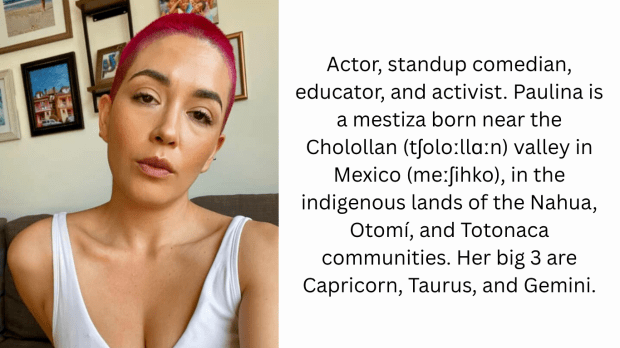
Around the World: Paulina’s Story

Mis raíces son de aquí y de allá.
My roots are from here and there.
But not literally here. By “here,” I mean Mexico—that’s where my “here” stayed.

Me and my family come from a long line of immigrants who arrived from northern Spain and Italy, eventually mixing with Indigenous people and mestizxs in Mexico. And no, I didn’t spit into a tube for Google to find this out.
I know, because where I come from, that kind of knowledge is passed down, close to the heart. Being of European descent still carries a kind of social value—less weight, more pride—even if it was five or seven generations ago.

Having that said, my gay genes are from all over the world!!
I only dare say genes because science hasn’t settled on it—it’s a mix of hormonal, genetic, and environmental factors. And I plan to tell my family that. So they can start taking responsibility for some of the emotional baggage they’ve passed down.

Yes, I’m from Mexico—from a city surrounded by three volcanoes.
Since I was little, my horizon has always been populated. It was hard to pick a favourite volcano, so I just decided to love them all. Which… maybe explains a lot.
I’m pansexual. And my volcano city was named Puebla by colonizers. Puebla doesn’t mean anything, but it sounds close to Pueblo—”town” in Spanish—just sapphic.

The city is colourful, artsy, painfully colonial. The population is mixed—Indigenous communities that still hold on to language and tradition, and whitexicans who think they’re more European than they actually are. There’s pride in food (rightfully so—don’t @ me!), but the snobbery doesn’t come from that. It comes from whiteness and class.
And even though we are all mixed, with Asian, Indigenous, European, black, over and over again, mestizaje didn’t mean equality. Now, Indigenous communities are a little better preserved, but that’s only because they have been pushed out to the peripheries—margins of the capital city.
In Puebla, waves of immigrants were welcomed: Lebanese people escaping the Ottoman Empire, Spaniards fleeing civil war, Germans leaving post-Nazi trauma behind. These communities were—and still are—respected, owning businesses, having their own schools, social clubs, factories. And indeed, in private schools in Puebla, you’re  taught German, English, and French.
But not Nahuatl. Not Otomí.

Close to my hometown is a valley called Cholollan—renamed Cholula. Please, add it to your bucket list. This city was once a spiritual hub for many Indigenous communities, all praising different deities, but gathered in the same land.
Not only pan, but poly.
The first time I lived alone was in Cholula. Mi Cholu. Colourful, bike town, full of markets and fields of flowers, maiz, and so many fireworks, like crazy, every single day there’s a saint’s celebration. Because colonialism ensured Catholicism wasn’t just adopted in Mexico — it was absorbed, so now there aren’t temples — called calpullis—  for different deities; now they are churches.
Puebla and Cholula are only 20 minutes apart: the whitewashed “we’re still European” city, and the cempasúchil lands that bloom every September.

I never really felt the need to come out to my family. I’d already come out as “the artist,” the cycle-breaker, the one who says no más to abuse and misogyny.
And as JuanGa said—and if you don’t know who Juan Gabriel is, how are you even here? Juan Gabriel was our Mexican Elton John, but gayer and way more legendary. He, maybe they, said “What is obvious doesn’t need to be asked” 

I don’t know if I had any queer relatives, I never saw anyone in my family that could have been.
What I did see were women who got shit done and men who “worked all day” but had mini-golf in their offices and collectible toys in their meeting rooms.
The women had strong hands that braided my hair so tightly it would probably qualify as child abuse today. But then they’d hand me a tortilla con aguacate y sal before dinner, and my favourite agua fresca—papaya…
Maybe they knew I was queer before I did.

But don’t get me wrong—I’ve known for a while. I just did gay stuff before I said I was gay. Like kissing my girlfriends at parties (with consent, always). I also shared my first orgasm with a girl.
It’s funny how we think we have “first times,” and then someone reminds us: “Didn’t that happen… back in the day?”
I thought my first time having sex was with my middle school boyfriend—he told everyone. I didn’t even come. Double asshole.
Later in life, I wanted to leave Mexico, but my Saturn return aligned with the pandemic, and I ended up living in San Francisco. There one day, I was with friends and playing Never Have I Ever, and someone said, “Never had sex with a woman.”
I didn’t put a finger down. But a friend said, “Wait—you told me a story from when you were 13.”
And I said, “We didn’t have sex. We just touched each other… and came.”
(Everyone laughed. I didn’t.)
It took my poly, demi, pan, ADD, PTSD brain a hot minute, but I finally connected the dots… My first time had been with a girl. YAY!!!!!!

By 28, I started calling myself bi. I didn’t need to come out dramatically. I just accepted it, named it, and started dating a woman.
We met on an app—because, of course. It was late 2020. She was beautiful—blue eyes, ballerina body, smile that could heal your inner child. It was sweet and short. I had to return to the U.S. We still orbit each other’s socials. A win.
Especially since my relationships with men tend to end with full drama:
The “never speak to me again” kind… or worse.

In 2021, I finally moved to Vancouver.
Why did I leave Mexico in the first place? Because I was afraid. Afraid to walk free. To wear something tight. To show my breasts.
I had experienced too much violence. Misogyny lived too comfortably in my home, in the media, in our streets. So I leapt. I trusted myself—and my craft as an artist.
Living outside of Mexico gave me perspective.
In Mexico, I’m not considered a person of colour. I had white privilege—despite my mom calling me the N-word for being “the darkest one.”
But here? I’m not white. I’m brown. More than anyone in my family would ever admit. And I embrace it.

I have an accent. YES.
I wear colours. YES.
I cook amazingly. I dance badly. I sing, not so bad.
I’m loud. My eyebrows speak before I do.

At a staff party for an immersive theatre company I worked at, I realized I was the only non-Canadian, non-white person there. We were drinking, joking, talking about patriarchy (as you do). Then this guy—let’s call him Hunter, because that’s his name—says: “You’re not like the other girls. You’ve got Big Dick Energy.”
I was like… “WHAT?”
And the guys were nodding. “Yeah, like you’re confident, you speak your mind…” One added, “All the women at work are into you. It’s like they see the big dick.”
Then someone else chimed in: “Or maybe… they’re into her because she doesn’t have a dick at all—but treats them as if she did.”
I didn’t know what to do with that info. Still don’t.
But I did find out later, at a New Year’s party, that they weren’t wrong. I made a move on one of the women—she said yes… until she didn’t. She ghosted me when I got COVID. Then asked me out again. So… not a total loss. Not a total win, either.

As I’ve grown, I’ve realized I don’t just love femme femmes or masc boys.
I love people across the spectrum. Masc femmes, femme boys. I love trans folks. I love queers. I love sapphics. I love love—as long as they’re not assholes or racist.
And the biggest victory, I love me. All my spectrum. All my mixed, from all around, magical self.
Even my lows. ‘Cause nobody gets depressed like I do. And most certainly nobody binges peanut butter at midnight like I do. And if someone does, I hope we can be friends.

My hope here is that younger people out there get to see more of us queers. Because we are not going anywhere, and they don’t have to wait 28 years to name themselves.
You don’t need to come out perfectly formed.
Just come out… as you.