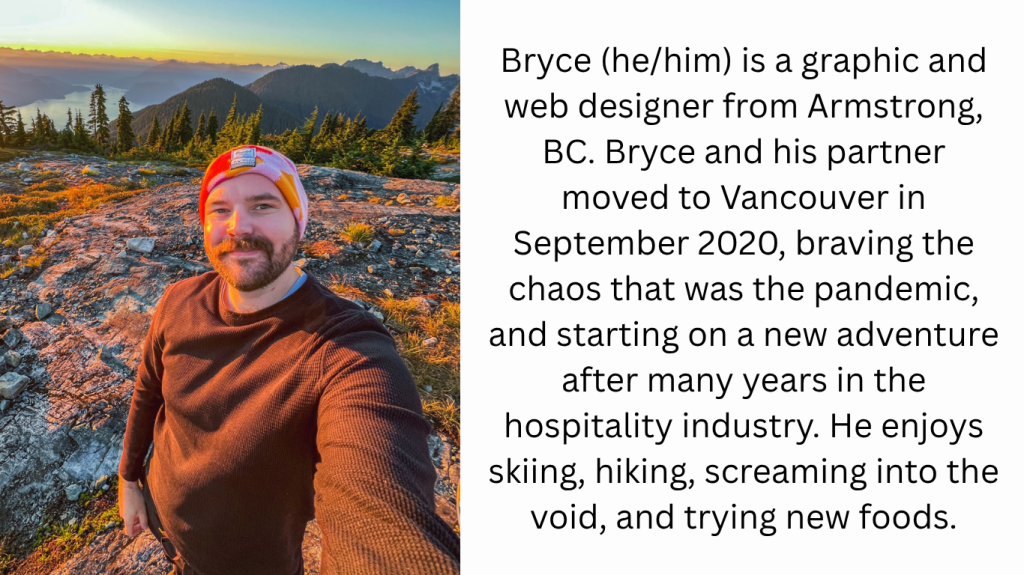
Summer Loving: Camille’s Story

This is not your typical steamy summer romance (although trust me, I have tried). My story is more of a love letter. A love letter not to a person, but to a place. This place. Vancouver.And it’s a story that spans almost two decades, from my first visit as a first grader to my moving here just last summer. If you have watched The Summer I Turned Pretty, this is kind of like that. But queer. And hopefully, with better writing. Do it for the plot, as they say.

Now, I haven’t done this sort of thing since university so I’m a little out of practice. In this essay I will… no, I’m just kidding.

A little bit of context. Like some of you, I am not originally from here. I grew up in Belgium. I went to catholic school, sang in the church choir, etc, etc. I can confirm that the catholic school to queer pipeline is real.
And don’t get me wrong, my love for Vancouver is not the same as dislike for Belgium. I love it there and I’m proud to be from there. I talk about it pretty much all the time. The people I miss, the food, the history, and culture. The fact that Belgium was the second country in the world to legalize same-sex marriage in 2003. And yet it’s a perfect example of how different legislation can feel to daily life.
Because. Growing up there for me also meant growing up with a lot of baggage. I lived and went to school with mostly white, cisgender, straight, conservative people. My home life was a crash course in emotional survival. This and other factors made it feel like I was keeping more and more inside as the years went by. Naturally averse to any type of confrontation, I kept my head down, twisted and bent myself so I wouldn’t cause any waves, trying not to catch any attention. It was a survival strategy, something I wasn’t always aware I was doing, but, over time, it shrinks you.
Now, it’s not like Belgium doesn’t have queer people. Trust me, as someone who got a liberal arts degree, sometimes it feels like I have met most of them. And although I attended university with plenty of rainbow merch and queer friends, sometimes it still felt like I was playing a part. My real, true, queer self was starting to make appearances, before I commuted back home at the end of the day and faded into that washed-out version of myself again. I was learning how to use non-binary pronouns in French and then going home to hear how queer people shouldn’t make such a spectacle of themselves.

Something I have left out until now is that me and my sister were lucky enough to spend many summers here in Vancouver while growing up. Something I definitely did not understand or appreciate while it was happening. Why was I being shipped off to the other side of the world every summer to be with people I hardly knew or understood? Why did I have to leave my home, my friends, my language, and everything that was familiar to me? Weirdly enough, these are some of the most vivid memories I have from my childhood and adolescence. They say you can’t remember an actual emotion, only the memory that feeling left behind. Maybe that is why summers in Vancouver are so bright, painted in colorful emotions, happy, sad, and angry. Because there was a lot of anger. There were a lot of tears. But at times, I was also happy.

I had a lot of firsts here:
This is where, as an angry tween in the middle of summer, I watched my first pride parade. Right on Robson Street. I did not know what was happening; I just remember it being loud and bright and colorful.
When I was a little bit older, Vancouver is where I had first dates, best dates. Most memorably the girl who planned a walking date to visit the best independent bookstores in the downtown area. For someone with a literature degree, that’s about as hot as it gets.
I spontaneously booked a walking tour called “The Really Gay History Tour,” diving into the queer history of this city. And I felt it. A hum, a buzz, whatever you want to call it. Something small, brave, vulnerable sitting in my chest, making its presence known. This place felt good, right.

Deciding to move here was not intentionally something I chose to do for myself. It made sense for a bunch of boring legal reasons and like many, I was a bit adrift after finishing university. What do you mean there isn’t anything I’m working towards over the next 4 years? I made the choice, initially for a year, to be closer to my sister, who had been living here for years. Probably the least problematic relationship I have in my life, the person who I have leaned on (sometimes a little too much) since we were 2 lost kids in this city. It was a risk. Once again, I was leaving my home, my friends, everything I knew, but this time it was my own choice, and it was for longer. But even though I was comfortable there, I was still clenching. I was myself, but I could still feel myself purposely not taking up space at times.

So. Since I recently passed my 1-year anniversary of moving here (or my Vaniversary, as I like to call it), I thought it made sense to do a little performance review.

After many many, many job applications, I started working at what I am convinced is the queerest workplace in the greater Vancouver area. If our queer staff members were given the day off for Pride, there would be no one left to keep the place running. The people I have met there, dare I say the friends I have made there, mean more to my little gay heart than I can express.
I have also joined a queer fitness class (yes, that is a thing, and I could not recommend it more). After a fun night out dancing at The Birdhouse, I woke up the next day not with a hangover, but with a hangover and my lower back in spasm. This queer cardio class, pitched to me as “gay line dancing,” seemed like a smart solution and has led to another first. My first time actively, loudly, proudly participating in a pride event earlier this summer.
It definitely hasn’t always been easy, though. In the past year, I have experienced more than one type of heartbreak here. The distance and space have given me a lot, but they have also taken things from me. Missing out on friends’ important life events, not getting the chance to say a final goodbye. Sometimes I feel like I am living a parallel life. It is so hard to fight the urge to regress into who I used to be when my old life comes knocking.

But. There is one memory that I keep going back to. It was August 2024, right after I moved. I packed my book and towel and biked on one of the crappy Mobi bikes to sit at English Bay Beach. The pride parade was going by. I watched the colours. The sun was shining. I could hear the waves on the beach and felt the wind on my face. This memory is so warm and bright in my mind, because I felt so… peaceful. And even though I had no idea what was coming in the year ahead, I felt I could finally, truly exhale.
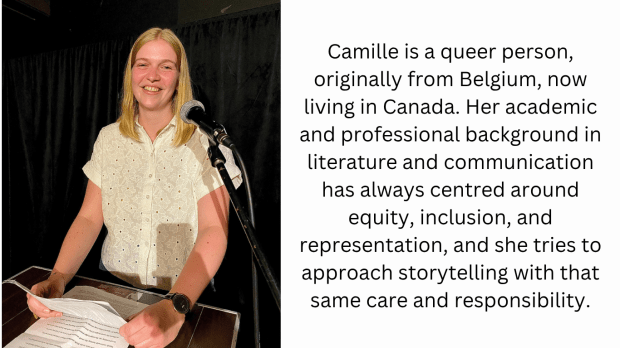
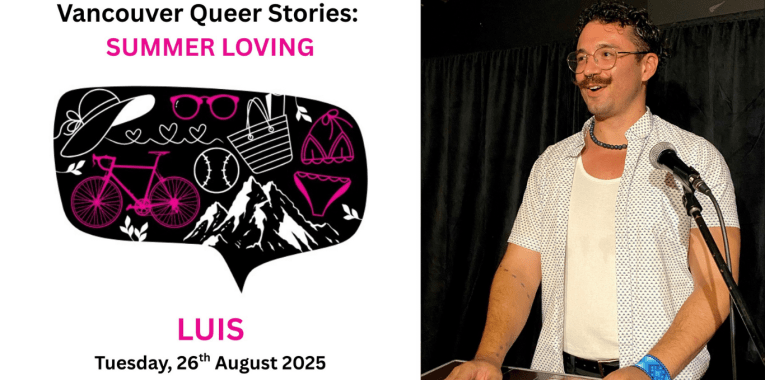
Summer Loving: Luis’ Story

This is a story about my on-and-off love affair with, metaphorically, the beach, open waters, and the sea. 

My first ever date was in the first post COVID summer, in coastal Victoria.
I ventured out to meet a guy I met online. Through text, he was emotionally available and aware he was avoidant. The hot beach day was the perfect environment to bring any incompatibilities to the surface; looking back, I realize how the sound of crashing waves was a beautiful, soothing sound, but being caught underwater as the currents break was not. Almost immediately, we were in an anxious-avoidant trap, and it would take me two years’ worth of poems, and counting, to learn how to love myself enough to not go into steep shorelines unprepared.

After that, my longest ever relationship, although it is best defined as a situationship, was here in Vancouver with a guy I used to say was the sea, Poseidon himself. If I went with the flow, I had a wonderful time; the best dates, though technically  hangouts, were trips to the beach. Blissful sunny happiness quickly clouded by my capacity to receive love that did not come with any strings attached, and unfortunately, without this clarity of what I needed, intention, I was once again in an anxious trap. A strong cycle manifesting itself like a lunar calendar. Fortunately, through poetry I was able to capture and reflect on the push and pull of the tide through this period of my life, and wonder where and why I was repeating it. Similar to the erred myth that the Aztec calendar was believed to foretell the end of the world, and not that the Aztecs were resetting their seasons, this loop of breakups and reconciliations revealed itself at the beach on January 1st: 

In 2012, my cousins and I went into the sea. 
Before we realized, the high tide took us away. 
We tried to swim as we screamed mayday,
I split from my cousins and tried to get help, 
We all got away, but not the fear that I felt.

I don’t trust the sea like before, 
my sandcastle falls when a wave knocks on the door. 
My comfort zone lays in more stable terrains
I even ask friends to play the water levels in videogames. 
So you could say I am afraid of the sea,
Because I wouldn’t be able to blame it for drowning me. 

The sea did not try to kill us, we ventured too far. 
The sea does not have a memory, we remember the scar. 
The sea will drown you if you let it be guide, 
The sea behaves in a pull and push of the tide. 
I compared you and the sea, and now I don’t know what to do with this commentary.
 

Let me offer my hand and help you down from the pedestal, 
Take a hammer to the columns and pipes and let the water flood my skeletal. 
I lean towards the synchronicity:
It’s the color blue that beacons to me. 
The blue in your eyes, or the blue in your name, 
Or the blue in the way you move.
 

I want to get out of the water, but I don’t know how.
Question the trail dripping from my body, 
Wonder:
If it was an emotionally aggressive father, no, 
If it’s how I process emotion and choose a path to follow, no, 
If it’s how my Mexican blood reacts like oil to Canadian waters, no,
else trying to heal every other part of me when the pipes in my sandcastle are spilling water, yes.

This life isn’t sustainable. 
You can’t heal personality. 
I’m never in reach of the perfect standard of healing every single part of me.
How many rooms do I split myself into before I forget where every part went initially?
 

In this new layout of my castle, where do I fit your memory?
The thought makes the tide in my mind go red, I’ve ventured too far. 
I can reason the sea’s behaviour but not a man’s vocabulary.
For that ethical ambiguity, I have no vacancy.
Not for the men I am unsure if I even “dated”, 
or whatever definition fits from your dictionary.
Not for those whose banter belittle me, 
Make a joke out of me and try to convince me it’s funny. 
Not for the men who cross my boundary, 
And dare to say the walls of my castle are imaginary. 

It’s through time, in each wave that hits the sand. 
That the sea and sand bank resemble each other’s hand.
I lose sight of what works for me and start becoming part of a narrative
That exists only in your mind and what I twist into poetry. 

Only when I focus on what I felt
not what you said does the tide relax.
I know I’ll put the memories, the good ones left,
Not in the sea or the places we spent time in, 
But in a brand new room.
Of people I rode the bus with, whom 
I flirted like we were strangers, 
driving away from Wreck beach, away from the currents and dangers.

Destined to get at different stops.
Dead calm waves, the high tide drops.

The idea that a place can have revealing properties is not a new one. In The Exterminating Angel, by Luis Bunuel, dinner party attendees become trapped in a sociological limbo that eventually reveals all their secrets and unravels their relationships. Robert Östlund’s Triangle of Sadness, Prime Video’s Yellowjackets, William Golding’s Lord of the Flies, break and rebuild social hierarchies after crew and travellers are castawayed. 

I’ve gone to the beach alone, with friends, family too, and have found similar results: an exposition of ideals and compatibility. Do you go to the beach with people who leave trash behind? Do you? How comfortable are they seeing their and other people’s bodies? How comfortable are you? Is their job really “beach” and are they qualified for it? Are you? Do they go to the beach only during summer? Do you?

I love that poetry, like the sandy coast, is as much an external as an internal space. Privacy shared publicly coexists with the secret agenda of knowing, being “in” on personal intimacy of a shared story. Being caught naked or seen in your underwear has a different moral weight than being seen at a beach wearing a range of birthday or bathing suits.

After spending the last day of Vancouver Pride weekend at Oasis in Wreck Beach with a diverse, safe, stable group of friends, I wrote about these conclusions in a poem called The beach:

I love the smell of sunscreen, sand, coconut oil;
Touch hungry, I’m picky as to who I ask for help. 
At a shy distance from the ocean, water, turmoil,
I’ve learnt going to the beach’s Reckoning itself,

Of what is not said but felt: interpersonal health.
Here, where there’s not much to do but connect
We watch, talk, listen, or that’s what I’d expect,
We wear our comfort levels, habits, our neglect:

Wreck/Jurassic/Oasis, SPF, over, under dressed.
By the coastline, waves flirt with the sandbank. 
A touch, a kiss here and there, a look at a chest,
A drift, a rip current wipes the shore prints blank,

Washed it away. Replaced by beautiful patterns.
The tide’s intention revealed in the rill and ripple:
It is Nature, to mix below the surface, “we” aren’t
But an undertow of elements chasing currents is.

As in, not ideal, life at the beach. I’m sunburnt
From a Sun’s hand, the Moon takes over control,
Rising and setting the pace of the ebb and soul.
I head home to myself, entirely made up of sand.

Today, as I visit familiar or new beaches, I am more aware of my qualities and needs, because I’ve been to the beach and continuously see how anxious, shy, body-dysmorphic, sexy, creative, secure I and others can be. 
Today, firstly, I know myself and get a life jacket for open waters, wear a speedo and SPF 50, and trust I am capable of swimming… for survival, probably not for recreation. 
Today, if I am curious about the health of my relationships, with myself or with somebody else, I go to the beach. 

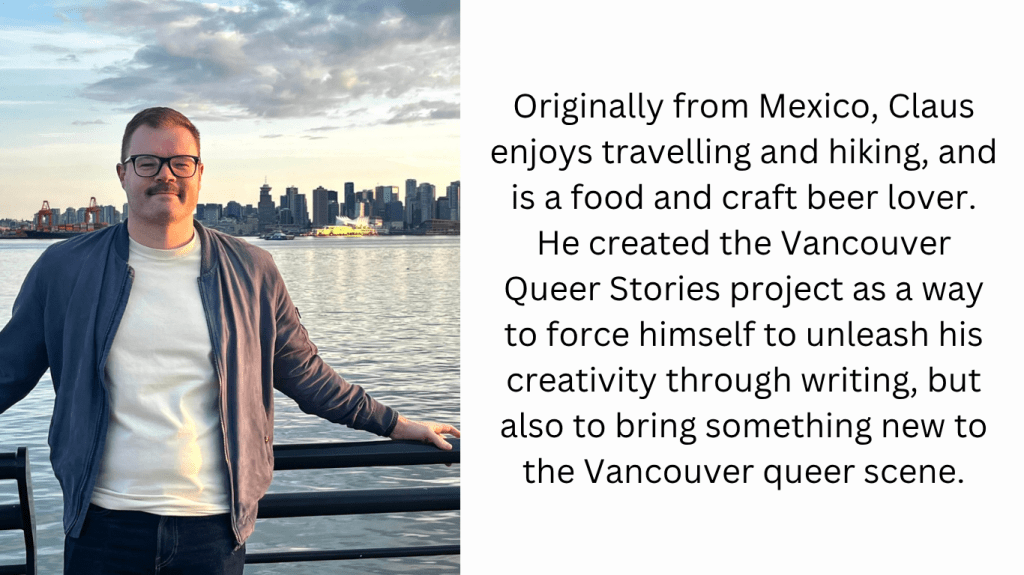
Summer Loving: Claus’ Story

Day 1
The speedboat dropped us off on a deserted beach and drove away. Ahead of us was the West Coast Trail, a 75km trek in Vancouver Island. It was the end of summer 2018 when my friend Carly and I embarked on this adventure, with $5,000 worth of hiking gear and a shared sense that, maybe, we weren’t quite prepared for what lay ahead. (Carly is straight, btw, but we won’t hold that against her).

The first five kilometres took us an unbelievable six hours, climbing over tree roots, balancing on slippery logs, carrying 50lb backpacks.
“Do you think there is wifi at the camp?” Carly asked, shocked and dehydrated after hours of hiking, even though we both knew we’d have no cell service or electricity for a week. During our orientation that morning, we were told there was “running water” at the campsites; Carly thought they meant bathrooms. They were referring to rivers.

Reaching that first campsite at Thrasher Cove (KM 70) felt like a small miracle. The final stretch alone nearly did us in: steep, muddy switchbacks that seemed to go on forever, followed by ladders that dropped the equivalent of a fifty-story building to sea level. There, we used the remaining daylight to set up camp, and had to cook and eat our dinner (dehydrated space food that expires in 2099) in the dark. Two Advil for the pain. A hot chocolate spiked with bourbon to reward ourselves. Sleep. 

Day 2
We woke up cold and sore, and took a ridiculous four hours to pack up and eat breakfast. As we left camp, the skies opened up, and we quickly discovered that rain gear, even when it costs hundreds of dollars, isn’t fully waterproof. We would not be dry again for a week. 

When we hit the first of four cable cars (small metal boxes that fit two people and two backpacks, hanging from a rope and pulley system to help you cross swollen rivers), we were already trudging through ankle-deep mud, and knee-high water.

We ended the day at Camper Bay (KM 62), tucked between the forest and the sea. By our second night, we thought we were starting to settle into the rhythm of trail life: wake up sore, put on wet clothes, pack up, walk, set up camp, eat space food, take two Advil, drink a bourbon hot chocolate, sleep, repeat.

Day 3
We challenged ourselves to take down our camp, eat breakfast, and pack faster. We cut down our time in half… which means it still took us two full hours.

If the West Coast Trail is infamous for anything, is its ladders. There are around seventy of them along the trail, varying in length and inclination. Some of the ladders stretch the equivalent of a thirty-story climb. One ladder is completely vertical, and another is tilted slightly sideways. Most of them are slick with rain and moss. Every one is a test of courage; a slip can end up in disaster.

After hours of literal ups and downs on a ladder-heavy day, with hands and legs shaking from holding on to slippery rungs, we set up camp at Walbran Creek (KM 53), on a soft square of moss between two logs. Space food dinner, two Advil, hot chocolate — dammit, we emptied our bourbon flasks, meant to last the week! 

In the middle of the night, Carly shook me awake.
“Papi, there’s something outside the tent,” she whispered fearfully.
“A big something, or a little something?” I asked, alert. The West Coast Trail is home to bears, cougars, and wolves.
She thought about it for a while, then whispered, “A little something…”
“Carly, wake me up if you hear a big something.”

Day 4
We woke up that morning to a full downpour, so strong that we didn’t cook our usual hot oatmeal for breakfast. We tried to speed up our morning routine, but ended up taking two hours to pack up camp — again.

Shortly after leaving, we reached the longest cable car, stretched across an impossibly wide river. We loaded in and let gravity do its thing… except, the soaked rope sagged so badly that we stopped dead centre, dangling above the rapids, with rain blasting from every direction.
I began pulling at the rope with all my strength, attempting to pull us across to the other side, while Carly… well, while Carly cried. “I can’t do this,” she sobbed, broken by the elements.
Now, I’m not known for being patient. But Carly needed a pep talk, so I was honest with her. Yes, this was hard. Yes, I was broken too. But staying in that swaying metal box wasn’t an option. So, together, we hauled ourselves, inch by inch, to the other side.

Later that day, we came across “Chez Monique’s,” a legendary burger shack in the middle of nowhere. Except, Chez Monique had died the previous winter, so the place was closed. A man was there, and he let us sit under a tarp to cook a much-needed hot lunch away from the rain. He also sold us an outrageously expensive beer (which we paid for, gladly). And then he said we could set up our tent there for the night. Carly agreed cheerfully. I declined politely, convinced we’d end up in some sort of West Coast Chainsaw Massacre story.

So, we quickly escaped through rain that had gotten worse during our break. We walked along the sea (where Carly hilariously got taken down by a wave), then trekked through the forest.
The trail eventually spat us back out to the coast, and it felt like coming through to the other side of the looking glass. A path of tall grass led from the woods to an endless beach, bathed in beautiful golden light. The sea was deep blue, the pine trees a brighter green, the seagulls resplendent white.

The sun’s warmth seeped into our rain-soaked bones as we walked to Cribs Creek campsite (KM 41.5). We spent the evening on the beach until the sun set, giving way to a black sky speckled with glittering stars.

Day 5
After leaving camp, we walked along the ocean shelf at low tide, admiring sea creatures trapped in the tidal pools, and watching otters darting along the rocks — probably feasting on said sea creatures.

In the afternoon, we reached Nitinat Narrows (KM 32.5), where we enjoyed a BBQ salmon steak and baked potato at the Indigenous-owned Crab Shack. Sitting on the sunny deck, eating a real meal (not space food!), and sipping on a cold beer, we almost felt human again. 
After lunch, we took a boat across the narrows. On the other side, a thick, cold fog rolled in. We couldn’t see beyond 20 metres in any direction as we walked along a rocky beach, with barely an hour of daylight left. We both began to lose hope, thinking we’d have to set up camp on the uninhabited beach, but finally heard the rushing water of a fog-covered Tsusiat Falls, our next campsite (KM 25). 

Space Food. Two Advil. Virgin hot chocolate #sadface.

Day 6
A long, but easy day: flat, with well-kept trails. At Michigan Creek campsite that night (KM 12), someone started a campfire, the first and last of the entire trek. We gathered with a dozen other hikers around the fire, and for a night, it felt like a vacation: sharing stories, laughing, warmth soaking into our bones.
Absolute bliss.

Day 7
Our last morning began with another two-hour packing routine  — why can’t we get better at this?! The trail was once again easy, incomparable to what we had experienced the first five days. A few kilometres in, we got one last highlight: Sea Lion Rock (KM 9), where dozens of massive creatures barked and rolled atop a large reef. It was like nature’s grand finale.

We got back on our way, and suddenly, there it was: the one-kilometre marker. Euphoria surged through us, as we walked that last stretch to Pachena Bay, back to the real world.

***

Despite the challenges and bad weather, I’m grateful for the opportunity to have experienced such beautiful, untouched nature. And to appreciate the little things, like feeling joy every single time I saw a mustard-yellow banana slug, or a funky mushroom, or when I found my favourite lichen (old man’s beard) in the most unexpected places.

The West Coast Trail was breathtaking. It was brutal. It broke us down and built us up again. It made me closer to Carly than I ever expected to be to a woman. And I wouldn’t trade a single rain-soaked step of it for the world.

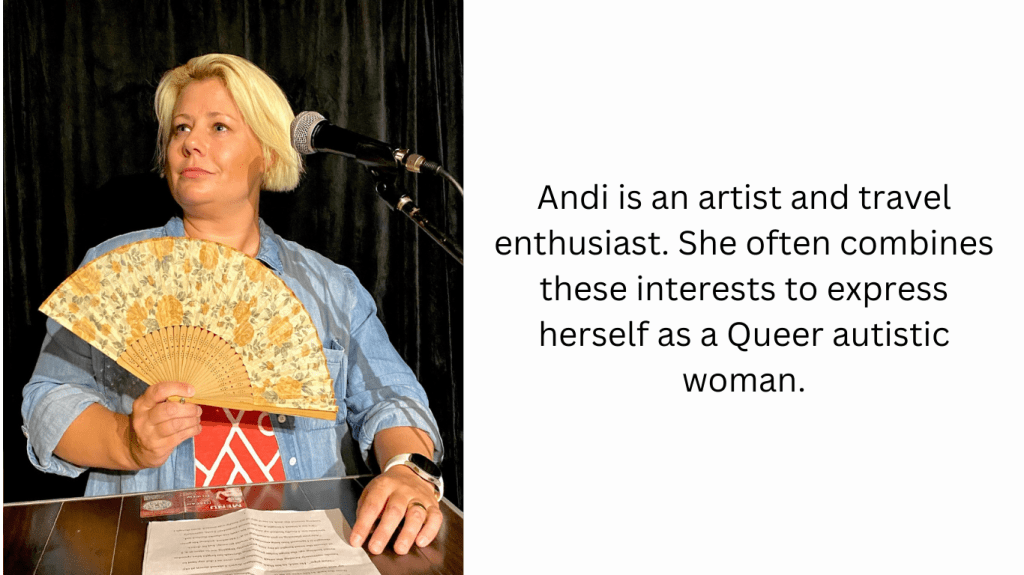
Summer Loving: Andi’s Story

I remember sitting at my desk and feeling every molecule in my body pull me towards the door. In the past 6 months, I had only enough energy to come home after work and sleep. I would wake up the next day, head back into work, and completely disassociate.
At work, sounds were becoming louder, I could hear the photocopier at the rear of the office better than the person trying to converse in front of me. I had zero short-term memory. If a conflict arose, even if it was an easy fix, my mind would draw a blank, my eyes would well, and my voice would stop working. I felt like I was hanging on by a thread; I had no core inside my chest to hold the weight I was feeling. 
I thought to myself “why am I the only person not able to cope in this environment?” 

On that same day, I listened to my gut and I started the process of going on medical leave. I made a doctor’s appointment, I emailed HR for the paperwork, and then I bawled my eyes out that night thinking I was a failure and doomed to go nowhere in life because of my perceived shortcomings. 
A few days later, after processing some emotions, I realized how deprived I had been from the things that brought be joy and peace. I made a plan. The first thing I was going to do was put in the film The Sound of Music, because Julie Andrews knows how to do.
Then I was going to commit to doing more art and, despite not having a car at the time, I was going to get out of the city one way or another (these are a few of my favourite things). 

I thought about flying home to see my folks in prairie nowhere, Manitoba, but given the circumstances, I didn’t think a family visit was going to alleviate the stress and guilt I was experiencing. There was, however, one family member I had recently reconnected with who I felt understood me more than anyone else at that time: My 93-year-old Great Aunt Maizie; the eccentric sister of my late grandfather who had moved out to the West Coast in the 1950s to practice yoga and to become a “heathen” (as Grandpa would say)! 
I remembered first meeting her when I was 5 years old during a trip to Vancouver for my uncle’s wedding. I thought she was a spunky old lady… And that odd old house she lived in decorated with beads, candles, and photos of bearded East Indian men, it was so different from my regular surroundings…That yard she had, it was full of lush trees and flowers… That ocean, where I collected shells near that massive park… that terribly scary swinging bridge I cried the entire way across holding my Dad’s leg for dear life… those Godly Totems… That had all been 23 years prior, and it had evidently left a mark on me. It became clear to me where my journey out of Calgary was going to be: Vancouver. 

Remember when Airbnb was cheap? I booked 5 nights in a shared apartment that overlooked Davie Street for $37 bucks! I mean, it was no Shangri-La, the room was a closet with a window to the kitchen, and the folks living there didn’t care much for their own privacy (saw a lot of bum), but hey! I made it! 
After dropping off my bag, I went straight to Beach Avenue and down to the water. I felt the sea air fill my lungs like drinking a cold glass of mountain spring water. The bay was like glass and appeared to stretch beyond the horizon. I needed to swim. I stripped down into my bathing suit. I fell into the sea, and then it fell into me. In the middle of a busy city, I could finally hear the silence I so desperately needed just beneath the water’s surface. I felt an internal exhale. 
Afterwards I walked to the edge of Stanley Park and around the giant trees. I felt nostalgic, the farm I grew up on was full of big trees and I missed them, but another feeling returned to me that I hadn’t felt in years. I felt like I was home. 

The following day I ended up going over to North Vancouver. The journey up and down the mountain felt magical; a maze through hills and trees, all of which extended beyond my bus framed vision. But you know what else was fricken cool? The Seabus! Woah, I was on a boat! That may seem ridiculous to some, but if you’re from the prairies, it’s absolutely delightful! The angle of the light during my initial crossing lit up the buildings on the North Shore as if I was entering the ‘Kingdom of North Vancouver.’ 
And then there was Maisie’s house… It was EXACTLY THE SAME as it had been all those years prior! Maisie however, was much older, much more frail, but that did not stop her from showing me her flexible yoga moves! We chatted about family for a bit, then life and philosophy. Despite the enormous age gap, I felt like I was talking to an old friend who understood that I needed to set my spirit free. 

Coincidentally, a few different old friends were in Vancouver at the same time, and I ended up having a blast catching up with them! I went out on a party boat and hit up all the gay bars on Davie! Joy had returned, and experiencing a little more Queer representation around me also brought about a sense of safety. 
I went back to the North Shore once more, not just for that Seabus thrill, but to shop and chill at the Lonsdale Quay. I sat at the brewery that shared its patio with the promenade, sipped my IPA, and watched the ships, boats, and aircrafts go by. Despite my busy surroundings, I had found a bit of peace. 

Inevitably, the day to board my departing flight had come. I settled into my window seat and felt tears come to my eyes. I didn’t want to go, but I knew I would do my best to return. I consciously left a piece of myself at YVR that day, imagining that one day, even if only for a week every other year I would meet myself again. 

That soul cleansing visit in the summer of 2015 put me on a incredible trajectory. 3 weeks after returning to Calgary I would meet my future wife. 5 months later I left my job for good. 2 years later, my partner and I would take a trip to Vancouver together to start apartment hunting after she accepted a new position. 5 years later in Vancouver, I would be diagnosed with Autism Spectrum Disorder which allowed me to reflect on and reevaluate my own needs at work and in life (as it turns out I have selective mutism and what I had gone through was burnout). An engagement, and a whole pandemic later, my partner and I married in a spectacular service at Christ Church Cathedral with all our family and loved ones present. 

As for my dear Great Aunt Maisie of whom I found a kindred spirit, she would pass on just shy of her 101st birthday. Sometimes we fall in love with people, and sometimes we fall in love with places, whether it’s a summer “fling,” or something that later becomes a long-term commitment. Vancouver was my summer fling that later became my home. Vancouver opened up her ocean stretched arms and nestled me into her mountainous earthy embrace, she filled my cup, and restored my peace. 

Whatever the future has in store, even if my wife and I end up leaving this place down the road, I will always love Vancouver because Vancouver reminded me how to love myself.

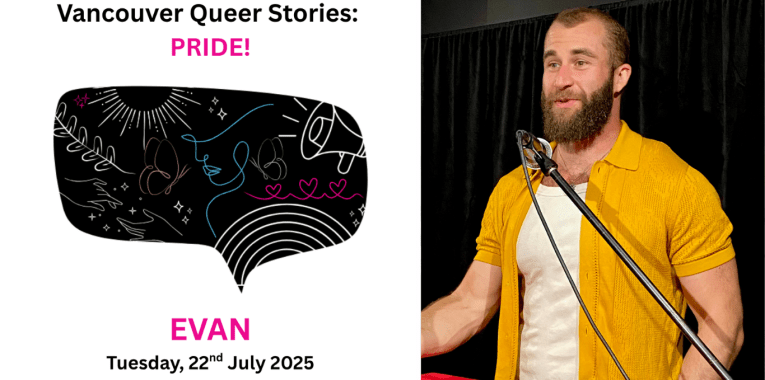
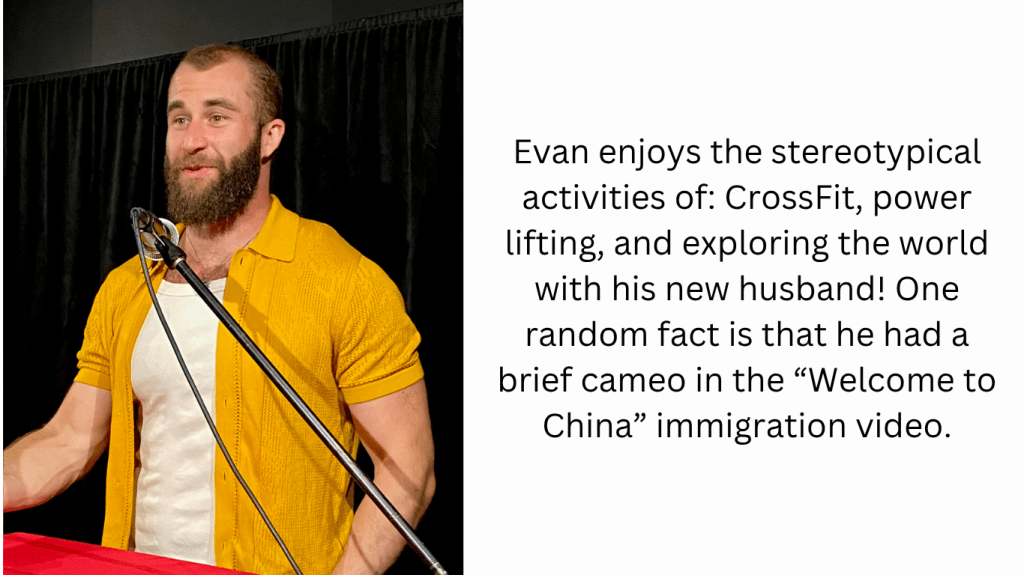
Pride!: Evan’s Story

When I came out almost 10 years ago, I could never have anticipated the journey that would lead me to my life partner. Let alone expect to be someone’s husband, for the past 30 days. As I stand here today, I am grateful for every minute of it, even the hard parts. I’m thrilled to say that the most wonderful man, to quote Beyonce, put a ring on it. Technically, we both did… Happy endings aren’t just for bathhouses. I’d like to take a few minutes to tell you about our recent wedding and elopement.
Our relationship, while, of course not perfect, has been relatively smooth when it comes to planning things: since I like doing all general planning things and Parm is extremely detail-orientated. I ride the hot-mess ADHD express and lose my dopamine rush when it comes to the more precise points. It’s truly a great match to have planning a vacation, moving apartments, redecorating, but when planning a wedding it can be a blessing and a curse.

Parm and I got engaged December 2023 and since we’re both planners we wanted to have a long engagement to make sure we had adequate time to plan things out. A quick backstory on how we got engaged. I decided to surprise him on our anniversary, since Parm hates surprises. It was the one way I could ensure he wouldn’t be suspicious I was planning something. I had tried, and failed, to surprise Parm a few times. I thought It would be a good idea to take him to high tea, after he was at the gym in street clothes, and was underfed from a leg day.  For the proposal, I tried to keep the destination a secret. But who would have thought he would’ve figured out I was taking him to Circle Wellness on Granville Island of all places. On the walk to where I had arranged his friends to meet us, Parm launched into a diatribe about why I shouldn’t try and surprise him anymore. Mainly since he wanted to know the plan to be mentally prepared and be properly dressed for the occasion. All I could think of in the back of my mind was, oh boy, you’re in for one major surprise in 5 minutes

Going back to wedding planning, one of the greatest strengths I’ve learned since coming out is that there isn’t a “right” or “normal” way to be queer. So many social norms and expectations are shed when we come out and start living as our queer, authentic selves; especially when you enter a relationship. In gay relationships, nothing is assumed. You must clearly and openly communicate your roles, your responsibilities, and expectations. When Parm and I moved in together, we had to discuss how laundry, cooking, cleaning worked.
When we were planning our formal wedding, we had to figure out how walking down the aisle would work. If we wanted to include gendered cultural wedding traditions, how that would work. Being able to define all these things on our terms was (and is) a powerful thing, and I hope the same intentionality and partnership starts to show up more in hetero relationships. Be open and communicate what works for you as an individual and as a couple, and don’t just assume your role based on gender. We initially had a the “big white wedding” planned. Well, maybe not big, since we had capped it at 80 people. And maybe not all that white, since Parm has a big Indian family.

We were excited for our formal wedding here in Vancouver and placed the deposit for our dream venue, but as the time started coming closer to actually need to put pen to paper, we just weren’t excited at the idea. It just seemed like work and didn’t really feel like us. We toyed with the idea of eloping, at first here in BC, by doing a helicopter wedding to ensure none of our family could sneak in. But we had already planned on doing a honeymoon… before our wedding I may add, in the Faroe Islands and Mallorca. Why were we going to the Faroe Islands? Parm had seen it and wanted to explore it for it’s beauty. I wanted to go because there was a sweater shop I wanted to go to. Parm had an excellent idea to have our elopement in the Faroe Islands since the nature is beautiful and dramatic.

We cancelled our Vancouver wedding and instead carried out our plan to do our wedding there. And it was the best decision that we could’ve made. But first we had to make it legal and literally got married in slippers and bathrobes here in the West End. We forgot to give our officiant a heads-up, so she was a little surprised. It was unapologetically us. We love to travel, we love going to random places, we love hiking and nature, and we love doing things differently. We spent the whole day exploring the country with a local photographer, who proclaimed that five tourists at a site was “busy”.  We think he would have an aneurysm seeing the steam clock crowds in summer…
We did everything that we loved. We explored a small picturesque town with colourful houses. Went to a waterfall and scaled the rocks in dress shoes. Did our vows in the rain. Got, possibly a top-10 burger, at a gas station. And ended the day doing a hike in our tuxes to see one of the most beautiful parts of the Faroe Islands, Traepania, Where there is a lake above the ocean, backdropped by sheer cliffs. We were tired, muddy, and had our wedding night back at the hotel, lying in bed with pizza. In short, we wouldn’t have done things any different, and it was a perfect wedding day.

I’m just so happy that Parm is the person I got to marry. The full story of how we came together is a story for a different day, but I initially tried to push him away.  I had come out of quite a toxic relationship and wasn’t ready to date. He actually went on a few dates with my ex and pieced it together by the missing furniture in our respective apartments. Needless to say, he learned that I wasn’t the crazy ex.
In spite of all of the emotional push and pull (and the occasional self sabotage, of course) Parm stuck by my side. He gave me endless patience, a safe space to be irrational if I was spiralling while trying to process my trauma, and showed me that not everyone is out to get me. That I could feel safe enough to trust someone again.
I’m looking forward to building a life together and this next chapter is just the beginning. I’m just excited to be writing this one together as husband and husband.

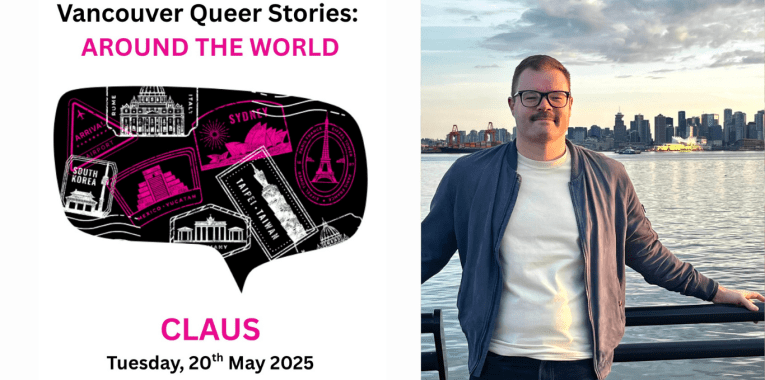
Around the World: Claus’ Story

I fell in love in Paris.

I know, what a cliché – guy goes to Paris, and falls in love. But I couldn’t help it. Falling in love isn’t really something that you do. It’s something that happens to you.

The year was 2008, and this was my first trip ever outside of North America. It was also the first time I had ever travelled on my own, and with my inexperience and terrible planning, I ended up with a 23-hour layover in the French Capital. My budget was too low to pay for a hotel, so my plan was to spend that time at the airport… but after one hour of doing Sudoku, I was bored.

Courageously, I took the train to the city — where I managed to get stuck overnight, because I was under the mistaken impression that Paris was a 24-hour city, with 24-hour trains. Remember, smartphones didn’t exist at that time, so travelling was much more difficult than it is today. Without these modern tools, I wasn’t able to find accommodation that didn’t cost hundreds of Euros. So, I spent the night outside, half-sleeping, freezing, and scared, at the Champ-de-Mars park overlooking the Eiffel Tower — but that’s a story for another day.

Before I got stuck overnight without a hotel, I found myself roaming through the various neighbourhoods of Paris, with a heavy backpack and beautiful shoes that left my feet full of blisters. I walked all over the city, admiring its riverside banks, it’s palaces, and parks. I saw the Eiffel Tower, and the Notre-Dame Cathedral, and I had a subpar coffee with one of the best pain au chocolat I’ve ever tasted. And then, I made it all the way to the Montmartre neighbourhood, and there she was.

Beautiful and grand, tall and statuesque — commanding the attention of everyone around her. She stood there, looking out over a picture-perfect panorama of Paris from the top of the hill of Montmartre. The late afternoon sun reflected off her flawless fair skin, illuminating every one of her features so beautifully, that they seemed to come to life. Her curves, perfectly symmetrical, made to be admired. She was ageless, despite having been 94 years old at the time. 

By now you probably have realized, I hope, that I’m speaking about a building. But not just any building: The Sacré-Cœur Basilica, the most beautiful piece of architecture I’ve ever laid my eyes on. It was love at first sight, and from that moment on, I told —half jokingly— to everyone that would listen, that if anyone ever proposed to me, I wanted it to be there, at the Sacré-Cœur.

Fast forward to 2019, more than a decade after I first laid eyes on her, and three visits later. By then, I had been with my partner Eamonn for four years, and we were in the midst of planning a trip to the Balkans when he suggested: “Why don’t we do a stopover in Paris on the way there?” Just a quick one night stop, to see the sights, and visit friends.

“Oh my god,” I thought to myself. “This. is. it!” 

To be perfectly honest, I had never really cared about marriage before. It wasn’t that I didn’t want to get married. I simply didn’t care either way. But at that moment, I actually started to think, “he is the right person, so why not?”

We stayed with our friends, who conveniently lived in the Montmartre district. On our first night, we enjoyed dinner and a couple of bottles of red on the patio of a wine bar with them. The next day, Eamonn and I set off to wander alone. We walked along the cobbled stone streets of Montmartre, through alleys filled with cafés and boulangeries, and finally, to my old Parisian fling: the stunning Sacré-Cœur Basilica, looking as beautiful as she had one decade earlier.

It was the middle of summer and the crowds of tourists were thick around us. Eamonn led the way, as we circled the basilica. This way, then that. We walked down the steps to the bottom of the hill, the Sacré-Cœur looking down at us from its summit, her white domes resplendent under the August sun. Eamonn was clearly looking for the perfect spot to propose. He looked nervous. I was nervous, too, wondering how I should react when the moment finally came — should I act surprised? Should I admit that I was expecting it? Or would an unplanned emotion take over?

After some time, a selfie or 10 later, Eamonn suggested we grab a beer with a side of espresso (the Paris way) at the Café des Deux Moulins, famous for appearing in the film Amélie. We sat at the café, and the whole time, in the back of my mind, I kept wondering when the moment would come. And finally, after paying for our beers (with a side of espresso), Eamonn finally said: “We should get going, we have a train to catch.”

And so, we left Paris —and the Sacré-Cœur— behind. The romanticized idea of our imaginary engagement dissolving as the train pulled further away from the city.

But worry not, dear listeners, because this story has a happy ending.

Less than two weeks later, in Slovenia, we planned a day trip from Lubljana to Lake Bled. After spending the morning walking around the lake, admiring the stunning scenery that surrounded us, Eamonn suggested we hiked up a hill to what he described as a “famous bench.” I was surprised, as I am the more-enthusiastic hiker of the two of us. 

It was a hot day, in the mid 30s, when we embarked on an uphill trajectory through a dusty path in search of this bench. The vegetation was too sparse to provide us any shade, but I persevered, unsure of what our final destination was, and completely unaware of what was coming next.

Finally, we got there. The bench: meh. A standard park bench with no redeeming features. But the view. I’m not exaggerating when I say it is one of the most beautiful vistas I’ve ever seen, to this day. The expansive Lake Bled below us, with its many shades of turquoise, and blue, and green. An island in the middle of the lake with a church rising from it. The mountains all around us, lush with vegetation, extending as far as the eye could see. And atop one of the mountains, on the opposite side of the lake, a castle. A view taken right out of a fairytale, made all the more beautiful under a blue sky splattered with white cotton clouds, and the love of my life by my side.

We caught our breath from the hike (and lost our breath to the views), and after some time, we sat on the so-called-famous bench. And suddenly, the words fumbled out of Eamonn’s mouth: a not-so-romantic speech that included something about “finalizing the contract” and “this seems as good a time as any.” 

In his hands, a silver ring. An Irish Claddagh, with its iconic design featuring two hands, symbolizing friendship. A heart, for love. And a crown, for loyalty. 
And around the length of the ring, a Celtic knot, to represent eternity.

I fell in love in Paris, and the Sacré-Cœur will always have a special place in my heart. But nothing could compare to the perfect moment that had me saying a resounding “yes, yes, yes,” before Eamonn could even ask the question.

Around the World: M.’s Story

Okay, so this story takes us back to 2015. I was just 18, still a student at AUB, which is basically the UBC of Beirut, where I’m from. But instead of being half an hour away from downtown, it’s literally in downtown. Picture a university inside Stanley Park.

Back then, I was still closeted — obviously living with my parents — and I used to drive to university every morning. And, like many gay men in the Middle East, I had Grindr. Because let’s be honest, that was the gay community. There were very few queer events or hangouts, just a bar or two… but mainly, a grid of torsos and chaos.

And that’s where I met Julien. French guy, blonde, older. In Beirut for a few days. Very much giving “European tourist with a tote bag and a mysterious backstory.” He told me he was travelling through French-speaking countries writing a book — which, at the time, sounded super fake; but he was still hot, so I didn’t question it.
I tapped him. He tapped me. We chatted. And we decided to meet up for coffee on campus, like respectable homosexuals. I picked him up, gave him a little tour of AUB, and also showed him around the city in my car, which honestly made me feel so cool. Like, I was 18! Driving this charming older French man around Beirut like it was nothing. I was glowing. Walking a little faster. Laughing a little louder. You know the vibe.

That night — the same night we met— he ran into a little problem. His iPhone locked him out. Completely. He kept saying, “I’m sure I’m typing the right code,” but his phone was like, “Nope. Try again in 3 days.” If you know, you know.
So now he’s in Lebanon, with no Google Maps, no contacts, no apps. Not even Grindr. Dark, dark times.
Buying a new phone? Too expensive. Renting one? Is that even a thing? And that’s when I saw my little gay moment to shine — not to impress, but to be useful. I told him, “I actually have a second phone; you can use it while you’re here. I’ll bring it tomorrow.”

It wasn’t a flex. It was just something I could do… so I did.

Now, everyone I told thought I was absolutely out of my mind.
“He’s going to disappear with your phone.” “It’s a scam.” “He does this in every country.” But honestly? I trusted him. I don’t know why. Maybe I was being naïve. Or maybe I just liked the way he said merci.

We saw each other a couple more times after that. Nothing major (okay, we fooled around a bit). One thing that I remember, that makes me cringe so hard, was this moment when I asked him, very stupidly, if he had downloaded Grindr on the phone. And of course, he had. And I was like, “…oh.
He explained that Grindr was how he met people when he travelled. At the time, I didn’t really get it. To me, Grindr was still this secret, shameful hookup thing. But now? I mean… most of my friends today? I met them on gay hookup apps.
So… yeah. Julien was ahead of his time; or at least ahead of mine.
Before he left, Julien gave me back the phone and thanked me. Said his trip would’ve been totally different if he hadn’t met me. And that meant something. It made me feel kinda special — like I had made a little mark on someone’s journey.

We kept in touch here and there. He only messaged me in French — partly because his English wasn’t great, and partly because he’d say, “tu dois pratiquer.” Little did I know, my French skills helped me get my PR in Canada 10 years later.
And for a long time, I really thought that was it. A sweet little story. I didn’t expect to see him again.

But then, seven years later, I visited France for the first time. I messaged him, just to say hi. “Hey… I’m coming to Paris.” And he replied immediately: “Let’s meet.”
And just like that, we did. He showed up on a bicycle — of course he did — looking older than I remembered. More silver in his hair. Definitely giving daddy energy. And if you know me, you know that’s very on-brand.

This time, it wasn’t flirty. It was just… really lovely. We spent a few days together, and it honestly felt like picking up a thread from a story I thought had ended. He showed me around Paris like a true local. We vibed, got a little drunk, had the best time. He took me to beautiful theatres, gay bars, this riverside queer spot called Rosa Bonheur — which is basically the Paris version of Birdhouse. If you ever visit, highly recommended.

And on my last day there, we took the train to Versailles to go to a theatre festival — because I’m a theatre gay, obviously. We wandered through the gardens with some strawberries and a bottle of bubbles, because in France, you can literally just crack open a bottle of wine in public, and it’s totally normal. We had this quiet, beautiful day, just the two of us. And I don’t know, there was such a strong connection between us. And if you’re wondering: no, nothing happened. He had a boyfriend, not that this ever stopped anyone. But honestly, nothing needed to. The vibe was there. That was enough.

And of course, the trains back got cancelled. So, we had to navigate this maze of night buses, switching lines, figuring it all out. I would never have made it back alone. So I guess we’re even now: I gave him a phone in Beirut, and he got me home in Paris.
On the way back to Paris — after running around trying to figure out which random village bus was actually going back to the city — we were both exhausted. Sitting there in silence, half-delirious, half-relieved that we even made it onto the right bus.
We both kind of knew this was the last time we’d see each other before I left. 

And somewhere between stops, Julien turned to me and said, “By the way… I mentioned you in my book.”
And I was like, “Wait — what book?” I had totally forgotten that he was even an author.
He smiled and said I was one of the memorable friendships he made along the journey of writing it. Just a small mention, nothing dramatic. But still — it really hit me. Like… damn. I actually meant something to this person.

We still talk sometimes. Send each other voice notes. He still corrects my French grammar like it’s his life mission.

And that’s my story. A little Grindr match in Beirut. A train ride from Versailles. A mention in a French linguistics book. Nothing dramatic. Just one of those rare, quiet connections that stick with you — even when you know you probably won’t cross paths again.

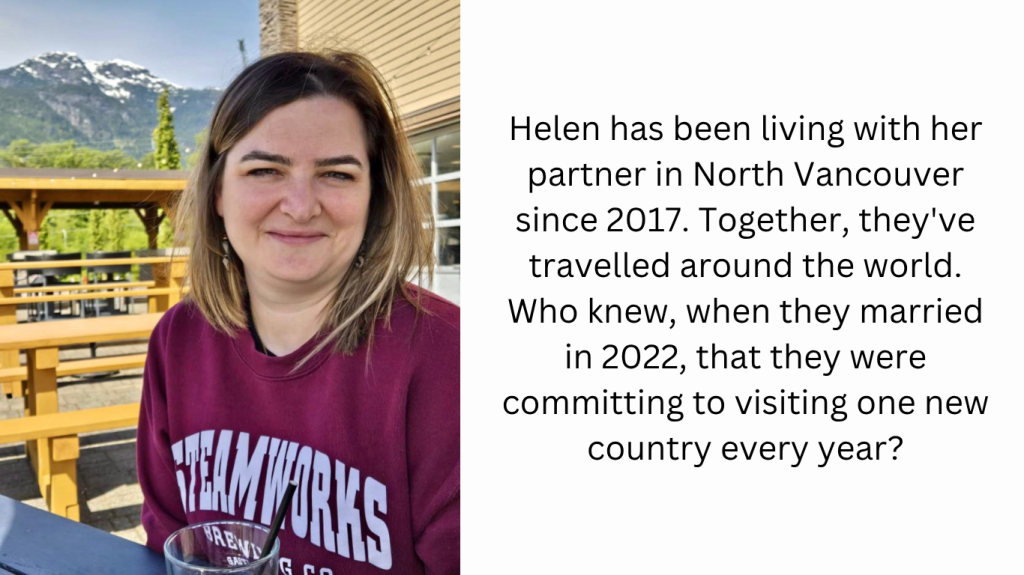
Around the World: Helen’s Story

There’s something you need to know about me before I tell this story: when I’m not writing travel tales for Vancouver Queer Stories, I moonlight as an Anglican priest. No, seriously, I’m ordained, and it’s taken me to some incredible places. I want to assure you that I’m not here to preach a sermon: I’m here to tell you about the time I travelled to the Northern Philippines, and, on the first day, promptly and irreparably broke the toilet. 

I awoke on that fateful day to the sound of rush-hour traffic. I had slept well after a 12-hr bus ride, which involved 40 degree heat, views of the renowned rice terraces (a UNESCO World Heritage Site), and roads which were under construction following a recent earthquake. As I was getting ready for the day, I finished showering, did my business, and prepared to flush the toilet, manually.
I had done my research, you see. I was well aware of the adjustments we’d have to make while in the Philippines. I knew how to deal with foreign plumbing—bucket style. I filled up a nearby trash can with water from the sink. I tossed it with great force into the toilet like I’d been shown—on YouTube.
When I was unsuccessful, I rolled up my sleeves and thought to myself, “I know how to fix this.”

I took hold of the porcelain lid and removed it from the tank. I felt the thin layer of condensation that had settled on its surface. It felt slippery between my fingers, like, well, like you would expect a porcelain toilet lid to feel.
As my palms reached for the edges, my fingers spread easily over the lip, and just when I thought I had hold of it, like an angel dressed in white taking flight, or a white-robed resurrected Jesus bursting forth from the tomb, the toilet lid shot into the air—set free from my grip. It landed on the floor—smashed into a thousand pieces. I followed suit shortly thereafter.

So, I did what any self-respecting person would do in a situation like this. I picked up the pieces, one by one, and hid them in my suitcase, in a bag that I would later dispose of when no one was looking. But, there was still a terrible mess and after labouring on the bathroom floor for hours (let’s be real, it was five minutes), I admitted defeat and made my way down to the lobby to plead my case with the hotel manager.

As I left my room, though, there was my colleague: the Executive Archdeacon, the Venerable Father Arnold Graystone. He was seated on the balcony, hands clasped, eyes closed, deep in prayer. I tip-toed my way towards the stairs.

“Good morning, Mother,” he said.
“Good morning, Father,” I chimed.
“Everything alright with the room?”
The story came tumbling forth, my words as hurried and fragmented as my attempts to clean up the porcelain pieces from the bathroom floor.
“Well, you’d better go down and have a word with the manager, haven’t you?” he said.
(Yes, I’d better go down and have a word with the manager, haven’t I?)

I made my way to the main floor and greeted the manager.
“I have some very bad news,” I said.
I pulled up a photo on my phone. She nodded and gestured to one of her sons. I began to apologize profusely. I insisted on paying for the damage. I asked if I could take a mop and clean it up myself. She smiled and pointed to a stack of porcelain lids in the back room.

“We have extras,” she said, “because of tourists, like you.”
I thanked the manager, and turned to make my way upstairs.
“One more thing,” she said.
“Next time, ma’am, just press the button. The toilets are automatic.”

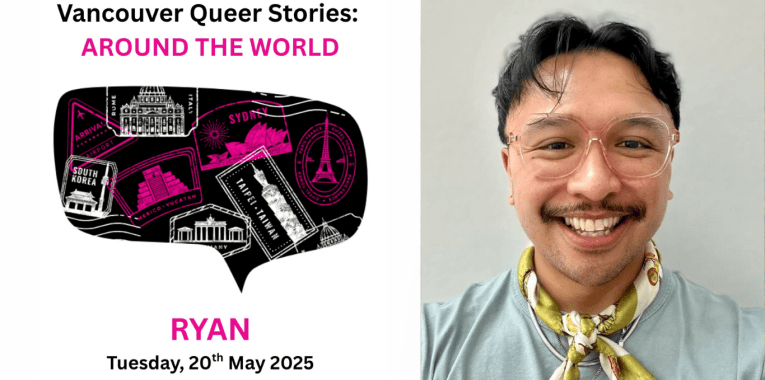
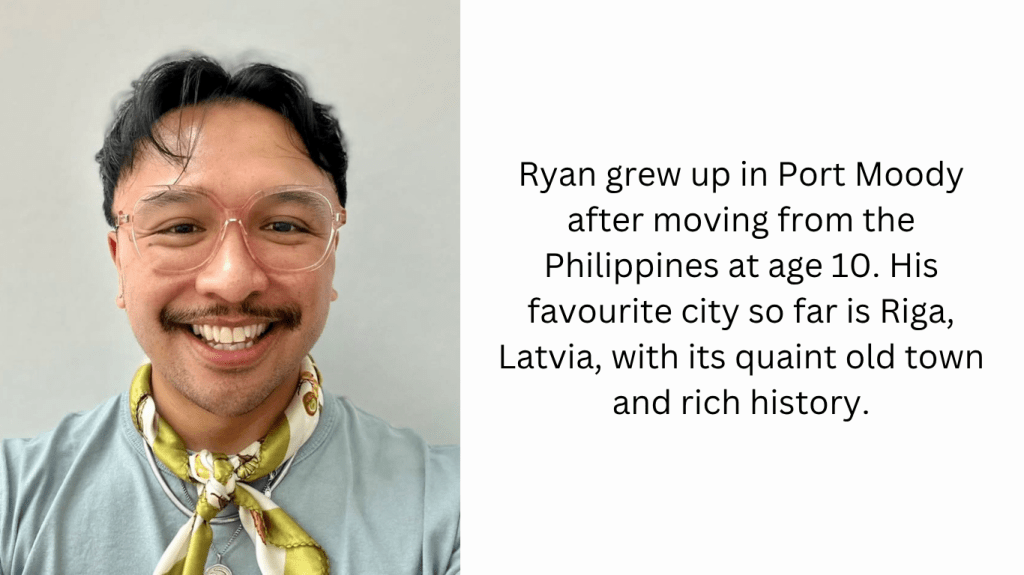
Around the World: Ryan’s Story

I used to think identity was something I had to wear like a badge.
Queer.
Person of Colour.
Canadian.
A neatly folded résumé of who I was supposed to be before anyone even knew my favourite food or how I take my coffee.

In Vancouver, I could feel the labels arriving before I did.
Like I walked into the room after my own footnotes.

But then I left.
Packed two suitcases and a nervous heart, and landed in Berlin —
a city colder than I expected, stranger than I imagined,
and somehow, freer than I’d ever known.

No one knew me there.
Not the barista who handed me my first Latte Macchiato with a crooked smile, not the cashier at Rewe who tossed my groceries with zero small talk, not the friend-of-a-friend at a Kreuzberg Altbau party who didn’t ask “where are you really from?” Or “what do you do for work?”
just asked, “what’s your sign?”

I said Cancer.
They said, “figures.”

And just like that, I wasn’t explaining myself.
I was just existing.

Berlin didn’t care what box I fit in.
It didn’t ask me to choose between my softness and my strength.
It didn’t ask me to be a role model or a symbol or a teachable moment.
It just asked me to be.
To show up.
To dance to pop EDM remixes in Schwuz or twerk at a Latin party in Lido.
To get lost on the winding Straßes.
To survive on Simit, Franzbrötchen and Club Mate.
To fall in and out of routines, and sometimes out of love.

And so I travelled.
Not just through Europe —
though yes, I did float through Stockholm,
sweated under the Barcelona sun,
and blinked at the beauty of Prague’s cobblestones at midnight —
but I also travelled through versions of myself.

The me who stood silently in museums.
The me who laughed too loudly in the S-Bahn.
The me who forgot to be afraid.
The me who wasn’t performing — wasn’t on display —
just living.

See, travel doesn’t just teach you about the world.
It teaches you about who you are when no one’s watching.
When there’s no audience.
No expectations.
No need to explain your history to justify your presence.

In Berlin, I was “the Canadian,” sure.
But that wasn’t code for “outsider.”
It just meant, “you’re not from here, but neither are we.”
I was allowed to take up space.
To make mistakes.
To speak German badly.
To start again.

And maybe that’s what travel gave me most —
the gift of not being anyone’s definition but my own.

In Vancouver, being queer and a person of colour was often the first thing.
Before my name.
Before my jokes.
Before my energy even had a chance to walk in the room.

But in Berlin, in those trains and cafés and moonlit strolls along the Spree —
I got to be just Ryan.

Not reduced.
Not erased.
Not tolerated
But revealed and accepted.

Because I am queer.
I am a person of colour.
And I’m also tender, and smart, and sometimes a little too dramatic.
I wear sheer shirts and glitter nail polish.
I write poems, I’ll never show anyone.
I miss my dog when I’m gone too long.
And I love citrus scents like they’re a personality trait.

And that — all of that — is who I am.
Not a headline.
Not a box.
But a body in motion.
A soul in translation.
A person in process.

Now I’m back.
Different city, same name.
Still me — but expanded.
And when I walk into rooms now, I don’t shrink.
I don’t lead with the résumé of what I am.
I just say, “Hi, I’m Ryan.”
And let the rest unfold.

Because travel didn’t change who I was.
It just reminded me I didn’t need to prove it.

So if you ever feel like you have to explain yourself before you’re allowed to be yourself,
if you ever feel like the world only sees you in fragments — go.
Even if it’s not far.
Even if it’s just to the next town over, or the next friend’s couch.
Find the place where your name is enough.
Where you don’t have to be a statement.
Where you’re not reduced to your resistance.

Find your Berlin.
And then bring it back with you.
Wear it like a soft hoodie.
Speak it in the way you order your coffee.
Live it in the way you look people in the eyes when you say:

“Hi. I’m not here to explain. I’m here to exist.”
Just me.
Just Ryan.

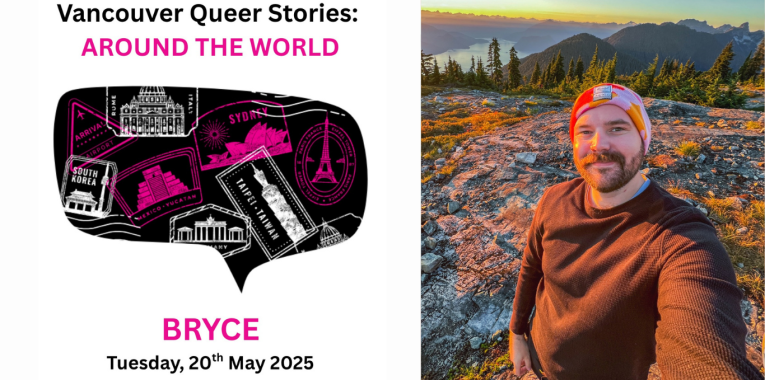
Around the World: Bryce’s Story

Let me take you back.

I was 18. That magical age where you think you’ve got it all figured out, but you still call your mom when your laundry turns pink. I had just hit that point in life where everything in my hometown felt too small. The streets, the routines, the same familiar faces. It was all closing in on me.
I needed space. Air. Maybe even some chaos. So, I packed up my car—if you could call it that. It was more of a metal box with an engine and a slight identity crisis. No GPS, no credit card, barely any cash, but a lot of heart.
I didn’t even tell many people I was leaving. I just drove west and decided I’d figure it out on the way.

When I got to Vancouver, I had exactly zero plans. Zero housing. Zero resources. But I had arrived, and that felt like… something?
I found myself driving around Stanley Park. I’d never seen anything like it. There were trees that made my little car look like a toy. Water that sparkled like it was auditioning for a movie. And people, jogging like they actually enjoyed it.
I parked and sat in silence for a bit, pretending this was all part of some Eat, Pray, Love moment. In reality, I was stalling because I had nowhere else to go.
That night, I curled up in the driver’s seat, hoodie rolled up as a pillow, trying to convince myself it was an adventure. The air was damp. The windows fogged up. But hey, I was free… right?

By morning, my back felt like it had aged 50 years, but I was still in one piece. I took that as a win. I stretched out, rubbed my eyes, looked out across the park and said, “Okay, day one in the big city—let’s do this.”
I drove into downtown. The city was buzzing: there were bikes, buses, beeping horns, neon signs. And somehow, every single person seemed like they had somewhere important to be.
Except for me, that is. But I didn’t want to look like an outsider, so I did what any self-respecting newcomer would do: I pretended. I adjusted my sunglasses. I leaned back like I knew where I was going. I even nodded at the people on the street, like I was one of them.

And then I saw it: a street that looked like it led somewhere cool. Brick buildings, people walking dogs, some artsy-looking cafés. Perfect. So I went for it.
Left-hand turn. No big deal.
Except, within seconds, I realized… big deal.
Because coming directly toward me, fast, was a silver Audi R8.
I froze. Like, full-body, “brain not working,” kind of frozen.

There are moments in life where time slows down. Where everything gets very clear, very fast. This was one of those moments.
I could see the grill of that car. The expression on the driver’s face (equal parts confusion and rage). And even the little sunglasses dangling from his rearview mirror. That man had money—and zero patience for a kid in a $2,000 car, going the wrong way.
I heard honking, shouting. I saw people on the sidewalk point at me like I was some kind of public safety demonstration. One guy just shook his head, like I’d personally disappointed him.

I did what my instincts told me to do: I cranked the wheel and swerved into the nearest side street—right past a massive green dumpster.
Parked—slammed my car into park. And just sat there.
I was shaking. My face was hot. I felt like I’d just survived an extreme sport, except the only thing I’d done was make a left turn.

And then the thoughts came, one by one, loud and clear:
Did I actually just do that?
Am I still alive?
Is it too late to move back home?

I slumped down in my seat, like hiding would help. I was parked beside literal garbage, and somehow it still felt like a step up from what had just happened.
I remember looking around to make sure no one had followed me; as if the Audi guy was going to chase me down, and hand me a bill for emotional damages.

Eventually, the adrenaline wore off, and something strange happened: I started laughing. Like, really laughing. The kind of laugh that starts as a nervous giggle and then snowballs until your stomach hurts. Because in the grand scheme of things… it was kind of hilarious.
I had survived my first real Vancouver experience. Not a sunset on the seawall. Not a cozy coffee shop moment. But a full-blown, wrong-way-down-a-one-way-street near-death experience.

Over time, I got better. I learned the roads. I found a place to live. I even got a credit card—with a limit so low, it was more symbolic than useful, but still. I figured it out. But I’ll never forget that feeling—of being completely out of place, completely lost. And somehow still okay.

And that, my friends, is how I learned about one-way streets.
Not from a sign. Not from a city tour. Not even from Google Maps.
No, I learned about one-way streets the old-fashioned way:
With fear. With adrenaline.
And with a luxury car speeding directly at my face.