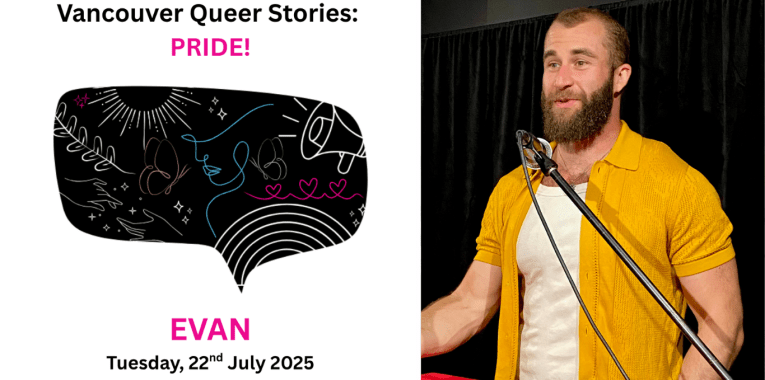
Pride!: Evan’s Story

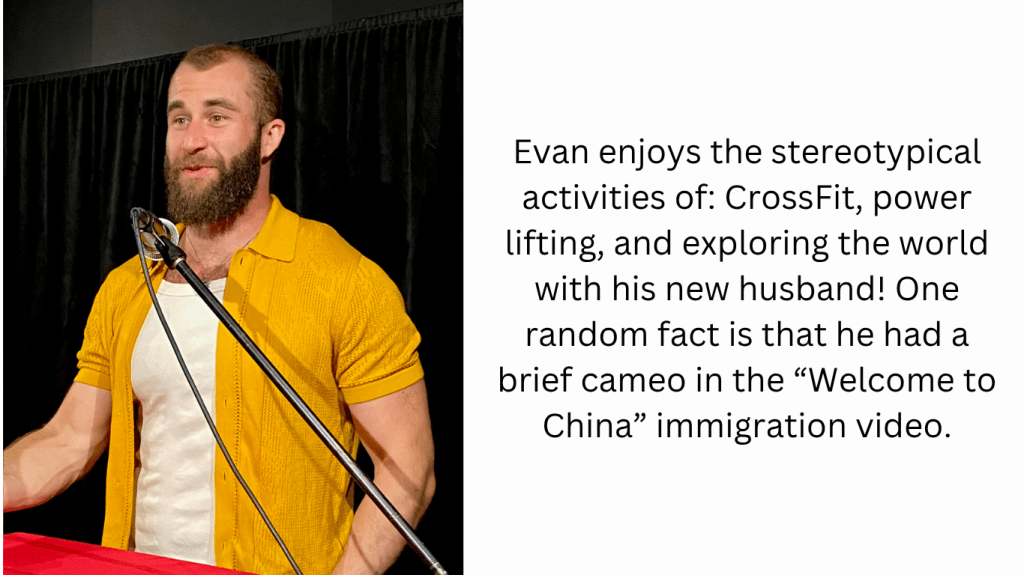
When I came out almost 10 years ago, I could never have anticipated the journey that would lead me to my life partner. Let alone expect to be someone’s husband, for the past 30 days. As I stand here today, I am grateful for every minute of it, even the hard parts. I’m thrilled to say that the most wonderful man, to quote Beyonce, put a ring on it. Technically, we both did… Happy endings aren’t just for bathhouses. I’d like to take a few minutes to tell you about our recent wedding and elopement.
Our relationship, while, of course not perfect, has been relatively smooth when it comes to planning things: since I like doing all general planning things and Parm is extremely detail-orientated. I ride the hot-mess ADHD express and lose my dopamine rush when it comes to the more precise points. It’s truly a great match to have planning a vacation, moving apartments, redecorating, but when planning a wedding it can be a blessing and a curse.

Parm and I got engaged December 2023 and since we’re both planners we wanted to have a long engagement to make sure we had adequate time to plan things out. A quick backstory on how we got engaged. I decided to surprise him on our anniversary, since Parm hates surprises. It was the one way I could ensure he wouldn’t be suspicious I was planning something. I had tried, and failed, to surprise Parm a few times. I thought It would be a good idea to take him to high tea, after he was at the gym in street clothes, and was underfed from a leg day.  For the proposal, I tried to keep the destination a secret. But who would have thought he would’ve figured out I was taking him to Circle Wellness on Granville Island of all places. On the walk to where I had arranged his friends to meet us, Parm launched into a diatribe about why I shouldn’t try and surprise him anymore. Mainly since he wanted to know the plan to be mentally prepared and be properly dressed for the occasion. All I could think of in the back of my mind was, oh boy, you’re in for one major surprise in 5 minutes

Going back to wedding planning, one of the greatest strengths I’ve learned since coming out is that there isn’t a “right” or “normal” way to be queer. So many social norms and expectations are shed when we come out and start living as our queer, authentic selves; especially when you enter a relationship. In gay relationships, nothing is assumed. You must clearly and openly communicate your roles, your responsibilities, and expectations. When Parm and I moved in together, we had to discuss how laundry, cooking, cleaning worked.
When we were planning our formal wedding, we had to figure out how walking down the aisle would work. If we wanted to include gendered cultural wedding traditions, how that would work. Being able to define all these things on our terms was (and is) a powerful thing, and I hope the same intentionality and partnership starts to show up more in hetero relationships. Be open and communicate what works for you as an individual and as a couple, and don’t just assume your role based on gender. We initially had a the “big white wedding” planned. Well, maybe not big, since we had capped it at 80 people. And maybe not all that white, since Parm has a big Indian family.

We were excited for our formal wedding here in Vancouver and placed the deposit for our dream venue, but as the time started coming closer to actually need to put pen to paper, we just weren’t excited at the idea. It just seemed like work and didn’t really feel like us. We toyed with the idea of eloping, at first here in BC, by doing a helicopter wedding to ensure none of our family could sneak in. But we had already planned on doing a honeymoon… before our wedding I may add, in the Faroe Islands and Mallorca. Why were we going to the Faroe Islands? Parm had seen it and wanted to explore it for it’s beauty. I wanted to go because there was a sweater shop I wanted to go to. Parm had an excellent idea to have our elopement in the Faroe Islands since the nature is beautiful and dramatic.

We cancelled our Vancouver wedding and instead carried out our plan to do our wedding there. And it was the best decision that we could’ve made. But first we had to make it legal and literally got married in slippers and bathrobes here in the West End. We forgot to give our officiant a heads-up, so she was a little surprised. It was unapologetically us. We love to travel, we love going to random places, we love hiking and nature, and we love doing things differently. We spent the whole day exploring the country with a local photographer, who proclaimed that five tourists at a site was “busy”.  We think he would have an aneurysm seeing the steam clock crowds in summer…
We did everything that we loved. We explored a small picturesque town with colourful houses. Went to a waterfall and scaled the rocks in dress shoes. Did our vows in the rain. Got, possibly a top-10 burger, at a gas station. And ended the day doing a hike in our tuxes to see one of the most beautiful parts of the Faroe Islands, Traepania, Where there is a lake above the ocean, backdropped by sheer cliffs. We were tired, muddy, and had our wedding night back at the hotel, lying in bed with pizza. In short, we wouldn’t have done things any different, and it was a perfect wedding day.

I’m just so happy that Parm is the person I got to marry. The full story of how we came together is a story for a different day, but I initially tried to push him away.  I had come out of quite a toxic relationship and wasn’t ready to date. He actually went on a few dates with my ex and pieced it together by the missing furniture in our respective apartments. Needless to say, he learned that I wasn’t the crazy ex.
In spite of all of the emotional push and pull (and the occasional self sabotage, of course) Parm stuck by my side. He gave me endless patience, a safe space to be irrational if I was spiralling while trying to process my trauma, and showed me that not everyone is out to get me. That I could feel safe enough to trust someone again.
I’m looking forward to building a life together and this next chapter is just the beginning. I’m just excited to be writing this one together as husband and husband.

Pride!: Gerardo’s Story

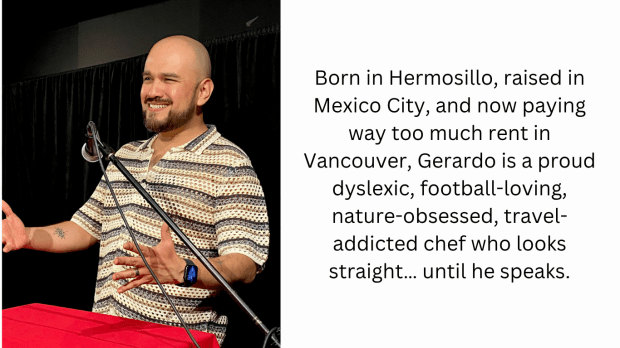
I was 15
when I came out of the closet…
and ended up on the street.

No applause.
No rainbow confetti.
No RuPaul track playing in the background like a fabulous gay fairy tale.

Just me,
a garbage bag of clothes,
a slammed door,
and a silence that hummed like heartbreak.

That was my welcome to being gay.

I was raised Catholic.
Not “Christmas and Easter” Catholic,
I mean full-blown confess-your-thoughts-about-Ricky-Martin Catholic.
Church every Sunday.
Rosaries.
Guilt… lots of it.

They told me to love God…
but not like men.

So I prayed. Hard.
To be “normal.”
To wake up with a sudden interest in boobs and dirt bikes.

I prayed so much,
I could do the Hail Mary in under 10 seconds,
blindfolded, while crying, and brushing my teeth.

But when I finally said the words,
“I’m gay,”
those prayers didn’t soften anything.

No angels showed up.
Only a mother with heartbreak in her eyes
and a “pack your things” on her lips.So I did.

Here’s the twist though:
I used to play football.
Yeah… cleats, tackles, full-on jock life.
And so did my first boyfriend.

We were teammates…
and then roommates.
And then, well,
boyfriends with shared trauma and a twin mattress.

When both our parents kicked us out,
we moved in together.
Two 15-year-old boys,
figuring out rent, ramen,
and how to hide tears in public bathrooms.

I lied about where we were living.
Said I was “staying with friends.”
Showed up to school like everything was fine.
Even when I was starving.
Even when everything hurt.

And that…
was my first taste of Pride.

Not the parade.
Not the glitter.
Not the glam.
But the quiet, stubborn kind.
The “I’m still here” kind.
The “watch me survive” kind.

In school, I got bullied.
They whispered “faggot” like it was a spell meant to vanish me.
And for a while… I did disappear.
Into myself.

Until one day,
I cracked. I got loud.
Got mean.
Got funny.
And accidentally became… a bully.

Because if I made you the punchline,
then I couldn’t be one.

And honestly?
Therapist says: iconic trauma, villain era.

But broken kids wear armour however they can.

In my 20s, I was a mess with Internet.
(Yeah, that one with the horrible phone sound.)
Terrible jobs…
Worse taste in men…
A strict diet of frozen pizza, mezcal shots, and red flags.

But I kept going.
Finished two degrees.
Opened my own little restaurant.
Not Michelin-starred…
but hey, the health inspector only gave us one warning. (Just kidding. Kind of.)

Safe.
Stable.
Mine.

Then one day…
a message.

From her.
My mom.

“I miss you. Can we talk?”

So we did.
We cried.
We screamed (in Spanish… very healing).
We listened.

She apologized.
I told her I was still hurt.
But we tried.

Slowly,
we learned each other again.
Found love in the wreckage.

And now?
Now I’ve got something 15-year-old me never dreamed of…
I’m married.
To a man who makes me laugh,
makes me coffee,
and makes me feel safe in a way I didn’t know men could.

And yes…
my mother walked me down the aisle.
She cried.
I cried.
Even the DJ cried.
(It was Madonna’s “Like a Virgin…” who doesn’t cry at that?)

So yeah,
I’m proud.

Proud of the pain I survived.
Proud of the boy who didn’t disappear.
Proud of the man I became…
with jokes, scars, and a hell of a lot of glitter.

Pride isn’t just a parade.
It’s not just drag and disco (although… bless those queens).
It’s surviving.
It’s forgiving.
It’s calling your mom after coming out…
and knowing she’ll answer.

It’s saying,
“This is who I am,”
and not flinching anymore.

I used to kneel in church,
begging God to fix me.

Now I stand up tall,
husband by my side,
knowing there was never anything broken to begin with.

And bro…
no slammed door,
no whispered slur,
no prayer for “normal,”
will ever make me doubt my pride again.

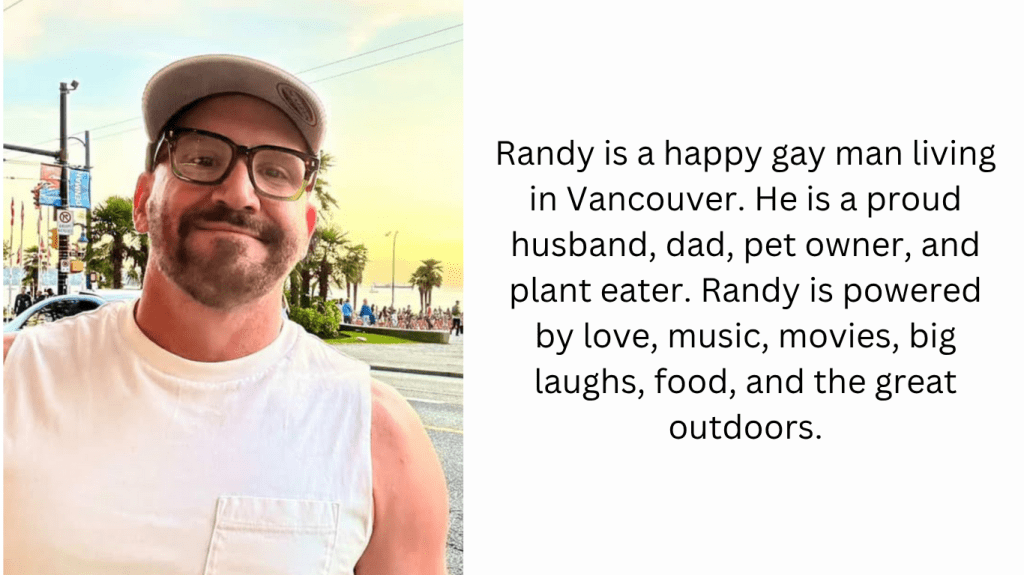
Pride!: Randy’s Story

From as far back as I can remember, self-confidence, and feeling a general sense of pride, has been a challenge for me. As a skinny kid growing up in East Vancouver, I was vaguely insecure and slow to make friends. By the time I became a teenager and became aware that I was gay, the sense of feeling different or “other” did nothing to improve my self-image. 

When the mid-’80s hit, and I was at an age where coming out as gay was even a remote possibility, the AIDS crisis was full-blown. This increased the homophobia in the world, and in the home I shared with my family– not to mention my insecurities and fears. I didn’t come out as a gay man until my late 20s, and I did not do so with a sense of celebration or liberty, but with fear and uncertainty. Feeling a sense of pride about myself as a gay man was still a long way off.

In the new millennium, I did some hard work with a fantastic gay psychologist who helped me significantly in unpacking and understanding my fears and feelings. This increased my need to connect with other gay men, so I decided to be brave and open myself up to as many coffee and/or dog-walking dates with eligible men as I could fit into my schedule. The bar scene wasn’t my thing, so this seemed like a good way to go, as I am fairly confident in a one-on-one setting. My thinking was that every date could be a) a friend, b) a romantic connection, or c) a fascinating and eye-opening experience. I used a pre-smartphone online dating service called Lava Life, and I let everyone in my life know that I was open to being set up for blind dates as well, even if the only reason that they might think that me and the other person would be a match was that we were the only two gay men they knew. It was a busy year, which ultimately felt like a series of job interviews. But by the end of year one of my power-dating marathon, I was lucky enough to have met Drew, the man who would become my husband.  

At the time, he was living life as a hippie on Pender Island. We connected online, by phone, and eventually in person. A few months later, he moved to the Lower Mainland, and we saw each other regularly. He was handsome, kind, funny, smart, and a good kisser. So, why was I dragging my feet? I told him directly one night that I had no idea why I wasn’t in love with him. After some mutual tears, a week’s time, a huge bouquet of flowers, and a lot of personal introspection, I realized that I was sure that he, like most gay men, would deceive me, hurt me, and disrespect me in some way. This came from a few past experiences, but mostly some homophobia that had built up in me over the years, via my parents, and possibly TV & film. It shouldn’t take the approval of friends to convince me to give him a fair chance, but the unanimous approval of him from my social circle was highly influential. From that point on, I jumped in with both feet, and not a day has gone by when I wasn’t sure that I made a great choice. Choosing to be with this wonderful man is the best decision I have ever made.

Drew and I were very much in love and wanted the same things out of life and out of our relationship. This marked the first time I felt a sense of pride as a gay man. A big part of that was my joy at having found someone whom I loved and wanted to be with, and who loved and wanted to be with me, too. I felt proud to let the world know who my wonderful partner was, and that we were together.
A few years later, we were married and were lucky enough to welcome a newborn baby boy to our family. We were very visible wherever we went, and this felt amazing to me. As a family, we were as out and proud as we could be – we were part of several documentaries about gay dads, and also a real estate reality show on HGTV. We spent the next 15 years or so living a fairly heteronormative life, and tended to surround ourselves with couples with children. We therefore had very little contact with the gay community.

About five years ago, when our now-teenaged son wanted very little to do with his dads, and we were called upon to do much less parenting, we decided to address the fact that we had almost no gay friends. I didn’t fully understand it at the time, but I was really craving having people around me who I could relate to on many more levels than I do with my straight friends. It was both exciting and scary, but I felt very motivated to find my place in the community. I dove in headfirst, finding connections through social media, and then through the gay softball league, and ultimately, socializing at local gay bars. I found, and still find, that it is difficult to make new friends in Vancouver’s gay community. However, I feel a real sense of gratification being out and about in the village or where queer people congregate, and to be able to greet numerous people whom I now know. It’s a great feeling that I never really imagined I would have access to, and I have to say: I love it. People who know me will tell you that when I am out, I tend to be chatty as hell, love to connect with folks I don’t know, and that I occasionally turn my flirting all the way to eleven.

Feeling a sense of pride as a gay man was a long process, but I finally feel comfortable in my skin. I welcome any and all opportunities to connect in the community, and to tell anyone in the world who I am. I feel no regret about not doing this sooner, as my journey is my journey, and I believe things are meant to happen when and how they happen. I wouldn’t change a thing.

During the last few years, I have prioritized challenging myself to do things that are not in my wheelhouse and that I could not have imagined doing just a few short years ago. Some of these include telling you my story right now; go-go dancing at parties while wearing very little clothing; singing karaoke at Pumpjack; and being a back-up dancer for my softball team’s drag queen at the annual WESA pageant.

Part of the pride that I feel comes from being a tiny part of a long history of brave people who have risked their lives and livelihoods to fight, and yell, and scream for the rights that I have and benefit from on a daily basis. I did nothing to earn the right to marry my husband, to start a family with him, and to live in a city where we can comfortably hold hands in public — except, come of age at the right time.  I take none of this for granted.

Pride was a long time coming, but it feels fantastic. Being with my husband built me up and continues to do so to this day, after almost 23 years together. How I feel about myself, my general sense of happiness, and how much joy I am able to experience, have increased decade over decade. 

As an older-than-middle-aged man, I will passionately resist becoming a crabby old person whose worldview becomes more and more narrow with time. I will continue to be open to new connections and experiences, and travel, and do it all with Drew by my side.

I can’t wait to find out what happens in the next ten years.

Pride!: M.’s Story

The first time I came out, I lied.
I told a story that never happened.
But in that moment, it was the only way I could tell the truth.
I was 15. In a Catholic Sisters school. Closeted.
And carrying enough shame to light every candle at Sunday Mass.
So I made up a story.
A boy. A waterpark. Two accidental boners in the changing room.
I told my best friend at the time that I saw a naked senior guy at the waterpark, and we both got instant boners.
Was it believable? I mean… no.
Was it weirdly specific?… Maybe.
But it was the only version of gayness I thought she might accept — 
if it came packaged like a confession instead of a fact.
I wanted her to be curious. Supportive.
To say something like, “Oh my god, really? Tell me more.”
Instead, she blinked. Changed the subject. And that was it.
The closet door slammed shut again.

Second try. 
New story. New lie. New setting. New hope. Same best friend.
This time: a man in the library. We exchanged numbers. We texted. A whole made-up story, with some text messages to prove it.
(There was no library. It was a guy I met online.)
And she —bless her homophobia— told me to block him.
That it was the only way for “the thoughts” to go away.

Ma’am
… they did not go away.
My coming out attempts were failing. But still, there was this urge.
An instinctive need to share what I was feeling.
Not because I needed to announce it —
but because I needed someone else to say, “It’s okay.”
Keeping it a secret made it feel wrong.
Made it feel shameful.

SHAME.

I gave up on telling her. We drifted.
Best friends turned into strangers.

*****

Then came camp.
No, not like that, I mean actual summer camp.
Religious, of course. Orthodox church this time, for range…

I met a girl. We hit it off instantly.
The camp ended. We exchanged numbers.
And a week later, I texted her. Told her the truth.
This time, no fake boys. No boners.
Why her? I think I just had a gut feeling.
I’d been attending church camps since I was a kid — and for the first time, I’d made a friend who wasn’t there for the Jesus of it all. 
She was there for the fun. And somehow, that gave me reassurance. 
That maybe —just maybe— she wouldn’t think I was going to burn in hell.

Part of me felt: If this goes badly, the stakes aren’t high. I haven’t known her long.
“Hey. I need to tell you something… I’m gay.” I said
She replied: “I hope you’re not joking. I don’t tolerate jokes like that — I have gay friends.”
I found out later… I was her first gay friend.
She just wanted to make it clear she was safe, before she even had the words to say it. She’s now my lifelong best friend.
And that’s when I learned: Some people just get it.
Even if they’re still figuring out how to say it.

*****

But from there, I wasn’t coming out as much as I was living out.

It became less about declarations and more about decisions.
Who deserves to know me? Who deserves access?
In the Middle East, coming out isn’t an event — it’s a strategy.
You don’t burst out of the closet. You leave little doors ajar.
You observe. You feel it out. You find your people.
I met so many who got it.
Supportive friends. Chosen family.
People who held space for me.
But I also had to let go of some people I thought I’d keep forever.
People who said they were okay with it — but their eyes changed.
They saw me differently.
As unserious. As broken. As someone struggling.
Even when I was not really struggling.
And honestly? That can be worse than rejection.
That quiet shift, from friend to case study.

SHAME!

It wasn’t dramatic. It wasn’t even angry. But it was necessary.
Their silence told me everything I needed to know.

At that point in life, I didn’t feel the need to come out anymore.
I had my people. My little queer bubble. My peace.
But there was always that question.
“Do your parents know?” “What about your brothers?”
“Have you come out to your family yet?”
There was no roadmap.
And I had distanced myself from my family. Partly because of geography…
and partly because of me.
Because of the life I was building, and the parts I wasn’t ready to explain.
I had seen how queerness was met in my family: reactions that made me afraid of what it could do to the dynamic we had; how it might change things, forever…

But there was my cousin. My closest cousin.
The one who told me everything: hookups, dating drama, men with questionable tattoos in questionable places.
She clearly trusted me, so it finally felt like the right time to trust her back.
When she asked about my love life, I told her. It didn’t make sense to lie anymore.
Hey, you know I date men, right? I’m gay
She blinked. Paused.

I could see her flipping through some imaginary “How to Talk to Your Gay Cousin” guide — one she hadn’t finished reading.
And even though it wasn’t long ago, the memory’s quite blurry now.
But I remember the awkwardness. She asked if something triggered it. If something happened to me when I was younger. As if there had to be a reason.
And she ended with: “I won’t bring it up again… unless you want to.”
That was the cherry on top of the shame sundae.

SHAME.

We haven’t spoken  since. Life drifted us apart.
But if I’m being honest… I chose to let it.

*****

In my last visit to Lebanon, I met my Catholic school friend again.
The one I lied to — just to say something true.
We ran into each other years later and were catching up.
And somewhere in the conversation, she figured it out.
She put two and two together and looked at me and said:
“I’m really sorry for how I reacted when we were younger.
I didn’t know how to process what you were telling me.”

And, for the first time, I didn’t flinch.
I understood. I had made peace with it, with her, with the past, with myself.
And I realized… That was maybe what I needed all along.
Not an apology. Not validation. I just needed to be seen.
To have someone look at me — not as who I was when I first tried to tell the truth, but as who I’ve become since.

*****

Living in a society that doesn’t tolerate your queerness isn’t just hard —
it’s disorienting.
It rewires how you see yourself. How you remember yourself.
How you imagine others will see you.
The way we’re raised makes it almost impossible to believe that “love is love,”
when every message you’ve ever received screams:

SHAME. SHAME. SHAME!

But somehow, despite all of that, we find each other. We find ourselves.
And once we do, we begin to learn — that Pride isn’t just a destination we reach.
It’s a practice we return to.

A conversation we carry. A story we tell. A quiet, rebellious act, not just for ourselves, but for those still searching for their reflection.
So maybe my story doesn’t end with one perfect coming out… but with a dozen imperfect ones. Some with lies. Some with silence. Some with pain.
But also, some with laughter. Some with apology. And some with peace.

And even now —living in Canada, a place I chose because I could finally breathe; because I could finally say “I’m gay” out loud without looking over my shoulder— even here, with all the safety and freedom I’ve found…
I still think about those who don’t have this.
Those who wake up every day to a cup of shame served by their families, their governments, their gods, their “friends.”
Those who have never had the chance to live their truth and are still told that love is wrong.
We still live in a world where Pride is a privilege.
And I don’t take that lightly.

So if I have it now —if I get to walk through life with my shoulders a little higher, my voice a little louder— I want to honour every version of me that never thought this would be possible.
Because, the pride I feel now?
That is one of the greatest blessings of my life.

And I’ll never stop being grateful for it.

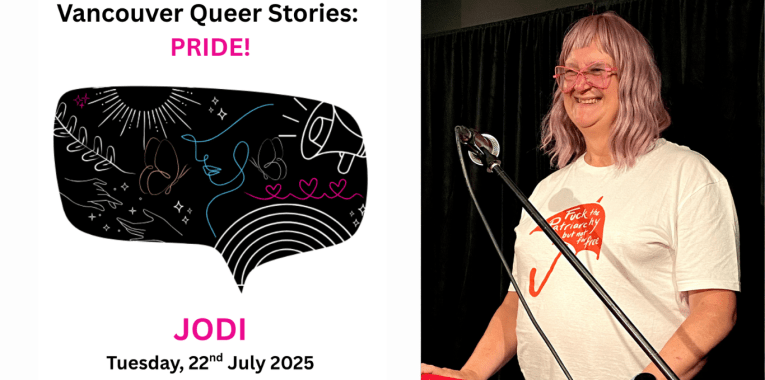
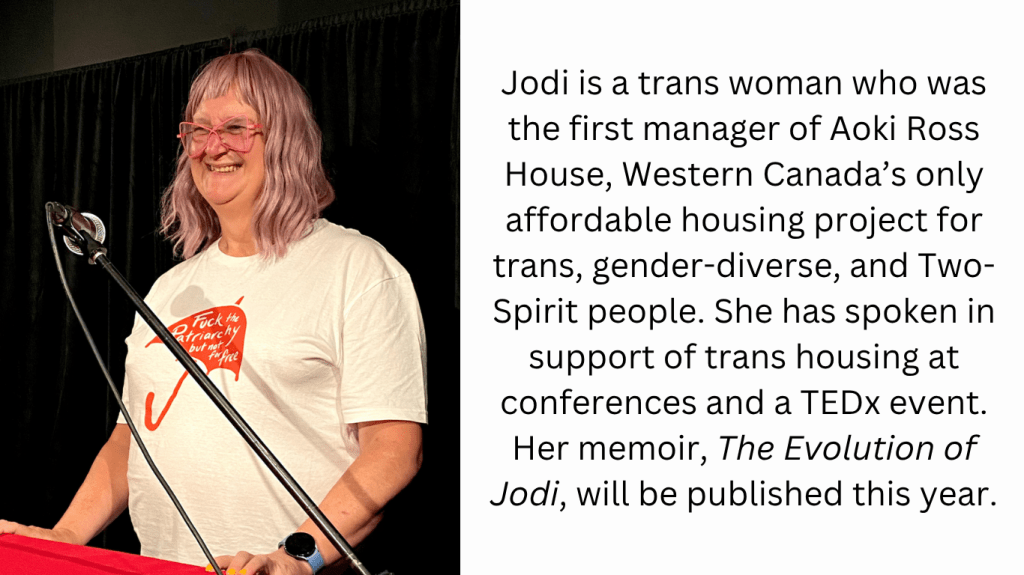
Pride!: Jodi’s Story

I began cross-dressing in my early 20’s. It was always in secret, and always followed by shame. When I was done, I would throw the clothes away and vow to never do it again; a vow that would last only weeks or months, before I gave in and bought another skirt or dress. I did this for two decades, as I continued to fight with myself over my true identity.

When I moved to Edmonton in 2013, I went to a safe consignment store I knew about from when I had lived in the city years earlier. I bought a cute leather skirt and a black, sleeveless knit top with a zipper in the front. All I needed was black stockings and some lacy black panties to have a complete outfit. See, I don’t have a fetish for lingerie, but it never felt right dressing with my stupid boy underwear on.  

I drove to a lingerie and toy store nearby, in a strip mall in the West End. By the time I got there that Saturday evening, the parking lot was almost empty. I wasn’t sure how I would be received in the store, and I was really nervous, so I parked as far away as I could. This made no sense: I would probably look more suspicious parking that far in an empty parking lot. And besides, I couldn’t see if any other customers were in the store from that distance. Instead, I walked over to the Arby’s next door, got some food, and sat by the window so I could watch the lingerie store. After watching for 45 minutes with no one going in or out, I figured it was a pretty safe bet that the store was empty. I had also finished my food by then, and didn’t want to look any more suspicious than a middle-aged man staring at a lingerie store for almost an hour would look. 

I gathered my courage and went in, quickly heading to the far corner where no one could see me. So much for courage.
I started looking at the display racks, too afraid to even touch anything. I guess I was hoping to find that magical rack that had just what I wanted, in my size, right in front where I didn’t have to look for it. Needless to say, this didn’t happen.  On my second pass through the racks, a clerk came over. She was short, very muscular, covered in tattoos, with bright red hair. She looked tough and mean, and intimidated me right away. She was between me and the front door so I couldn’t run for it… and I was kind of frozen in place, anyway. 
When she asked if she could help me find something, I said I was looking for a present — for my girlfriend. There, that takes care of that… I bet she gets this all the time.  “Ok, what size is she?,” she said. Damn, she flanked me.  What could I say?: “She is about the same size as me.” Ha, I certainly am a quick thinker!  She looked at me and said, “it’s for you, isn’t it?”  That’s the one thing I hadn’t planned for. I had no answer. Who is the quick thinker now? In defeat, I looked down and said: “yes.” 
I braced myself; will she punch me? Will she laugh and call over the other clerk? Maybe she’ll release the CCTV recording to the news. I won’t be able to show my face anywhere in Edmonton anymore. Oh no, I hope CBC doesn’t pick up the story, I might have to move out of Canada! How could I have let this happen? I’ve ruined the rest of my life for a pair of panties. Maybe I can get plastic surgery — yeah that’s it, no one will recognize me then. Hopefully they won’t fingerprint me. 
It’s amazing how much can go through your mind in a few seconds.

The one thing I didn’t count on happened, though: another customer walked into the store. Great, now there is a live witness to my humiliation. But to my surprise, this angel of a biker bitch redhead took my hand and led me to a dressing room to hide.  She told me she would bring me some things to try on.  I ended up staying in the store for hours, having a great time. When I left, she gave me her number.  She said if anyone laughed at me to call her.  She and her friends would take care of anybody. I believed her, too.
Her name was Ali and it didn’t take long for us to become friends.  She said she liked how brave I was for walking into the store.  I thought, “yeah brave, that’s it.”
Ali and her girlfriends immediately welcomed me into their group. They would go dress-shopping every Sunday, usually to a cool pinup shop on Whyte Ave. Afterwards they’d go to lunch. I would try on dresses with them, giving and getting fashion advice.  They were all tough-ass biker bitches so no one messed with us.  It must have been quite the sight for the other customers. 
My favourite dress was a sparkly silver, form-fitting dress.  I spent time in the back of the lingerie store, learning to walk in Pleasers.  I got a pair of black Mary Jane Pleasers that looked great with the dress.  The only place I wore this outfit was at home, but I loved it.  

And when it was time for the Pride Parade in Edmonton, Ali asked me if we were going.  Ok, that wasn’t really her style; she asked what I was going to wear when we went.  I didn’t know, I had never been to any Pride Parade, so she told me I would wear my silver dress and Mary Janes.  I was so nervous, I had never worn a dress in public. 
Ali’s fiancé said he would wear a dress in solidarity (and he did!)  That felt safe.  I would have this tough biker, Ali, with me, and a dress-wearing welder who was 6’3” and had arms as big as my thigh! 

The day came, and we hopped in Ali’s SUV.  Ok, she hopped in, and I awkwardly crawled in with Pleasers and a dress, managing to flash everyone as I did. 
On the way, Ali stopped at the coffee shop where her son worked.  I said “just bring my coffee out to me,” and she said “absolutely not. We are going there so he can see you in your dress.”  A small coffee shop in an Alberta suburb was the first place I ever went in public in a dress.  Suddenly, my nerves going into that lingerie shop for the first time seemed like nothing.  They almost had to hold me up to get me into the coffee shop.  I blamed it on the heels.  Once inside, her son laughed, but in a good way, and the other baristas gave us compliments.  It actually felt pretty good and boosted my confidence.

When we got to Edmonton and the parade, it was so crowded. I didn’t feel like I stood out anymore.  How could I stand out among the drag queens, people wearing next to nothing, and all the colours?!  We pushed right up to the front of the crowd so I could enjoy my first pride parade.  Ali’s fiancé and I had our picture taken with a drag queen.  The only downside of the whole day was learning that pleasers really aren’t meant to be worn for walking and standing all day.  I ended up walking barefoot on the hot pavement, it hurt less than the heels. 
But still, I basked in that feeling for weeks. For the first time ever, I felt no shame for being who I was. I realized I am not alone, and that the entire world is not against me.
I never threw my clothes out again.  My clothes, and especially my shoes, have become more comfortable since then, but that Pride Parade was the start of my acceptance of my true self.

Shortly after that Pride, I got a tattoo of a female eye, looking out of my heart. Just a peek out, but for me, an acknowledgement that she was in there all along, and the process of letting her out had finally begun. She had always been watching, waiting for the day I would let her be seen.

Around the World: M.’s Story

Okay, so this story takes us back to 2015. I was just 18, still a student at AUB, which is basically the UBC of Beirut, where I’m from. But instead of being half an hour away from downtown, it’s literally in downtown. Picture a university inside Stanley Park.

Back then, I was still closeted — obviously living with my parents — and I used to drive to university every morning. And, like many gay men in the Middle East, I had Grindr. Because let’s be honest, that was the gay community. There were very few queer events or hangouts, just a bar or two… but mainly, a grid of torsos and chaos.

And that’s where I met Julien. French guy, blonde, older. In Beirut for a few days. Very much giving “European tourist with a tote bag and a mysterious backstory.” He told me he was travelling through French-speaking countries writing a book — which, at the time, sounded super fake; but he was still hot, so I didn’t question it.
I tapped him. He tapped me. We chatted. And we decided to meet up for coffee on campus, like respectable homosexuals. I picked him up, gave him a little tour of AUB, and also showed him around the city in my car, which honestly made me feel so cool. Like, I was 18! Driving this charming older French man around Beirut like it was nothing. I was glowing. Walking a little faster. Laughing a little louder. You know the vibe.

That night — the same night we met— he ran into a little problem. His iPhone locked him out. Completely. He kept saying, “I’m sure I’m typing the right code,” but his phone was like, “Nope. Try again in 3 days.” If you know, you know.
So now he’s in Lebanon, with no Google Maps, no contacts, no apps. Not even Grindr. Dark, dark times.
Buying a new phone? Too expensive. Renting one? Is that even a thing? And that’s when I saw my little gay moment to shine — not to impress, but to be useful. I told him, “I actually have a second phone; you can use it while you’re here. I’ll bring it tomorrow.”

It wasn’t a flex. It was just something I could do… so I did.

Now, everyone I told thought I was absolutely out of my mind.
“He’s going to disappear with your phone.” “It’s a scam.” “He does this in every country.” But honestly? I trusted him. I don’t know why. Maybe I was being naïve. Or maybe I just liked the way he said merci.

We saw each other a couple more times after that. Nothing major (okay, we fooled around a bit). One thing that I remember, that makes me cringe so hard, was this moment when I asked him, very stupidly, if he had downloaded Grindr on the phone. And of course, he had. And I was like, “…oh.
He explained that Grindr was how he met people when he travelled. At the time, I didn’t really get it. To me, Grindr was still this secret, shameful hookup thing. But now? I mean… most of my friends today? I met them on gay hookup apps.
So… yeah. Julien was ahead of his time; or at least ahead of mine.
Before he left, Julien gave me back the phone and thanked me. Said his trip would’ve been totally different if he hadn’t met me. And that meant something. It made me feel kinda special — like I had made a little mark on someone’s journey.

We kept in touch here and there. He only messaged me in French — partly because his English wasn’t great, and partly because he’d say, “tu dois pratiquer.” Little did I know, my French skills helped me get my PR in Canada 10 years later.
And for a long time, I really thought that was it. A sweet little story. I didn’t expect to see him again.

But then, seven years later, I visited France for the first time. I messaged him, just to say hi. “Hey… I’m coming to Paris.” And he replied immediately: “Let’s meet.”
And just like that, we did. He showed up on a bicycle — of course he did — looking older than I remembered. More silver in his hair. Definitely giving daddy energy. And if you know me, you know that’s very on-brand.

This time, it wasn’t flirty. It was just… really lovely. We spent a few days together, and it honestly felt like picking up a thread from a story I thought had ended. He showed me around Paris like a true local. We vibed, got a little drunk, had the best time. He took me to beautiful theatres, gay bars, this riverside queer spot called Rosa Bonheur — which is basically the Paris version of Birdhouse. If you ever visit, highly recommended.

And on my last day there, we took the train to Versailles to go to a theatre festival — because I’m a theatre gay, obviously. We wandered through the gardens with some strawberries and a bottle of bubbles, because in France, you can literally just crack open a bottle of wine in public, and it’s totally normal. We had this quiet, beautiful day, just the two of us. And I don’t know, there was such a strong connection between us. And if you’re wondering: no, nothing happened. He had a boyfriend, not that this ever stopped anyone. But honestly, nothing needed to. The vibe was there. That was enough.

And of course, the trains back got cancelled. So, we had to navigate this maze of night buses, switching lines, figuring it all out. I would never have made it back alone. So I guess we’re even now: I gave him a phone in Beirut, and he got me home in Paris.
On the way back to Paris — after running around trying to figure out which random village bus was actually going back to the city — we were both exhausted. Sitting there in silence, half-delirious, half-relieved that we even made it onto the right bus.
We both kind of knew this was the last time we’d see each other before I left. 

And somewhere between stops, Julien turned to me and said, “By the way… I mentioned you in my book.”
And I was like, “Wait — what book?” I had totally forgotten that he was even an author.
He smiled and said I was one of the memorable friendships he made along the journey of writing it. Just a small mention, nothing dramatic. But still — it really hit me. Like… damn. I actually meant something to this person.

We still talk sometimes. Send each other voice notes. He still corrects my French grammar like it’s his life mission.

And that’s my story. A little Grindr match in Beirut. A train ride from Versailles. A mention in a French linguistics book. Nothing dramatic. Just one of those rare, quiet connections that stick with you — even when you know you probably won’t cross paths again.

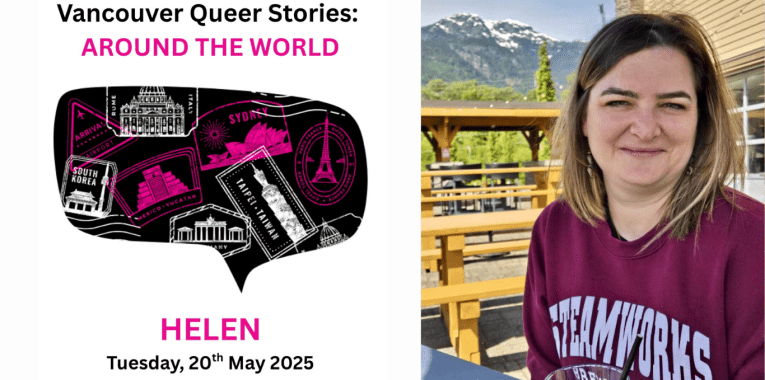
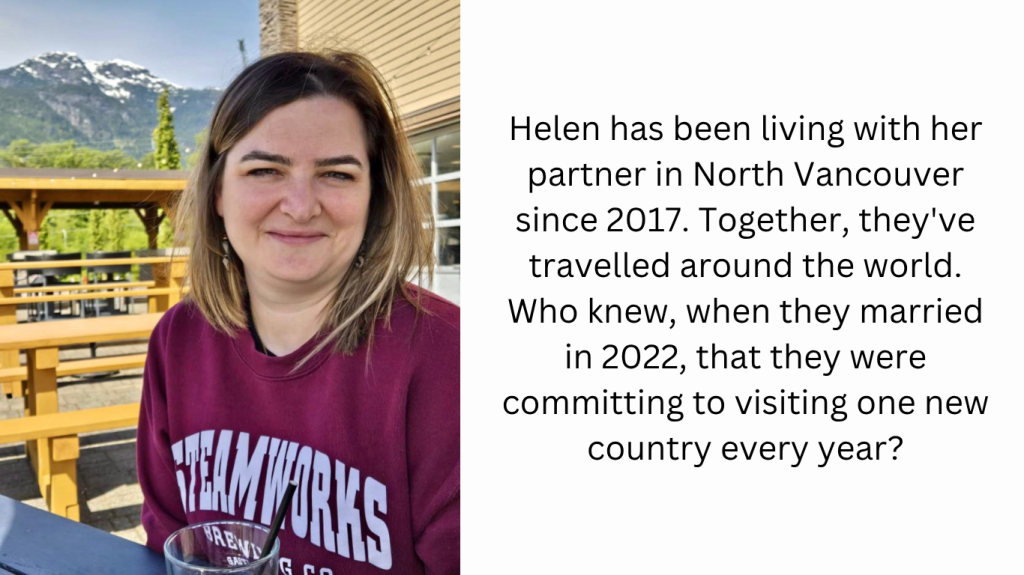
Around the World: Helen’s Story

There’s something you need to know about me before I tell this story: when I’m not writing travel tales for Vancouver Queer Stories, I moonlight as an Anglican priest. No, seriously, I’m ordained, and it’s taken me to some incredible places. I want to assure you that I’m not here to preach a sermon: I’m here to tell you about the time I travelled to the Northern Philippines, and, on the first day, promptly and irreparably broke the toilet. 

I awoke on that fateful day to the sound of rush-hour traffic. I had slept well after a 12-hr bus ride, which involved 40 degree heat, views of the renowned rice terraces (a UNESCO World Heritage Site), and roads which were under construction following a recent earthquake. As I was getting ready for the day, I finished showering, did my business, and prepared to flush the toilet, manually.
I had done my research, you see. I was well aware of the adjustments we’d have to make while in the Philippines. I knew how to deal with foreign plumbing—bucket style. I filled up a nearby trash can with water from the sink. I tossed it with great force into the toilet like I’d been shown—on YouTube.
When I was unsuccessful, I rolled up my sleeves and thought to myself, “I know how to fix this.”

I took hold of the porcelain lid and removed it from the tank. I felt the thin layer of condensation that had settled on its surface. It felt slippery between my fingers, like, well, like you would expect a porcelain toilet lid to feel.
As my palms reached for the edges, my fingers spread easily over the lip, and just when I thought I had hold of it, like an angel dressed in white taking flight, or a white-robed resurrected Jesus bursting forth from the tomb, the toilet lid shot into the air—set free from my grip. It landed on the floor—smashed into a thousand pieces. I followed suit shortly thereafter.

So, I did what any self-respecting person would do in a situation like this. I picked up the pieces, one by one, and hid them in my suitcase, in a bag that I would later dispose of when no one was looking. But, there was still a terrible mess and after labouring on the bathroom floor for hours (let’s be real, it was five minutes), I admitted defeat and made my way down to the lobby to plead my case with the hotel manager.

As I left my room, though, there was my colleague: the Executive Archdeacon, the Venerable Father Arnold Graystone. He was seated on the balcony, hands clasped, eyes closed, deep in prayer. I tip-toed my way towards the stairs.

“Good morning, Mother,” he said.
“Good morning, Father,” I chimed.
“Everything alright with the room?”
The story came tumbling forth, my words as hurried and fragmented as my attempts to clean up the porcelain pieces from the bathroom floor.
“Well, you’d better go down and have a word with the manager, haven’t you?” he said.
(Yes, I’d better go down and have a word with the manager, haven’t I?)

I made my way to the main floor and greeted the manager.
“I have some very bad news,” I said.
I pulled up a photo on my phone. She nodded and gestured to one of her sons. I began to apologize profusely. I insisted on paying for the damage. I asked if I could take a mop and clean it up myself. She smiled and pointed to a stack of porcelain lids in the back room.

“We have extras,” she said, “because of tourists, like you.”
I thanked the manager, and turned to make my way upstairs.
“One more thing,” she said.
“Next time, ma’am, just press the button. The toilets are automatic.”

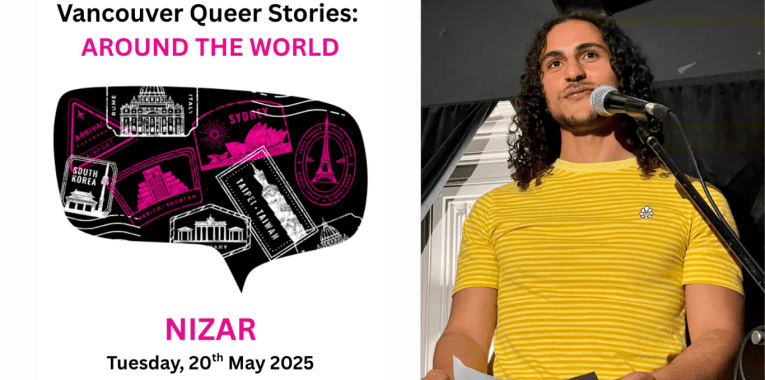
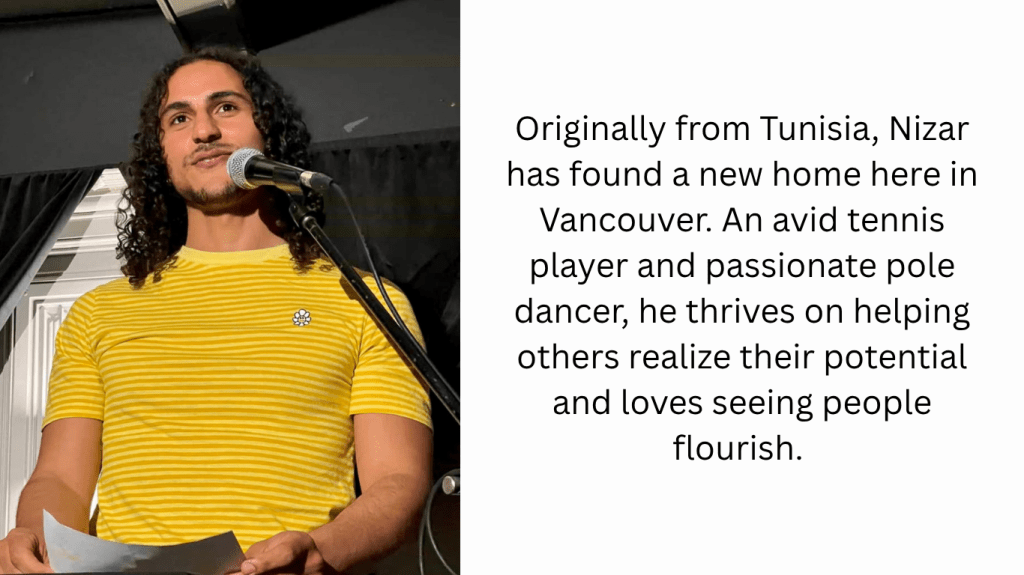
Around the World: Nizar’s Story

I grew up in a small town on the Mediterranean coast of Tunisia, a place where being different often meant being targeted. For those unfamiliar, Tunisia is a North African country with a rich and complex history. From the Phoenicians, Carthaginians, Romans, Vandals, Byzantines, Arabs, Berbers, Ottomans, to the French, many civilizations have left their mark. It’s a beautiful country with stunning landscapes and, if I may say so myself, a lot of beautiful men.

But despite its beauty, Tunisia’s laws are not as progressive. According to Article 230 of the penal code, same-sex relations are criminalized, with penalties of up to three years’ imprisonment. So, while the country is breathtaking, it’s not exactly a safe space for someone like me.

From as early as kindergarten, I knew I was different. My feminine manners and femme-presenting nature made me a target for relentless bullying. Before I even knew I was gay, people had already decided it for me. They called me “fag” and other slurs, and I couldn’t understand why. I felt trapped in a cycle of fear, confusion, and self-loathing.

Looking back now, I realize that people often fear what they don’t understand. In a place where traditional gender roles were set in stone, my existence challenged their norm. I didn’t know it then, but I was stronger than I thought simply for surviving that.

Every day, I’d walk down the street and brace myself for the insults, the rocks thrown my way, and sometimes even the beatings. I’d come home from school, bury my face in my pillow, and scream until I was exhausted. I couldn’t tell anyone, not my mom, not my dad, because I was terrified of judgment and ashamed of who I was. I contemplated ending my life more than once, but something within me, some spark, kept me going. Maybe it was hope or just pure stubbornness, but I wasn’t ready to give up.

As I approached my final year of high school, I knew I couldn’t stay in Tunisia any longer. I needed to escape. My parents couldn’t afford to send me abroad for school, but I was determined to find a way out. Here’s the funny thing about desperation: it makes you creative. I started browsing a website called GayCupid, it doesn’t exist anymore, but at the time, it felt like a lifeline. I reached out to countless men from around the world, Italy, France, Canada, the US, the UK, hoping one of them could help me leave. I convinced myself I was in love with one of them, a man named “Tom”. For two years, I stayed in touch with him, keeping that hope alive. Eventually, he helped me get a visa to Canada as an international student.

Moving to Canada was a huge relief, but living with “Tom” during those first two years was challenging. Even though I had set the boundary that we would just be friends, I often found myself doing things I wasn’t comfortable with to maintain stability. Eventually, I decided that I wanted better for myself. Leaving his place felt like reclaiming my own agency after years of feeling like I had to compromise to survive.

Not long after I moved out, I found myself on the phone with my mom. I wasn’t planning to come out to her that day, it just happened. The emotions overwhelmed me, and before I knew it, I was telling her everything I had kept bottled up since kindergarten; the bullying, the fear, the pain. I couldn’t stop the words from pouring out. It was raw, emotional, and something I didn’t know I needed. At first, she struggled to accept it, but I realized that I needed to accept her too, her background, her limited exposure to different perspectives. My dad’s reaction was different. He simply said, “I don’t care, be whatever you want.” Part of me wanted him to care more, to cry with me, but in time, I understood that his indifferent acceptance was a form of love.

One thing I’ve learned is that acceptance is a two-way street. I was asking my family to accept me, but I had to accept them too. When I let go of the need for my mom to fully understand and embraced her own struggle with my identity, a weight lifted off my shoulders. It wasn’t about them; it was about me, about learning to love myself despite the years of hatred and misunderstanding I had faced.

Living in North America has its own challenges, but it’s nothing compared to fighting for survival back home. Sometimes I feel like I’m going to be one of those people who say, “Back in my day…” but really, the contrast is stark. Back in Tunisia, just being myself was like trying to get a massage while stuck in a war zone. But here I am now, free, resilient, and finally at peace with who I am.

If there’s one thing I want you to take away from my story, it’s this: Sometimes, the journey to self-acceptance means accepting others, too. It’s about finding your own freedom without demanding that everyone understands it. The weight lifts when you let go of the need for validation and choose to live for yourself.

Around the World: Imogen’s Story

Identified Patient

I am in Calgary today learning how to diagnose autism. The training is in the same hospital building where I was detained for a month and ultimately diagnosed with OCD when I was eleven. A month of one-way mirrors and cheese whiz toast and CBT worksheets. My current therapist sends me a message before I leave that says “I hope this trip is somehow good for you rather than jarring,” which I think was supposed to be reassuring but ends up coming off ominous.

At the Vancouver airport I text my partner and tell them I cannot stop thinking that I’ve forgotten something important and something terrible is going to happen. There must be a ritual I can do to prevent it, they joke. Ha ha ha. It turns out the feeling that I have forgotten something is correct, although the scale of the catastrophe is a little off. When I arrive at the Calgary airport and try to pick up my rental car, my driver’s license has expired two days earlier, and I have to get a cab. I had planned to maybe check out trendy restaurants that have popped up here since I left in 2004, but quickly I realize I’m going to be basically confined to the strip mall around my Best Western and the children’s hospital where my
course is being held. Wings clipped, I feel like I’m waiting for my sixteenth birthday so I can go through Peter’s drive-in for milkshakes or drive to the airport just to look at it, so I can start to imagine forward movement as a real possibility.

The view out the cab window is vast and empty and slow, and I realize I had forgotten how this place seemed to be a mismatch for the pace I wanted to go. Wheels spinning on ice, futility and pent up energy; knowing there was a whole big world out there where I wouldn’t be such an anomaly. In the parlance of CBT: the feeling didn’t necessarily tell me the truth. There was a whole big world out there, and I wouldn’t necessarily feel like less of an anomaly once I found it. But the idea of it was enough to give me traction, to propel me out of this place that always reminds me of how no one can hear you scream in space because there’s nothing for the sound waves to even bounce off of.

Did you know that it’s more common to be afraid of wide open spaces than it is to be claustrophobic? I am sure that I do not belong here. They gave me diagnostic powers by mistake, it is an administrative error. A Freaky Friday type mishap where I have woken up with unearned power and freedom. I spiral and sweat through the afternoon lecture, imagining all of the catastrophic sequelae of this mistake. My heart races. On the break I get an ice cream from the vending machine where my mom would get me ice cream before family therapy, like trying to coax a feral animal. Only she’s dead now, so I’m trying to coax myself back to productivity or achievement, to my hard-earned place on the other side of the glass this time. I am conscious that adult professionals probably don’t eat ice cream for lunch when surrounded by colleagues. At any second they may realize I’m an impostor, and send me back downstairs for toast, a PRN, a worksheet and a nap.

I go for a walk to try to feel better, and end up feeling sad and slow and lonely, a specific sensation that feels like dull prairie winter in my chest. Vancouver moves fast – my favourite restaurants and memories disappearing before I can make new ones. Calgary moves slow, the pancake restaurant I used to go to with my mom before skiing preserved like a bug trapped in amber. The steakhouse we’d go to after church. The dead mall, standing there like the husk of a giant insect, where I had my first job selling novelty swords to nerds with poor impulse control, and which I recognized recently when it was used as a set in The Last of Us. Everyone I could call from my previous life here has moved or died.

It is dense with memory and devoid of connection. When I was nineteen I saw another psychiatrist who told me he thought I had Asperger’s, which was a thing then. Likely because I looked at the floor while I talked to him, and told him that I believed that the problem was not depression or even OCD, but that “I suffered from a pervasive remoteness.”

These days I have mostly abandoned the CBT I learned when I was eleven at the Children’s hospital psych unit. I still eat cheese whiz on toast, because it feels like a hug. But in light of everything that’s happened, it feels unhelpful to say “that’s a catastrophic thought.” It’s trite, but the only thing that slows down my heart rate and lengthens my breath is gratitude. When I was thirteen I found queer youth group, and when I was fifteen I started volunteering to run it. When I was sixteen they started paying me, and I’ve been lucky to build that into a career as a therapist. The early parts of that were nurtured by old (to me) lesbians who wanted to see me be happy and succeed; who understood that I was doing my best in a hostile environment and wanted to believe in the idea that someone like me could be okay. You couldn’t take a kid under your wing like that now; it would be called grooming. But no one was ever creepy, and I wouldn’t be where I am now without them.

When I moved to Vancouver, queer people felt unfriendly and suspicious of difference. There were a lot of invisible divisions I struggled to intuit – the mirror is never just a mirror. No one was jumping to take me under their wing. I still had the embarrassing tells of someone from a town that hosted the national high school rodeo, whose social and cultural centre was a grain elevator, and where you could ride your horse to school and hitch it there. I used to think it was too easy here, that there wasn’t the kind of exposure to hostility that makes us tender with each other’s earnestness.

When I started writing this, what I didn’t want to happen was for it to turn into a kind of city-over-country supremacy that I think it’s easy for anyone, but maybe especially for queer people, to slip into without noticing. When we do that, what we’re actually trying to signify is the cruelty and stress of the places we grew up, but we tend to do so without examining our own capacity for cruelty that we pack up in our backpacks and Rubbermaid totes and bring with us across mountain ranges on Greyhound buses. I’d even hazard to guess that as much as we learn what to tolerate in relationships from our families of origin, we learn how to be in community in places that hurt us. From where I stand now, I know that under a lot of the cool disaffectedness that I used to be so intimidated by, there is often deep vulnerability.

What I brought with me was a pane of one-way glass, the pain of being observed and described, the specific pain of the identified patient. I roll the words around in my mouth. Nothing goes away until it teaches us what we need to know. I repeat it to myself over and over again like a mantra until my mouth is dry, and it seems to help. My heart slows down to match the pace of this place, the thing I couldn’t do when I was growing into myself

Around the World: Ryan’s Story

I used to think identity was something I had to wear like a badge.
Queer.
Person of Colour.
Canadian.
A neatly folded résumé of who I was supposed to be before anyone even knew my favourite food or how I take my coffee.

In Vancouver, I could feel the labels arriving before I did.
Like I walked into the room after my own footnotes.

But then I left.
Packed two suitcases and a nervous heart, and landed in Berlin —
a city colder than I expected, stranger than I imagined,
and somehow, freer than I’d ever known.

No one knew me there.
Not the barista who handed me my first Latte Macchiato with a crooked smile, not the cashier at Rewe who tossed my groceries with zero small talk, not the friend-of-a-friend at a Kreuzberg Altbau party who didn’t ask “where are you really from?” Or “what do you do for work?”
just asked, “what’s your sign?”

I said Cancer.
They said, “figures.”

And just like that, I wasn’t explaining myself.
I was just existing.

Berlin didn’t care what box I fit in.
It didn’t ask me to choose between my softness and my strength.
It didn’t ask me to be a role model or a symbol or a teachable moment.
It just asked me to be.
To show up.
To dance to pop EDM remixes in Schwuz or twerk at a Latin party in Lido.
To get lost on the winding Straßes.
To survive on Simit, Franzbrötchen and Club Mate.
To fall in and out of routines, and sometimes out of love.

And so I travelled.
Not just through Europe —
though yes, I did float through Stockholm,
sweated under the Barcelona sun,
and blinked at the beauty of Prague’s cobblestones at midnight —
but I also travelled through versions of myself.

The me who stood silently in museums.
The me who laughed too loudly in the S-Bahn.
The me who forgot to be afraid.
The me who wasn’t performing — wasn’t on display —
just living.

See, travel doesn’t just teach you about the world.
It teaches you about who you are when no one’s watching.
When there’s no audience.
No expectations.
No need to explain your history to justify your presence.

In Berlin, I was “the Canadian,” sure.
But that wasn’t code for “outsider.”
It just meant, “you’re not from here, but neither are we.”
I was allowed to take up space.
To make mistakes.
To speak German badly.
To start again.

And maybe that’s what travel gave me most —
the gift of not being anyone’s definition but my own.

In Vancouver, being queer and a person of colour was often the first thing.
Before my name.
Before my jokes.
Before my energy even had a chance to walk in the room.

But in Berlin, in those trains and cafés and moonlit strolls along the Spree —
I got to be just Ryan.

Not reduced.
Not erased.
Not tolerated
But revealed and accepted.

Because I am queer.
I am a person of colour.
And I’m also tender, and smart, and sometimes a little too dramatic.
I wear sheer shirts and glitter nail polish.
I write poems, I’ll never show anyone.
I miss my dog when I’m gone too long.
And I love citrus scents like they’re a personality trait.

And that — all of that — is who I am.
Not a headline.
Not a box.
But a body in motion.
A soul in translation.
A person in process.

Now I’m back.
Different city, same name.
Still me — but expanded.
And when I walk into rooms now, I don’t shrink.
I don’t lead with the résumé of what I am.
I just say, “Hi, I’m Ryan.”
And let the rest unfold.

Because travel didn’t change who I was.
It just reminded me I didn’t need to prove it.

So if you ever feel like you have to explain yourself before you’re allowed to be yourself,
if you ever feel like the world only sees you in fragments — go.
Even if it’s not far.
Even if it’s just to the next town over, or the next friend’s couch.
Find the place where your name is enough.
Where you don’t have to be a statement.
Where you’re not reduced to your resistance.

Find your Berlin.
And then bring it back with you.
Wear it like a soft hoodie.
Speak it in the way you order your coffee.
Live it in the way you look people in the eyes when you say:

“Hi. I’m not here to explain. I’m here to exist.”
Just me.
Just Ryan.