
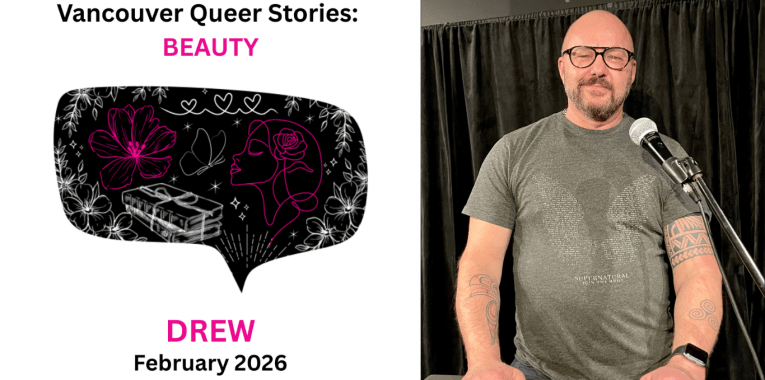
Beauty is mercurial and elusive.
It’s subjective. It changes and evolves. As does your perception, as you evolve with it. And apparently, it fades with age — unless you’re Brad Pitt.
Beauty has almost gotten me into trouble.
When I was a kid, I wasn’t into hockey sticks, jumping off trees onto the sidewalk head first, or whatever else boys were supposed to like doing.
I was sensitive. Not in a dramatic way — just… attentive. I didn’t want to wear my mom’s high heels or makeup, but I was fascinated by the pretty things in nature.
Flowers. Plants. Bugs. Furry animals. Mostly rabbits and skunks, because that’s what we had around. And lots of garter snakes.
While other boys were trying to shoot the rabbits with BB guns or pull the wings off insects, I was firmly in the catch-and-release camp. An early environmentalist without knowing it. Because I was admiring what I thought was beautiful.
My father did not see this as charming.
He was traditional. Grumpy. And convinced that boys were supposed to like cars, and fighting, smoking cigarettes, and whatever passed for manliness in the 1970s. He didn’t complain when I would bake a chocolate cake after school for dessert, which I am sure was on the not-so-masculine list.
Thankfully, my mother let me like what I liked. Now, she wouldn’t have been thrilled if I’d shown up in her best church shoes — and as a deeply religious woman, she would have prayed hard about that. Til her eyes bled. You don’t want to upset the Virgin Mary with drag too early in life.
By the time I hit my teens in the 80s, I thought I had beauty figured out. I had a modified Flock of Seagulls haircut and some truly committed eyeliner. You know the haircut — you can hear it before you see it.
I wore clothes that, in retrospect, should probably have been illegal. The 80s were a dark time: cheap asymmetry, massive shoulder pads, poor judgment, apparently a lot of cocaine.
As a kid, beauty was something outside of me. As a teenager — suddenly social, suddenly sexual, and wildly clumsy at both — beauty became about me. Or at least the shell I was walking around in. When you realize how much belonging matters, you start dressing for your tribe. We thought we looked incredible. Completely badass.
That is, until the real badass kids showed up — mullets, Mötley Crüe t-shirts — and we immediately ran away. If they threw anything at us, the thick coating of hairspray probably would have softened the blow to our young brains.
This was also the moment I realized something else:
I thought the guys around me were pretty too. Not in a competitive way. In a way that made my stomach drop. That realization opened an entirely different can of worms — one that would take decades to sort out.
Beauty, it turned out, wasn’t fixed. It kept moving. Expanding.
Fast forward about 25 years. Two University degrees. Many pints of beer. A series of very short-lived almost-relationships. Not because I didn’t want one — I did — just not with the wrong guys.
I found myself living on Pender Island in a van, pretending to be Jewel, having exhausted the entire gay male population of the island. All one of them.
So, I joined Manline. Also known as Lavalife. Pre-smartphone, Grindr, and Scruff. You use what you’ve got.
Every day, as the dial-up screamed and squealed, I waited. Hoping someone — anyone — had flamed me, or woofed me, or whatever it was called back then. As the page loaded, painfully, line by line, I saw his smile. My future husband. And I could feel it: oxytocin flooding my body — that ridiculous, euphoric high of being in love. I remember thinking, “I need to lock this beauty down.”
So I did. I put a ring on that. We built a life together.
Then we adopted — which was many things: complicated, exhausting, worth it. But not especially beautiful. That’s a story for a different day. Maybe a Vancouver Queer Stories entitled “Queer Parents Who Survived Parenthood”.
Around the same time, I finished my nursing degree at UBC. I worked in medicine, psychiatry, emergency, community mental health — and eventually landed in the Downtown Eastside, leading an outreach team working with people the system had failed over and over again.
I was intimidated. I had barely been there before. I was walking into single-room-occupancy buildings no one should have to live in. Truly. Shame on the city and the province for that.
I listened to stories of trauma so severe I couldn’t understand how anyone survived it. I remember thinking, there is no beauty here. This is a war zone.
But slowly — walking down Hastings, visiting clients, sitting in meetings with other service providers — something shifted. I started to see it.
Beauty was in the relationships. In the community. In the way people looked out for each other. In their resilience. In the small kindnesses — and in the gratitude they showed me, just for showing up as the nurse.
Was it always beautiful? Absolutely not. I ran from people who didn’t want me there. And if you’ve ever seen me play softball with WESA, you know I’m built more like a tortoise than a hare. The adrenaline helped.
But the thread that ran through everything was connection. Shared trauma bonds people deeply.
You would be amazed how far a little respect goes. These are the people our society treats as disposable — the reason NIMBY exists — and being treated like a human, even briefly, restores something vital.
That work forced me to face my own prejudices. It stretched my understanding of beauty in ways I didn’t expect.
Like a lot of things, when I was twenty and thought I knew everything, it turned out I knew very little.
And honestly?
I’m still learning what beauty really looks like. And I am very grateful for what it has taught me so far.
 vancouverqueerstories.com