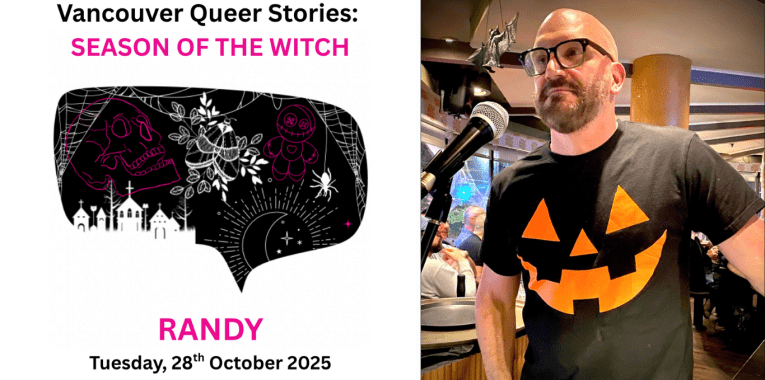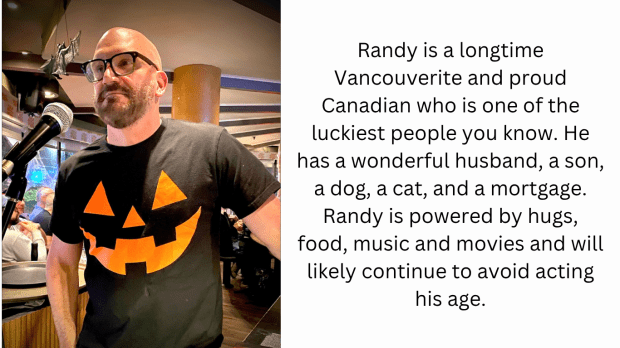
Season of the Witch: Randy’s Story

Me and my husband Drew, our son Jack, and our pets live in an old house that’s over 100 years old. It’s in a nice neighbourhood on the west side of Vancouver, which is home to most of the Jewish folks that live in our city. We once had a conversation with someone who had knowledge of the neighbourhood’s past, and they told us that they believed that many years back, our house was home to the area’s Orthodox Jewish butcher. This is notable because the highly-observant, Orthodox, meat-carving spirit might not take kindly to their ex-home being occupied by an atheist and a converted Jew, who are both gay and vegetarian. So, if our guess was correct that there was a minor haunting in our home, we likely had one pissed-off and resentful ghost.

In the first years in our house, we noticed odd things. One morning, I walked into the kitchen and the heavy, leaded glass light fixture over the counter was swinging. It was winter and the windows were closed, so there was no breeze. Everyone else in the house was asleep, including the pets.
On another day, Drew was in the basement and heard the dog’s footsteps in the TV room next door to where he was. He then heard the sound of the sofa springs as Charlie got up on the couch and curled up. He called out to her and, strangely, he heard her bark from upstairs. Then she came running downstairs to where he was (and where the demon on our couch was, apparently).
Things kept being odd. When I was taking down a thick wall that separated the kitchen from the living room, we noticed that the insides of the wall were covered in large scratch marks that looked to have come from an animal but were much too large to be attributed to a rat or a mouse. 
Over the years, we have had many, many things go missing (of course, this could possibly be due to the fact that we are fairly messy people and that our haunted house is where clutter usually goes to die). But still, many things are still missing years later.
Then, our neighbour from across the street told us they witnessed what looked like a solitary female standing still in our front yard at 4AM, staring at our house for quite a while, Blair Witch Project style. 

With no hints or direction from us, a friend who claims to have a connection to otherworldly forces has pinpointed a space in our house that had odd and creepy vibes. This is a room in our basement that always feels significantly colder than other rooms down there and has a door that doesn’t seem to stay closed, no matter how often we close it. Being lovers of scary movies, we had recently watched the movie Paranormal Activity, and were 82% sure the demon from that was living in that basement room.

The incidents that we had noticed had been amusing and only slightly creepy… That is, until 2015, when one bad thing after another seemed to happen to me, and my life went completely to shit. I needed someone to blame, so I figured it must be the uninvited guest in our home. You know, the demon from the movie Paranormal Activity.
Given my work and career issues, money problems, parenting struggles, and extreme self-doubt, I felt like I was cursed, and it was going to take multiple appointments with my longtime psychologist, a medication review, and additional self-examination to get myself out of the deep hole I found myself in. And, of course, significant sage smudging and a house exorcism administered by a flaky but entertaining specialist who had long grey hair and carried a tie-die backpack and a cloth bag of candles. You know, a good, science-based mental-health plan.

We went out and bought a bundle of dried sage. We lit it up, blew out the flame and the smoke from it smudged that old house within a centimetre of its life. The potent smell of the dried herb permeated our nostrils and every corner of every room. And then the specialist did their work as well. With eyes closed, mumbling to themselves and reeking of patchouli, they went about supposedly ridding our home of spirits who were annoying, occasionally frightening, and about as welcome at our place as a right-wing Albertan who wanted to discuss book banning and their views on the validity of medical vaccines.

Over time, things normalized. The sun came out. My outlook improved. I was able to see clearly that things were not nearly as grim as they seemed. It was a huge relief. It might have been the meds, maybe the time with my psychologist, but likely just that things got better all around. It probably wasn’t the smudging and the exorcism. If our guest is still cohabitating, it seems like maybe they’ve found a way to be cool, have stopped the annoying behaviour, and have remembered that they’re staying in our gay vegetarian home rent-free.

Having said that, over 20 of our forks have gone missing in the last few months. It could be lingering supernatural activity, but it’s more likely the fact that our teenage son continues to be not great at putting dirty dishes away.

On December 31 of the year in question, as a precautionary measure, I took the calendar that had hung in our kitchen all year, put it in a wheelbarrow in our backyard, and lit it on fire. It was fairly therapeutic to watch the damned thing burn.

Summer Loving: Camille’s Story

This is not your typical steamy summer romance (although trust me, I have tried). My story is more of a love letter. A love letter not to a person, but to a place. This place. Vancouver.And it’s a story that spans almost two decades, from my first visit as a first grader to my moving here just last summer. If you have watched The Summer I Turned Pretty, this is kind of like that. But queer. And hopefully, with better writing. Do it for the plot, as they say.

Now, I haven’t done this sort of thing since university so I’m a little out of practice. In this essay I will… no, I’m just kidding.

A little bit of context. Like some of you, I am not originally from here. I grew up in Belgium. I went to catholic school, sang in the church choir, etc, etc. I can confirm that the catholic school to queer pipeline is real.
And don’t get me wrong, my love for Vancouver is not the same as dislike for Belgium. I love it there and I’m proud to be from there. I talk about it pretty much all the time. The people I miss, the food, the history, and culture. The fact that Belgium was the second country in the world to legalize same-sex marriage in 2003. And yet it’s a perfect example of how different legislation can feel to daily life.
Because. Growing up there for me also meant growing up with a lot of baggage. I lived and went to school with mostly white, cisgender, straight, conservative people. My home life was a crash course in emotional survival. This and other factors made it feel like I was keeping more and more inside as the years went by. Naturally averse to any type of confrontation, I kept my head down, twisted and bent myself so I wouldn’t cause any waves, trying not to catch any attention. It was a survival strategy, something I wasn’t always aware I was doing, but, over time, it shrinks you.
Now, it’s not like Belgium doesn’t have queer people. Trust me, as someone who got a liberal arts degree, sometimes it feels like I have met most of them. And although I attended university with plenty of rainbow merch and queer friends, sometimes it still felt like I was playing a part. My real, true, queer self was starting to make appearances, before I commuted back home at the end of the day and faded into that washed-out version of myself again. I was learning how to use non-binary pronouns in French and then going home to hear how queer people shouldn’t make such a spectacle of themselves.

Something I have left out until now is that me and my sister were lucky enough to spend many summers here in Vancouver while growing up. Something I definitely did not understand or appreciate while it was happening. Why was I being shipped off to the other side of the world every summer to be with people I hardly knew or understood? Why did I have to leave my home, my friends, my language, and everything that was familiar to me? Weirdly enough, these are some of the most vivid memories I have from my childhood and adolescence. They say you can’t remember an actual emotion, only the memory that feeling left behind. Maybe that is why summers in Vancouver are so bright, painted in colorful emotions, happy, sad, and angry. Because there was a lot of anger. There were a lot of tears. But at times, I was also happy.

I had a lot of firsts here:
This is where, as an angry tween in the middle of summer, I watched my first pride parade. Right on Robson Street. I did not know what was happening; I just remember it being loud and bright and colorful.
When I was a little bit older, Vancouver is where I had first dates, best dates. Most memorably the girl who planned a walking date to visit the best independent bookstores in the downtown area. For someone with a literature degree, that’s about as hot as it gets.
I spontaneously booked a walking tour called “The Really Gay History Tour,” diving into the queer history of this city. And I felt it. A hum, a buzz, whatever you want to call it. Something small, brave, vulnerable sitting in my chest, making its presence known. This place felt good, right.

Deciding to move here was not intentionally something I chose to do for myself. It made sense for a bunch of boring legal reasons and like many, I was a bit adrift after finishing university. What do you mean there isn’t anything I’m working towards over the next 4 years? I made the choice, initially for a year, to be closer to my sister, who had been living here for years. Probably the least problematic relationship I have in my life, the person who I have leaned on (sometimes a little too much) since we were 2 lost kids in this city. It was a risk. Once again, I was leaving my home, my friends, everything I knew, but this time it was my own choice, and it was for longer. But even though I was comfortable there, I was still clenching. I was myself, but I could still feel myself purposely not taking up space at times.

So. Since I recently passed my 1-year anniversary of moving here (or my Vaniversary, as I like to call it), I thought it made sense to do a little performance review.

After many many, many job applications, I started working at what I am convinced is the queerest workplace in the greater Vancouver area. If our queer staff members were given the day off for Pride, there would be no one left to keep the place running. The people I have met there, dare I say the friends I have made there, mean more to my little gay heart than I can express.
I have also joined a queer fitness class (yes, that is a thing, and I could not recommend it more). After a fun night out dancing at The Birdhouse, I woke up the next day not with a hangover, but with a hangover and my lower back in spasm. This queer cardio class, pitched to me as “gay line dancing,” seemed like a smart solution and has led to another first. My first time actively, loudly, proudly participating in a pride event earlier this summer.
It definitely hasn’t always been easy, though. In the past year, I have experienced more than one type of heartbreak here. The distance and space have given me a lot, but they have also taken things from me. Missing out on friends’ important life events, not getting the chance to say a final goodbye. Sometimes I feel like I am living a parallel life. It is so hard to fight the urge to regress into who I used to be when my old life comes knocking.

But. There is one memory that I keep going back to. It was August 2024, right after I moved. I packed my book and towel and biked on one of the crappy Mobi bikes to sit at English Bay Beach. The pride parade was going by. I watched the colours. The sun was shining. I could hear the waves on the beach and felt the wind on my face. This memory is so warm and bright in my mind, because I felt so… peaceful. And even though I had no idea what was coming in the year ahead, I felt I could finally, truly exhale.

Summer Loving: Luis’ Story

This is a story about my on-and-off love affair with, metaphorically, the beach, open waters, and the sea. 

My first ever date was in the first post COVID summer, in coastal Victoria.
I ventured out to meet a guy I met online. Through text, he was emotionally available and aware he was avoidant. The hot beach day was the perfect environment to bring any incompatibilities to the surface; looking back, I realize how the sound of crashing waves was a beautiful, soothing sound, but being caught underwater as the currents break was not. Almost immediately, we were in an anxious-avoidant trap, and it would take me two years’ worth of poems, and counting, to learn how to love myself enough to not go into steep shorelines unprepared.

After that, my longest ever relationship, although it is best defined as a situationship, was here in Vancouver with a guy I used to say was the sea, Poseidon himself. If I went with the flow, I had a wonderful time; the best dates, though technically  hangouts, were trips to the beach. Blissful sunny happiness quickly clouded by my capacity to receive love that did not come with any strings attached, and unfortunately, without this clarity of what I needed, intention, I was once again in an anxious trap. A strong cycle manifesting itself like a lunar calendar. Fortunately, through poetry I was able to capture and reflect on the push and pull of the tide through this period of my life, and wonder where and why I was repeating it. Similar to the erred myth that the Aztec calendar was believed to foretell the end of the world, and not that the Aztecs were resetting their seasons, this loop of breakups and reconciliations revealed itself at the beach on January 1st: 

In 2012, my cousins and I went into the sea. 
Before we realized, the high tide took us away. 
We tried to swim as we screamed mayday,
I split from my cousins and tried to get help, 
We all got away, but not the fear that I felt.

I don’t trust the sea like before, 
my sandcastle falls when a wave knocks on the door. 
My comfort zone lays in more stable terrains
I even ask friends to play the water levels in videogames. 
So you could say I am afraid of the sea,
Because I wouldn’t be able to blame it for drowning me. 

The sea did not try to kill us, we ventured too far. 
The sea does not have a memory, we remember the scar. 
The sea will drown you if you let it be guide, 
The sea behaves in a pull and push of the tide. 
I compared you and the sea, and now I don’t know what to do with this commentary.
 

Let me offer my hand and help you down from the pedestal, 
Take a hammer to the columns and pipes and let the water flood my skeletal. 
I lean towards the synchronicity:
It’s the color blue that beacons to me. 
The blue in your eyes, or the blue in your name, 
Or the blue in the way you move.
 

I want to get out of the water, but I don’t know how.
Question the trail dripping from my body, 
Wonder:
If it was an emotionally aggressive father, no, 
If it’s how I process emotion and choose a path to follow, no, 
If it’s how my Mexican blood reacts like oil to Canadian waters, no,
else trying to heal every other part of me when the pipes in my sandcastle are spilling water, yes.

This life isn’t sustainable. 
You can’t heal personality. 
I’m never in reach of the perfect standard of healing every single part of me.
How many rooms do I split myself into before I forget where every part went initially?
 

In this new layout of my castle, where do I fit your memory?
The thought makes the tide in my mind go red, I’ve ventured too far. 
I can reason the sea’s behaviour but not a man’s vocabulary.
For that ethical ambiguity, I have no vacancy.
Not for the men I am unsure if I even “dated”, 
or whatever definition fits from your dictionary.
Not for those whose banter belittle me, 
Make a joke out of me and try to convince me it’s funny. 
Not for the men who cross my boundary, 
And dare to say the walls of my castle are imaginary. 

It’s through time, in each wave that hits the sand. 
That the sea and sand bank resemble each other’s hand.
I lose sight of what works for me and start becoming part of a narrative
That exists only in your mind and what I twist into poetry. 

Only when I focus on what I felt
not what you said does the tide relax.
I know I’ll put the memories, the good ones left,
Not in the sea or the places we spent time in, 
But in a brand new room.
Of people I rode the bus with, whom 
I flirted like we were strangers, 
driving away from Wreck beach, away from the currents and dangers.

Destined to get at different stops.
Dead calm waves, the high tide drops.

The idea that a place can have revealing properties is not a new one. In The Exterminating Angel, by Luis Bunuel, dinner party attendees become trapped in a sociological limbo that eventually reveals all their secrets and unravels their relationships. Robert Östlund’s Triangle of Sadness, Prime Video’s Yellowjackets, William Golding’s Lord of the Flies, break and rebuild social hierarchies after crew and travellers are castawayed. 

I’ve gone to the beach alone, with friends, family too, and have found similar results: an exposition of ideals and compatibility. Do you go to the beach with people who leave trash behind? Do you? How comfortable are they seeing their and other people’s bodies? How comfortable are you? Is their job really “beach” and are they qualified for it? Are you? Do they go to the beach only during summer? Do you?

I love that poetry, like the sandy coast, is as much an external as an internal space. Privacy shared publicly coexists with the secret agenda of knowing, being “in” on personal intimacy of a shared story. Being caught naked or seen in your underwear has a different moral weight than being seen at a beach wearing a range of birthday or bathing suits.

After spending the last day of Vancouver Pride weekend at Oasis in Wreck Beach with a diverse, safe, stable group of friends, I wrote about these conclusions in a poem called The beach:

I love the smell of sunscreen, sand, coconut oil;
Touch hungry, I’m picky as to who I ask for help. 
At a shy distance from the ocean, water, turmoil,
I’ve learnt going to the beach’s Reckoning itself,

Of what is not said but felt: interpersonal health.
Here, where there’s not much to do but connect
We watch, talk, listen, or that’s what I’d expect,
We wear our comfort levels, habits, our neglect:

Wreck/Jurassic/Oasis, SPF, over, under dressed.
By the coastline, waves flirt with the sandbank. 
A touch, a kiss here and there, a look at a chest,
A drift, a rip current wipes the shore prints blank,

Washed it away. Replaced by beautiful patterns.
The tide’s intention revealed in the rill and ripple:
It is Nature, to mix below the surface, “we” aren’t
But an undertow of elements chasing currents is.

As in, not ideal, life at the beach. I’m sunburnt
From a Sun’s hand, the Moon takes over control,
Rising and setting the pace of the ebb and soul.
I head home to myself, entirely made up of sand.

Today, as I visit familiar or new beaches, I am more aware of my qualities and needs, because I’ve been to the beach and continuously see how anxious, shy, body-dysmorphic, sexy, creative, secure I and others can be. 
Today, firstly, I know myself and get a life jacket for open waters, wear a speedo and SPF 50, and trust I am capable of swimming… for survival, probably not for recreation. 
Today, if I am curious about the health of my relationships, with myself or with somebody else, I go to the beach. 

Summer Loving: Claus’ Story

Day 1
The speedboat dropped us off on a deserted beach and drove away. Ahead of us was the West Coast Trail, a 75km trek in Vancouver Island. It was the end of summer 2018 when my friend Carly and I embarked on this adventure, with $5,000 worth of hiking gear and a shared sense that, maybe, we weren’t quite prepared for what lay ahead. (Carly is straight, btw, but we won’t hold that against her).

The first five kilometres took us an unbelievable six hours, climbing over tree roots, balancing on slippery logs, carrying 50lb backpacks.
“Do you think there is wifi at the camp?” Carly asked, shocked and dehydrated after hours of hiking, even though we both knew we’d have no cell service or electricity for a week. During our orientation that morning, we were told there was “running water” at the campsites; Carly thought they meant bathrooms. They were referring to rivers.

Reaching that first campsite at Thrasher Cove (KM 70) felt like a small miracle. The final stretch alone nearly did us in: steep, muddy switchbacks that seemed to go on forever, followed by ladders that dropped the equivalent of a fifty-story building to sea level. There, we used the remaining daylight to set up camp, and had to cook and eat our dinner (dehydrated space food that expires in 2099) in the dark. Two Advil for the pain. A hot chocolate spiked with bourbon to reward ourselves. Sleep. 

Day 2
We woke up cold and sore, and took a ridiculous four hours to pack up and eat breakfast. As we left camp, the skies opened up, and we quickly discovered that rain gear, even when it costs hundreds of dollars, isn’t fully waterproof. We would not be dry again for a week. 

When we hit the first of four cable cars (small metal boxes that fit two people and two backpacks, hanging from a rope and pulley system to help you cross swollen rivers), we were already trudging through ankle-deep mud, and knee-high water.

We ended the day at Camper Bay (KM 62), tucked between the forest and the sea. By our second night, we thought we were starting to settle into the rhythm of trail life: wake up sore, put on wet clothes, pack up, walk, set up camp, eat space food, take two Advil, drink a bourbon hot chocolate, sleep, repeat.

Day 3
We challenged ourselves to take down our camp, eat breakfast, and pack faster. We cut down our time in half… which means it still took us two full hours.

If the West Coast Trail is infamous for anything, is its ladders. There are around seventy of them along the trail, varying in length and inclination. Some of the ladders stretch the equivalent of a thirty-story climb. One ladder is completely vertical, and another is tilted slightly sideways. Most of them are slick with rain and moss. Every one is a test of courage; a slip can end up in disaster.

After hours of literal ups and downs on a ladder-heavy day, with hands and legs shaking from holding on to slippery rungs, we set up camp at Walbran Creek (KM 53), on a soft square of moss between two logs. Space food dinner, two Advil, hot chocolate — dammit, we emptied our bourbon flasks, meant to last the week! 

In the middle of the night, Carly shook me awake.
“Papi, there’s something outside the tent,” she whispered fearfully.
“A big something, or a little something?” I asked, alert. The West Coast Trail is home to bears, cougars, and wolves.
She thought about it for a while, then whispered, “A little something…”
“Carly, wake me up if you hear a big something.”

Day 4
We woke up that morning to a full downpour, so strong that we didn’t cook our usual hot oatmeal for breakfast. We tried to speed up our morning routine, but ended up taking two hours to pack up camp — again.

Shortly after leaving, we reached the longest cable car, stretched across an impossibly wide river. We loaded in and let gravity do its thing… except, the soaked rope sagged so badly that we stopped dead centre, dangling above the rapids, with rain blasting from every direction.
I began pulling at the rope with all my strength, attempting to pull us across to the other side, while Carly… well, while Carly cried. “I can’t do this,” she sobbed, broken by the elements.
Now, I’m not known for being patient. But Carly needed a pep talk, so I was honest with her. Yes, this was hard. Yes, I was broken too. But staying in that swaying metal box wasn’t an option. So, together, we hauled ourselves, inch by inch, to the other side.

Later that day, we came across “Chez Monique’s,” a legendary burger shack in the middle of nowhere. Except, Chez Monique had died the previous winter, so the place was closed. A man was there, and he let us sit under a tarp to cook a much-needed hot lunch away from the rain. He also sold us an outrageously expensive beer (which we paid for, gladly). And then he said we could set up our tent there for the night. Carly agreed cheerfully. I declined politely, convinced we’d end up in some sort of West Coast Chainsaw Massacre story.

So, we quickly escaped through rain that had gotten worse during our break. We walked along the sea (where Carly hilariously got taken down by a wave), then trekked through the forest.
The trail eventually spat us back out to the coast, and it felt like coming through to the other side of the looking glass. A path of tall grass led from the woods to an endless beach, bathed in beautiful golden light. The sea was deep blue, the pine trees a brighter green, the seagulls resplendent white.

The sun’s warmth seeped into our rain-soaked bones as we walked to Cribs Creek campsite (KM 41.5). We spent the evening on the beach until the sun set, giving way to a black sky speckled with glittering stars.

Day 5
After leaving camp, we walked along the ocean shelf at low tide, admiring sea creatures trapped in the tidal pools, and watching otters darting along the rocks — probably feasting on said sea creatures.

In the afternoon, we reached Nitinat Narrows (KM 32.5), where we enjoyed a BBQ salmon steak and baked potato at the Indigenous-owned Crab Shack. Sitting on the sunny deck, eating a real meal (not space food!), and sipping on a cold beer, we almost felt human again. 
After lunch, we took a boat across the narrows. On the other side, a thick, cold fog rolled in. We couldn’t see beyond 20 metres in any direction as we walked along a rocky beach, with barely an hour of daylight left. We both began to lose hope, thinking we’d have to set up camp on the uninhabited beach, but finally heard the rushing water of a fog-covered Tsusiat Falls, our next campsite (KM 25). 

Space Food. Two Advil. Virgin hot chocolate #sadface.

Day 6
A long, but easy day: flat, with well-kept trails. At Michigan Creek campsite that night (KM 12), someone started a campfire, the first and last of the entire trek. We gathered with a dozen other hikers around the fire, and for a night, it felt like a vacation: sharing stories, laughing, warmth soaking into our bones.
Absolute bliss.

Day 7
Our last morning began with another two-hour packing routine  — why can’t we get better at this?! The trail was once again easy, incomparable to what we had experienced the first five days. A few kilometres in, we got one last highlight: Sea Lion Rock (KM 9), where dozens of massive creatures barked and rolled atop a large reef. It was like nature’s grand finale.

We got back on our way, and suddenly, there it was: the one-kilometre marker. Euphoria surged through us, as we walked that last stretch to Pachena Bay, back to the real world.

***

Despite the challenges and bad weather, I’m grateful for the opportunity to have experienced such beautiful, untouched nature. And to appreciate the little things, like feeling joy every single time I saw a mustard-yellow banana slug, or a funky mushroom, or when I found my favourite lichen (old man’s beard) in the most unexpected places.

The West Coast Trail was breathtaking. It was brutal. It broke us down and built us up again. It made me closer to Carly than I ever expected to be to a woman. And I wouldn’t trade a single rain-soaked step of it for the world.

Summer Loving: Ben’s Story

Back in July 2019, pre-pandemic, pre-twink death, I met you, Lloyd. (Lloyd is a pseudonym, for you dear, my favourite Welshman.) Edinburgh – Edd-in-berg, if you want to be ridiculed. I was crashing on my sister’s couch in Marchmont. Bored, cramped, a little horny; friends going to a party I wasn’t interested in that night, I open an app.

Sniffies didn’t exist back then, so we did our business on Grindr like gentlemen. 

I don’t know what it is about Edinburgh, but I do extremely well there. So, I casually shoot my shot. And, you reply. Truthfully, I was surprised. You are too pretty. Your singular dangling earring (because those were in style then), the white button-up shirt so open to your chest. Too pretty. You, Lloyd with brown eyes. 

I steal away some weed brownies that my sister made. Keep in mind, this is Scotland, the UK (at least for now). Weed is rare goods. We are both excited to indulge. Even though European weed is shite, I tell you, including the stuff in Amsterdam compared to BC bud. We walk the Meadows, QU’EST-CE QUE C’EST in modern terms, ‘yapping.’ You tell me about cartography, and the archives you work in, poetry, and the jewelry you wear. I tell you about linguistics, the archives I work in, the dread of renting in Vancouver, the jewelry I wear. 

You live just up the road from my sister’s, so we go to yours. We don’t jump to sex – no – I want to show you the Canadian Cat Show Circuit documentary I saw earlier, while the brownies take full effect. You are enamoured by the cats. Eventually, we do find ourselves in bed.

This is the first time I ever had you on top of me. It might have been the weed brownies, maybe the amber lighting, and the bedroom’s high ceiling, your cheeky smile, the smoothness of your stomach, your nose, deep in my neck. Kissing and laughing at each other.

I wake up late; we wake up late. I need to meet some friends for brunch, now. I dash out the door, forgetting my wallet, and keys, but not my phone. Thank god. You are waiting for me at your flat’s entrance as I scamper back. I see you; you see me. We look terrible. Hickies abound. Hair disheveled. What I hope is toothpaste. We chuckle boyishly and kiss. It is not our last meeting that week.

I learn Lloyd likes old, pretty things and fresh clotted cream. He is sentimental and hates low-rise socks. He pulls his knee highs all the way up. 

He graduates from university later with a master’s degree; I return to Vancouver long before then. We keep in touch on Instagram as oomfs. (I have a real life oomf!) 

July 2022. We are in the pandemic, but some restrictions begin to ease. My sister is having their wedding Ceilidh in Edinburgh. It is a Gaelic social event, with dancing, fiddles, and alcohol, of course.

Perhaps, you can make the trip up from London. Perhaps, we can find a place to stay away from my family for the week. Perhaps, you want to come, and see me, that guy with the weed brownies, and cat documentary, (and ass eating). Wow. You are coming. I am a bit scared now. What if, we’re just friends and not friends this time. Not that we have to be friends like that: no expectations. I’m cool. You are cool. But, we are sharing a bed for the week. 

Your train is early. I am rushing to Waverley. I wanted to have something for you. I am pleading in a flower shop along the way to see what measly trimmings I can get for seven quid. [Huff] I am late. I am late, and I have shitty signal here. Fuck you, Fido! What if he isn’t getting my messages… But there you are. I am holding back smiling to look nonchalant, but my face is fuzzy, warm, and my chest is tight, racing. I can’t stop myself. My smile does not look like yours, and I don’t look like you: pretty. Have you always been taller than me? Oh, it is your shoes. He has cool shoes. “Hi Lloyd! I got you these.” 

That is the first ‘gorgeous’ of the week. He calls things he likes ‘gorgeous’. Sicilian pizza, tart wine, eclectic thrifted goods, my flowing green pants, a flat white whilst hungover, train station posies. 

At the Ceilidh, we give each other bruises from the swing dancing, swirling each other on the rental hall’s floor, switching partners, fumbling, tearing away, and to each other. My new brother-in-law’s third stepfather’s girlfriend, named Squirrel, from north of Aberdeen, asks us if we are together. We give each other that look. “Oh, so you are fuck buddies,” she quips in a brough. We laugh and shrug. 

The rest of the week is gorgeous. Most afternoons, I nap while you read; Lloyd is not a napper. He smiles when I enter the room half awake. I don’t know why. All week, he gets to revisit haunts from his uni days. For him, his past is here in Scotland. For me, just a present together, which itself is a fantasy. And, I should know better. Playing house on Leith Walk? You are the cruelest to yourself for this.

The morning finally comes. Because the UK is (and continues to be) an absolute shitshow and the climate is boiling us alive, the train schedule has ‘been better’. The rail cables are melting now. Your train is maybe here, so we rush to the station at high noon. These moments are all –  frantic, frenetic, while my insides are slow and sinking deep within me. You are leaving in an instance.

We hug, one last hug. And then, you step back, keeping me in your arms, and kiss me. I am caught off guard. You have to go. I have no choice but to linger there while your railcar leaves. 

Instead of dinner, I go to bed with stomach aches. I can’t wait to get home. I want my dog, my routine, to be as far away as possible from this place. I know for a fact we can’t be together if I am an ocean and a continent away. That is what makes it impossible, not the impossibility of you reciprocating this longing. You are there; I am here.

Somewhere in 2023, you delete Instagram. I respect that. But, I lose you. Wait! I signed up for that infrequent poetry email newsletter you do. Sigh. Quarterly, sometimes, tri-annually, I still get a glimpse of your thoughts and whimsy. I reply once to the email address, but don’t hear back. You added your cellphone number to it recently. I am still too scared to send a message. It is too direct. It is too late. Too – too! 

You have your Instagram again, but are never on it. Do I slide into your DMs? No. Also, a terrible idea.

I hate it: Having these thoughts and aches since you surely do not feel the same way about me. Hate acting foolish and teasing myself. Hate being reminded of you by the viola, wool pants, and Coronation chicken salad. Hate how these memories are mine, ours, but just mine really, fallible and reliably rose-tinted to a degree.
But I don’t hate you. No, I love you, Lloyd.
For how you make me breathless. For how you grin and say, ‘look at you’, when I walk in a room. 

Maybe one day, I will be one of those old, pretty things you enjoy again.

Not now, and not soon. No, but one day, when my love is no longer this loathsome and restless thing but somehow braver and tempered, for you.

Summer Loving: M.’s Story

I’ve always been a hopeless romantic.
And I don’t mean that metaphorically, I literally used to choose Hopeless Romantic as my personality trait on The Sims. Back when I still thought that picking it would somehow make my characters have sex faster. Not in real life.
At the time, I didn’t fully get what it meant.
Hopeless? Romantic? Isn’t that a contradiction?
But over the years and one too many impulsive heart flings, I think I’ve finally started to understand.

Let me take you back to the summer of 2014.
I had just graduated from school and freshly 18. Queer. Closeted and Horny. 
And freshly added to a friend group headed to Ayia Napa, a beach town in Cyprus best known for two things: foam parties and straight British tourists throwing up in alleys. I unfortunately witnessed both.
It was my first time traveling without my parents.
Which basically meant: I could finally go fool around without anyone up my ass… except the man who was gonna be up my ass.

The night before the trip, I opened Growlr, it’s like Grindr, but for bears… and with a UI that looks like it was designed in 2003 and never updated (it probably was).
I changed my location to Ayia Napa, and within minutes, I found THE guy. Early 30s. Local. Cute smile. Med student.
We chatted. We vibed. We made plans to meet the day I landed. I didn’t know much, but I knew this trip was already a success.
I told my best friend, the only one in the group who knew I was gay. I expected a lecture. Maybe a “Don’t get murdered.” But instead, she saw his photo, read the texts, and said: “OMG, go get it, girl.”
It was the first time I’d ever told someone, in real time that I was about to meet a guy. And just having someone know made me feel more confident. More excited. More me.

On the flight over, I couldn’t think about anything else. This wasn’t just a hookup, it was a movie: A summer escape. A foreign local who’d show me around, give me great dick, and maybe, just maybe, become my European boyfriend with whom I’d live a Mediterranean gay fantasy. Hopeless Romantic mode activated.
When I arrived, he picked me up in a retro car, looking hotter than expected. And as fate would have it, we ran into two people from my group crossing the street. 
They stared. I waved. Later, I told them he was a “family friend.” 
And they shockingly believed it. 
He drove me to this beach bar that looked like a queer fever dream. It had a giant stone mermaid mosaic with the words “Once In a Lifetime Experience.” Which… felt dramatic for a beer on the beach.
But okay, Mama Mermaid, let me dream.
We got drinks, sat at a table by the water, barefoot on the sand, and talked for hours. We laughed. He told me about med school in Romania, coming home every summer, how he loved the sea. I was enchanted.
We couldn’t really flirt openly, it wasn’t the safest place. But at one point, our bare feet were near each other, and he reached out… and gently tangled his big toe with mine. Yes. Toe holding. Hand-holding, but gayer.
Now listen… I don’t have a foot fetish. But my dick… begged to differ.
Later, we made out behind a dumpster. (Summer loving, baby).

I went back to the hotel with the biggest grin on my face. I couldn’t stop smiling. I couldn’t stop imagining us. How we met by chance. How perfect the date was.
He’s in med school? Great, my parents will love him… only after they kill me when they find out im gay.
Gay marriage is legal in Europe? Done. We’re getting married.
The gay delusion was DELUSIONING.
But then the next day… we argued. Over text.
I was being clingy. He was pulling back. It wasn’t dramatic, it was just deflating.
I’d gone from mermaid mosaics to “I guess I’ll die alone” in under 24 hours.
That night, my friends decided to get tattoos. I, fresh off heartbreak,  told my best friend I wanted to get his name tattooed on my thigh.
To which, she said: “Only if I get to tattoo my hand slap on your face.”
She’s an Icon.

Still… we met again. We talked. We laughed. We shared a joint, my first. (I had no idea how to smoke it, so it didn’t really do much.)
He invited me to his family’s beach house. We made out on the kitchen counter. We had sex on a squeaky metal bed that sounded like it was cheering us on. We took selfies.
Then, he dropped me off. And that was the last time I saw him.

My phone died shortly after the trip, all the pictures, his number, everything: gone. And for a while, I felt this weird sense of grief. Not because I’d lost him.
But because it was one of those rare moments that felt good, and I wasn’t ready to let it go just yet.
That was my first real taste of gay romance. Before that, most of my experiences were secretive. Sexual. Transactional.
This one was different. Even if it was short-lived. Even if it ended in toe-holding and a missed connection.
Because over time, I’ve realized: Being a hopeless romantic isn’t about getting your fairytale ending. It’s about choosing to feel deeply, even when it’s messy. It’s about believing, even if only for one night, that love is possible, and that you are worthy of it. And with every little story like this one… I evolve.
Not into someone less romantic,  but someone more grounded. I still believe in soulmates… I just don’t expect them to show up in beach towns with retro cars and squeaky beds.

So NO, this wasn’t a once-in-a-lifetime experience. I’ve had a few more summers like this since. And if I’m lucky… I’ll have many more.
Because being a hopeless romantic doesn’t mean you’re doomed. It just means you keep showing up for the magic. Even if it only lasts a night, or a week, or a beer on the beach.
Maybe the real once-in-a-lifetime experience is simply being someone who still believes in those moments.
And I still do.

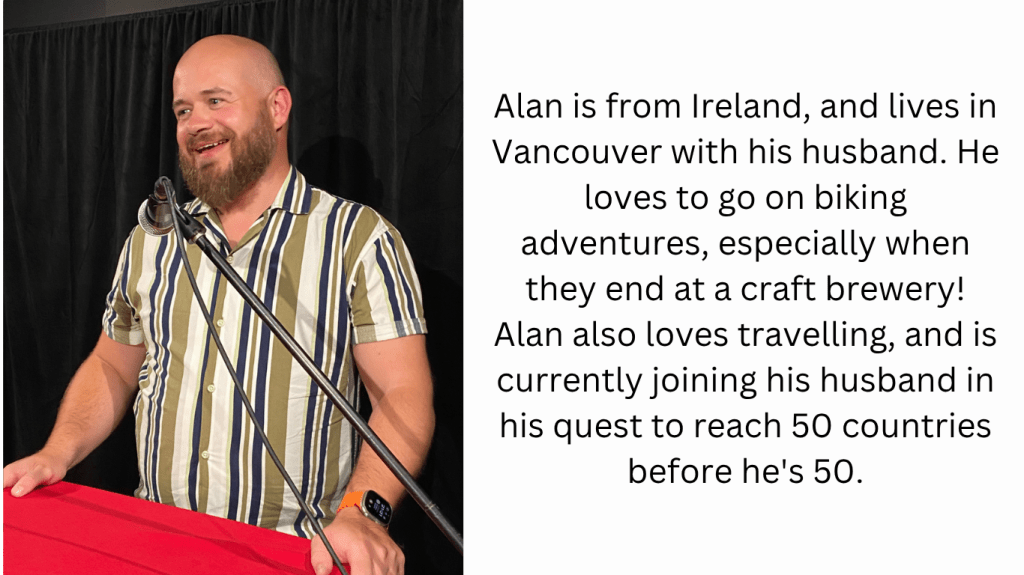
Pride!: Alan’s Story

I was born in Ireland in the eighties, raised in a catholic household, and educated in catholic schools. I was taught that pride was a sin – one of the seven deadly sins, in fact. 
It was painted as arrogance, as vanity. Something to be ashamed of. And shame? Shame was a virtue.
To be clear, I’m not even talking queer pride…we’ll get to that. I’m just talking about regular, good old pride in one’s own self. 

In Ireland, we were taught to reject compliments and diminish our accomplishments so as not to seem too proud. If you ever compliment an Irish person on their outfit, they’ll immediately tell you how cheap it was, or how old it is, and that they look like shit. 
We also judged people for being proud: growing up, discussions about someone else’s success were usually coupled with phrases like “he’s gotten too big for his boots” or “Miss high and mighty in the big city.”
So, before I was even sure I was gay, I was already afraid of being proud of anything. To baby gay Alan, the thought of being proud to be queer was impossible. Why would anyone be proud of that?

So, I learned to hide. I stayed quiet. I didn’t make friends often, and if I did, I didn’t let them get too close. I hid the way I wanted to express myself, the way I wanted to live. 
I was taught, in subtle and not-so-subtle ways, that my existence could make others uncomfortable. And so, I would shrink myself to make others feel safe. 

Pride is hard.

I eventually came out, of course; you can only hide for so long before something has to give. When I was 16, I told my parents and a select few friends that I was gay — and was met with just the right amount of fake surprise.
But if I am being honest with you, dear audience, I only really half came out. 
When I went to college, and when I got a job, I never talked about my boyfriend openly, or said the name of the bars I drank at on the weekend. 
Never talked about the hot guys on TV… but never talked about the hot girls, either. Never lying, but never really being fully truthful.
Even though people probably already knew, I still hid. 

The first time I went to a Pride parade, I was about 16 or 17. I didn’t tell anyone – I just showed up, alone, pulled there by a quiet curiosity I couldn’t ignore. I didn’t wear anything rainbow. I didn’t carry a flag. I stood at the edge of the crowd, heart pounding, scanning every face, terrified that someone I knew would spot me. That someone would recognize me and know… The irony of being ashamed to be seen at a celebration of pride isn’t lost on me. 

Pride is hard.

That moment at the parade stayed with me, even as life moved on. I immigrated to Vancouver about eight years ago. I came with my then-boyfriend. Here, we discovered an amazing queer community — something we’d never really had, back in Ireland. My then-boyfriend has since become my now–husband. We’ve made some of the closest friends we’ve ever had.

A couple of years ago, I joined the board of directors and became chair of the board of Vancouver Pride. 
If I thought pride was hard before,  I don’t think I was prepared for how hard Capital P pride is when you are at the helm of a struggling, underfunded not-for-profit organization, operating in a world with an ongoing genocide, during a time when trans and queer people are under attack globally.

For some people, Pride is impossible.

I had the privilege of being part of the Society and chairing the board through Canada Pride: Vancouver’s biggest pride celebration to date. A truly rewarding, exhausting experience that damn well nearly broke me. We had a record-breaking turnout, our largest parade ever, amazing performances… and threats of violence, budget cuts, and protests.

Friends, I know I’ve mentioned a couple of times now, but:

Pride. Is. Hard.

When I was a kid, and well into my twenties, the idea of wearing nail varnish, or anything even slightly effeminate, was unthinkable. Femininity was something to be feared or hidden.I would worry that I was walking or sitting too “girly” (whatever that means) , I would worry that I wasn’t talking like a “normal” man. All these small things that would consume my brain in an effort to suppress my difference.
But here I am, nearing my 40th birthday and A couple of weeks ago, I debuted as Lady Anal in my first-ever drag performance. I wore a corset, tutu, and 5-inch heels, and danced to Lady Gaga on a stage in front of around 600 people… and let me tell you – DRAG is hard!
I think baby gay Alan would be shocked to see me in a corset and heels—but I also think he’d be proud. Finally.

I often think back to that first parade. Hiding amongst the other spectators, heart racing. I was scared, but there was something else creeping in; something almost indescribable — queer joy. Queer joy isn’t always loud, or even obvious. Sometimes, it’s just the peace of being fully yourself, without apology. I didn’t know it then, but standing at the edge of that parade was the first step toward the centre of it.

Pride is hard… But it’s worth it.

Because every time someone steps up and says who they truly are, the world becomes a better, more interesting place.

Pride!: Ryan’s Story

I grew up Filipino.
Which meant I also grew up Catholic, respectful, and quiet when it mattered.
You didn’t talk back. You didn’t question your elders. You didn’t come home too late. And you definitely didn’t talk about queerness.
In our community, you could suspect. You could joke. But no one ever said it.
Being gay was either a punchline or a shameful rumor that hovered around someone until it stuck. So I learned early: keep it tucked away. Smile. Be helpful. Be successful. And I was. Success became my armour. Good grades. Good manners. A carefully curated version of myself.
If I couldn’t belong by being me, maybe I could belong by being perfect.

It wasn’t that I didn’t know I was queer. I did.
I felt it in the way I watched certain people longer than I should—especially my sister’s guy friends. These boys were always around: loud, confident in that casual way boys are when they’ve never had to question their belonging.
They’d play basketball, all shoulders and jokes and zero personal space.
And there I was, always on the sidelines wondering what it would feel like not having to hide.
I wasn’t just crushing—I was studying.
How they existed around each other without fear. They were soft with each other in ways no one called soft. Their masculinity was never questioned. Mine was something I monitored constantly.
And I’d sit there wondering, Do I want to kiss them? Be them? Or just be allowed
near that kind of ease? Let’s be real—probably all of the above.

That’s why my first Pride felt… surreal. It was in Vancouver. I had just started letting myself live more openly—not just online or in whispers, but out loud. I didn’t know what to expect.
I just remember putting on this yellow polo shirt—something bright, safe, cheerful. I added a rainbow pin, maybe some beads I’d been handed by a volunteer. It felt like putting on armour, but softer. Like permission. I watched from the sidewalk as the parade moved past. Rainbow flags everywhere. Glitter. Music. People cheering and kissing and dancing in the street like the whole city had finally taken a deep breath.
And then I saw it—the TD float, blasting music with half-naked people dancing in the sun. Glistening bodies. Queer joy. Sweat and pride and freedom.

But here’s the thing: I didn’t feel like I was part of it. I felt like a spectator. Like I was watching someone else’s celebration, not mine.
I was smiling, clapping, even laughing—but I was still on the curb. Still unsure. Still asking myself, “Am I queer enough to belong here?
It wasn’t shame exactly. It was distance. Like I had stepped into the world of Pride, but I hadn’t quite arrived in myself yet.

It took me a few more years, and a move across the ocean, before I’d feel anything different. Brussels Pride caught me off guard. I hadn’t even planned to go, but I found myself in the middle of the city, swept up in the energy.
This wasn’t a hyper-produced parade with big floats and barricades. It felt open. Messy. Intimate.
People weren’t just watching—they were walking. The barriers were barely there. Anyone could step off the sidewalk and join the procession. And people did. People of different backgrounds, mingling, dancing and exuberantly celebrating.
Young people marching with their chosen family. Straight friends carrying signs that said, “I’m here because I love someone queer.”

And the soundtrack? Pure Eurovision chaos. From someone blasting “Tattoo” by Loreen like it was church, to a rhythmic chant to “Europapa,” it was enchanting.
Every corner had its own beat. Every queer had a flag. Every moment felt like home—if your home also occasionally served techno with a side of identity crisis.
Honestly, if you’re a Eurovision fan, hit me up, we clearly speak the same emotional language: high drama, bold fashion choices, and the occasional key change that saves lives and after some time I stepped off the sidewalk.
For the first time, I didn’t feel like I had to earn my place.
I wasn’t perfect. I wasn’t loud. I was just present. And that was enough.

When I think about Pride now, I don’t think about the floats or the glitter or the corporations with their rebranded logos. I think about that moment in Brussels—stepping off the sidewalk and into the street.
Because Pride isn’t a performance. It’s a process. It’s the slow unlearning of shame. It’s the decision to stop apologizing. It’s choosing joy even when the world has only taught you fear.

And yet even now, when I walk into certain spaces—queer or not—I still carry that quiet calculation: “Am I too much here? Or not enough?
Because queerness is not a monolith and the mainstream image of Pride still doesn’t always look like me.
There’s a kind of queerness that gets celebrated more easily.
Usually white. Usually cis. Often male. Lean. Loud.
Unapologetic in a way that feels less like protest and more like branding.
And sometimes, in those clubs, those professional events, those “inclusive” queer spaces, I still feel like I’m back on the sidewalk. Watching the parade.
I’ve been the only brown face in a meeting. I’ve had coworkers pull me aside to tell me I’m “so well-spoken,” as if it’s a surprise. I’ve had white queer people talk over me in meetings about diversity.
I’ve been fetishized for my brownness. Othered, even in intimacy.
And I’ve seen how people treat me differently when I show up femme—when I wear non-conforming garments, when my voice softens, when my wrists move too freely. Sometimes, being a queer person of colour means walking into rooms that claim to celebrate you, but only if you come in fragments.
Only if you leave the messiness, the accent, the ancestors, the softness, the trauma, and the realness at the door.

But that’s not who I am anymore. I don’t fragment myself for anyone now.
Because Pride isn’t just about who you love. It’s about how you insist on your wholeness in a world that keeps trying to carve you into pieces.
I once heard someone say:
“We don’t just want to be tolerated—we want to be accepted.” And that hit me.
Because for so long, I’d been satisfied with tolerance.
With not being bullied. With not being the punchline. With being allowed to exist.
But now? I want more. I want room to be joyful. To be complicated. To be brilliant and brown and queer and soft and taken seriously.
I want acceptance. Not as a concession, but as a given.
I’ve found power in taking up space—not always loudly, but fully. In speaking up at work when something feels off, even if I’m the only one who notices. In mentoring other queer folks of colour, so they don’t have to wait as long as I did to feel seen. In holding space for softness, for mess, for nuance.
In telling my story, especially the parts that aren’t tidy.

Because this is Pride, too. Not just rainbow floats and party weekends, but healing. Boundaries. Audacity. The choice to keep showing up, again and again, in rooms that weren’t designed for you, and remaking them in your image.
Now, when I think about my journey, from hiding behind grades in a Filipino household, to staring longingly at sweaty basketball boys, to watching the parade in Vancouver, to marching through a sea of techno and tears in Brussels—I realize I was never chasing a performance.
I was building a relationship with myself. One where I could love all of who I am.
Brown. Queer. Soft. Strategic. Sensual.
Not half of anything. Not apologizing anymore.

So if you’ve ever felt like Pride wasn’t made for you—too brown, too quiet, too complicated—I hope you know this:
You don’t have to wait for someone to invite you in. You belong here.
Even if you don’t wear glitter. Even if your pride looks like staying in.
Even if your anthem is Loreen and you cry to “Europapa” once a week.

Because Pride is not a moment.
It’s a practice. A rhythm. A reclamation.
And it’s yours.

Pride!: Bryce’s Story

Growing up gay in a small town is like learning to whisper when all you want to do is sing. You get really good at editing yourself; at shrinking. I grew up in a town of 5,000 people, where most people knew each other, or at least thought they did. You learn quickly how to blend in, when the cost of standing out is being left out entirely. And so, I did what a lot of queer kids do: I said I wasn’t. I hid.

I knew I was different early on, but I didn’t have the language for it, or the confidence to claim it. In a place like that, being gay wasn’t something you admitted. It was something you denied, or joked about, before anyone else could weaponize it. I learned how to pass. How to act. How to keep one part of myself tucked away so well that sometimes even I forgot where I put it.

Then I met someone who had hidden just as well as I had. Someone from an even smaller town—500 people, if you can believe it! I used to joke that if I had it bad, he had it worse. But the truth is, we had something in common: we both grew up thinking we had to be less to be loved.

At first, being together was like finding a mirror. Not just in the obvious way—both of us boys, both of us figuring it out—but in how deeply we understood the effort it took to make ourselves palatable to the world. We didn’t just fall in love; we fell into safety. Into understanding. Into survival.

But we also fell into habits that mirrored our upbringing. We stayed quiet. We didn’t talk about our relationship in certain spaces. And even though our families knew we were gay, and knew we were together, we kept things toned down. We didn’t call each other “boyfriend” around them. We didn’t show affection. To them, I think we were just… neutral. Not hiding, exactly, but not fully seen either. We weren’t straight, but somehow, we still managed to look it.

For a long time, we didn’t feel like Pride was for us. It felt like something other people did: louder people, braver people. People who had figured it out. People with less to lose. It wasn’t shame, exactly. It was just… caution.

Then in 2019, we finally went to our first Pride event. Not in Canada. Not even in North America. It was in Manchester, England. And to be honest, one of the biggest reasons we went was because Ariana Grande was headlining the closing show. We had already seen her in April that same year… but Ariana at Pride? That felt like something different. It felt iconic. It felt like a good enough excuse to finally show up.
We booked the trip half for her, and half, I think, for ourselves, though we wouldn’t have admitted that then.

I remember walking down the street and hearing the music before we even saw the crowd. There were rainbow flags everywhere. Drag queens, couples holding hands, kids in rainbow tutus, protestors with signs, allies cheering. It was colourful and chaotic, and so beautifully alive. It was everything we weren’t used to. Everything we had quietly denied ourselves.

And for the first time, we didn’t feel like we were borrowing space. We felt seen. Not just tolerated. Not just allowed. Seen.

It was overwhelming, in the best way. We danced. We laughed. We kissed, even. Right there in the street, surrounded by strangers who clapped and cheered, and kept on dancing. I had never felt more free; or more aware of just how tightly I’d been holding myself.

That was the year Pride stopped being a word and became a feeling.

Since then, we’ve been to more Pride events, but not dozens. Just a few that mattered. Vancouver Pride has become a bit of a tradition for us. And this year, we went to Winnipeg Pride with the biggest group of gays I think I’ve ever travelled with. It was loud, joyful, chaotic, in the best way. A complete contrast to how we first learned to be gay: quietly, cautiously, carefully.

Every time, we let go a little more. Not just in public, but with ourselves. We let ourselves be soft. We let ourselves be loud. We remind ourselves that we don’t have to earn our space. We just get to be.

And here’s the thing: it’s not always perfect. Sometimes Pride is corporate. Sometimes it’s messy. Sometimes, it doesn’t represent everyone the way it should. But at its core, when you strip away the noise and the politics, Pride is about the right to exist fully. Without apology. Without compromise.

It’s a reminder that joy is resistance. That celebration is healing. That there is room for every kind of queer story, even the quiet ones. Even the ones like mine.

Because the truth is, I don’t have a dramatic coming out story. I didn’t run away. I didn’t get kicked out. I didn’t have to fight tooth and nail for acceptance. But I did fight. Quietly. Internally. For years, I fought for the right to be honest about who I am. I fought to believe that I didn’t have to shrink to be loved.

And that’s what Pride gave me. It gave me back the parts of myself I thought I had to hide. It showed me that visibility isn’t just about being seen by others. It’s about being seen by yourself.

So now, twelve years later, I get to stand next to the same man I met when we were both still scared. We’ve grown together. We’ve healed together. We’ve learned that the world is big enough for love like ours, and that we don’t have to water it down.

We still hold hands in some places, and not others. We still measure our surroundings before we kiss in public. The world isn’t perfect. But we are no longer pretending we’re something we’re not. And that matters.

Pride, to me, means hope.
Hope that someone else growing up in a small town—someone who’s hiding, someone who’s scared—can see people like us and feel just a little less alone.
Hope that the next generation won’t have to learn how to whisper.
Hope that one day, we won’t just be accepted—we’ll be celebrated.
Not because we’re exceptional, or brave, or resilient. But because we’re here.
And that’s enough.

Pride!: Evan’s Story

When I came out almost 10 years ago, I could never have anticipated the journey that would lead me to my life partner. Let alone expect to be someone’s husband, for the past 30 days. As I stand here today, I am grateful for every minute of it, even the hard parts. I’m thrilled to say that the most wonderful man, to quote Beyonce, put a ring on it. Technically, we both did… Happy endings aren’t just for bathhouses. I’d like to take a few minutes to tell you about our recent wedding and elopement.
Our relationship, while, of course not perfect, has been relatively smooth when it comes to planning things: since I like doing all general planning things and Parm is extremely detail-orientated. I ride the hot-mess ADHD express and lose my dopamine rush when it comes to the more precise points. It’s truly a great match to have planning a vacation, moving apartments, redecorating, but when planning a wedding it can be a blessing and a curse.

Parm and I got engaged December 2023 and since we’re both planners we wanted to have a long engagement to make sure we had adequate time to plan things out. A quick backstory on how we got engaged. I decided to surprise him on our anniversary, since Parm hates surprises. It was the one way I could ensure he wouldn’t be suspicious I was planning something. I had tried, and failed, to surprise Parm a few times. I thought It would be a good idea to take him to high tea, after he was at the gym in street clothes, and was underfed from a leg day.  For the proposal, I tried to keep the destination a secret. But who would have thought he would’ve figured out I was taking him to Circle Wellness on Granville Island of all places. On the walk to where I had arranged his friends to meet us, Parm launched into a diatribe about why I shouldn’t try and surprise him anymore. Mainly since he wanted to know the plan to be mentally prepared and be properly dressed for the occasion. All I could think of in the back of my mind was, oh boy, you’re in for one major surprise in 5 minutes

Going back to wedding planning, one of the greatest strengths I’ve learned since coming out is that there isn’t a “right” or “normal” way to be queer. So many social norms and expectations are shed when we come out and start living as our queer, authentic selves; especially when you enter a relationship. In gay relationships, nothing is assumed. You must clearly and openly communicate your roles, your responsibilities, and expectations. When Parm and I moved in together, we had to discuss how laundry, cooking, cleaning worked.
When we were planning our formal wedding, we had to figure out how walking down the aisle would work. If we wanted to include gendered cultural wedding traditions, how that would work. Being able to define all these things on our terms was (and is) a powerful thing, and I hope the same intentionality and partnership starts to show up more in hetero relationships. Be open and communicate what works for you as an individual and as a couple, and don’t just assume your role based on gender. We initially had a the “big white wedding” planned. Well, maybe not big, since we had capped it at 80 people. And maybe not all that white, since Parm has a big Indian family.

We were excited for our formal wedding here in Vancouver and placed the deposit for our dream venue, but as the time started coming closer to actually need to put pen to paper, we just weren’t excited at the idea. It just seemed like work and didn’t really feel like us. We toyed with the idea of eloping, at first here in BC, by doing a helicopter wedding to ensure none of our family could sneak in. But we had already planned on doing a honeymoon… before our wedding I may add, in the Faroe Islands and Mallorca. Why were we going to the Faroe Islands? Parm had seen it and wanted to explore it for it’s beauty. I wanted to go because there was a sweater shop I wanted to go to. Parm had an excellent idea to have our elopement in the Faroe Islands since the nature is beautiful and dramatic.

We cancelled our Vancouver wedding and instead carried out our plan to do our wedding there. And it was the best decision that we could’ve made. But first we had to make it legal and literally got married in slippers and bathrobes here in the West End. We forgot to give our officiant a heads-up, so she was a little surprised. It was unapologetically us. We love to travel, we love going to random places, we love hiking and nature, and we love doing things differently. We spent the whole day exploring the country with a local photographer, who proclaimed that five tourists at a site was “busy”.  We think he would have an aneurysm seeing the steam clock crowds in summer…
We did everything that we loved. We explored a small picturesque town with colourful houses. Went to a waterfall and scaled the rocks in dress shoes. Did our vows in the rain. Got, possibly a top-10 burger, at a gas station. And ended the day doing a hike in our tuxes to see one of the most beautiful parts of the Faroe Islands, Traepania, Where there is a lake above the ocean, backdropped by sheer cliffs. We were tired, muddy, and had our wedding night back at the hotel, lying in bed with pizza. In short, we wouldn’t have done things any different, and it was a perfect wedding day.

I’m just so happy that Parm is the person I got to marry. The full story of how we came together is a story for a different day, but I initially tried to push him away.  I had come out of quite a toxic relationship and wasn’t ready to date. He actually went on a few dates with my ex and pieced it together by the missing furniture in our respective apartments. Needless to say, he learned that I wasn’t the crazy ex.
In spite of all of the emotional push and pull (and the occasional self sabotage, of course) Parm stuck by my side. He gave me endless patience, a safe space to be irrational if I was spiralling while trying to process my trauma, and showed me that not everyone is out to get me. That I could feel safe enough to trust someone again.
I’m looking forward to building a life together and this next chapter is just the beginning. I’m just excited to be writing this one together as husband and husband.