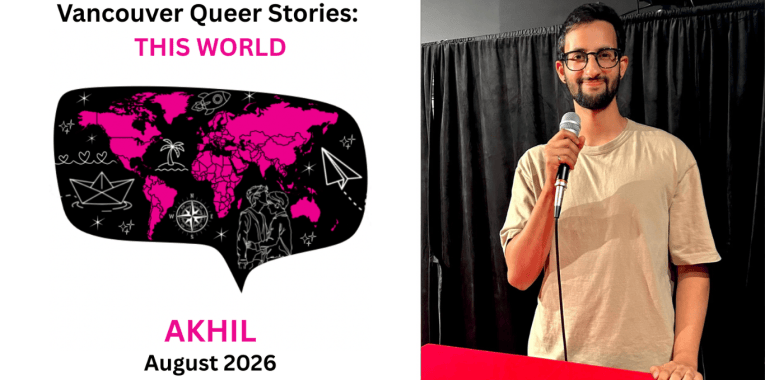
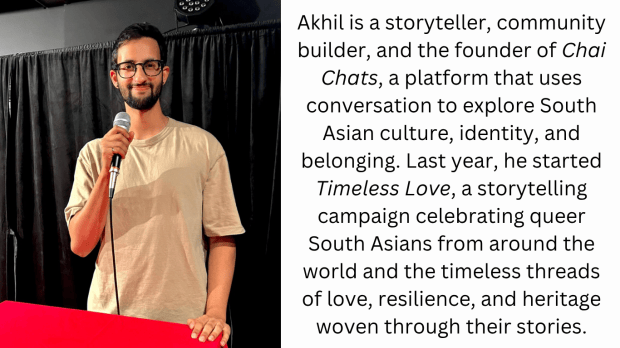
This World: Akhil’s Story

If you met me today, you’d probably never guess there was a time I could barely get a few words out. I was painfully shy. If someone simply asked me, “How are you?”, I’d rehearse the answer in my head over and over before stumbling through the words, grasping at air for support. I was terrified of saying the wrong thing.

School felt like a hunting ground..
I was picked on constantly for having what people called a “gay voice.” My classmates mocked the way I walked, the sway of my hips, the softness in my voice. Some days, groups of boys would surround me in the hallway like a pack of wolves, laughing while I stood there wishing I could disappear from the world.
I had spent years wanting nothing more than to fly away.
Then, in one moment of vulnerability, someone mistook my silence for permission. They reached for something that was never theirs, and when they left, it felt as though they had stripped away the very feathers that made me whole.
They stole my voice.
I stopped trusting my body. I stopped trusting my instincts. I convinced myself that the safest way to move through the world was to be as small and invisible as possible.
Silence felt safer than speaking.

But there’s something curious about silence. If you sit with it long enough, it begins to make room for other voices.
For me, it happened to be the voices of my ancestors.

I remember it so vividly. It was half past 9pm and my mother and I were nestled in blankets sitting together with cups of adharak chai and nankhatai biscuits, watching youtube videos exploring ancient Indian temples. I wasn’t expecting my life to change that night.

But then a strange sculpture appeared on the screen. I remember leaning forward, perplexed.
One half was unmistakably Shiva—matted locks, a strong jaw, broad shoulders, a trident resting beside him.
The other half was Parvati—soft features, flowing jewellery, a graceful curve through the waist.
They weren’t standing beside each other.
They were one.
One body.
One face.
One divine form.
Ardhanarishvara.

I couldn’t stop looking. How had I never seen this before? This image had been carved into stone more than a thousand years ago, yet in that moment, I felt like it was waiting for me.

For years I’d believed I had to choose which parts of myself the world would find acceptable. To be more masculine. Speak differently. Walk differently. Tone myself down.

Yet here, in one of the most sacred images of my culture, masculinity and femininity weren’t in conflict.
They weren’t competing.
They were in harmony.
Neither half diminished the other.
They were whole.

That night became the beginning of a journey I never expected to take.
One story led to another. One temple led to another. And before I knew it, I wasn’t simply learning about history anymore.
I was seeking refuge in my ancestors.

I came across the ancient chronicles of Shikhandi, A transgender warrior who was a central figure in the Mahabharata, one of India’s greatest epics.
I saw carvings of queer love etched into the stone walls of Khajuraho temple.
Two women.
Two men.
Lovers in embrace.
These weren’t hidden away in some forgotten text.
They were carved into the walls of temples for the world to see.

For years, I tangled intimacy with shame.
Yet here were my ancestors telling a completely different story.
Not with words.
With stone.
Love wasn’t hidden.
It was celebrated, honored and part of Prakriti–nature.

One discovery led to another.
I learned about Bhagiratha, born from two mothers.
I read translations of the Kama Sutra. There was one specific passage that I could never forget. It was two male lovers exchanging flower garlands, petals embracing each other as their first shared touch.
I had never seen queer love described with such tenderness.
Maybe because it was the first time I saw intimacy without shame.

The more I searched, the more I realized something.
The world I thought had rejected me was much older—and much kinder—than I’d ever been taught.
I hadn’t just been learning about history.
I’d been finding my way home.
The stories my ancestors left behind weren’t asking me to become someone new.
They were reminding me of something I’d forgotten—that I belonged.

Today, I tell stories. Stories of my ancestors. Stories of queer south asians. Stories that remind us we’ve always belonged.

I often think about how badly sixteen-year-old me needed to see something like that.
Back then, I thought I was the only one.
Now I stand beside queer South Asians from different faiths, languages, cultures, and backgrounds. I listen to their stories. We laugh together. We cry together.
And every single time i think about that lonely kid who believed there wasn’t space in the world for him,
I tell him… he was never alone.

When people ask me what changed my world, I tell them it wasn’t one story, or one sculpture or one temple.
It was realizing my ancestors had already made room for me long before I was born.
I spent years searching the world for somewhere I belonged.
In the end, I found it by looking back.
I found it in my ancestors.
I found it in my community.

And somewhere along the way, I found refuge in myself. 
Breaking Out: Sam’s Story

How could I have thought that the days of youthful innocence were the worst of it? Looking back now, it was easy. Life was full of the simple pleasures of childhood freedom: the smell of fresh-cut grass, the lingering haze that followed a midday shower before us kids took to the streets again, running amok with sun-licked shoulders, torn denim, and imaginations still in overdrive. Then Sundays would roll around, and my mother would force me to put on the freshly ironed clothes draped over the side of my bed for church. The image of my family was very important to her. Those little stints of angelic performance taught me how to wear different masks. I would present one way while feeling entirely different within. Much like the Gemini, June stood beneath the sun with two heads, one looking forward and one looking back. This was the month I was born.

Maybe that is why memory has always felt split to me. A collection of Polaroids carried around in my pocket like souvenirs: tangible reminders of moments I survived and experiences I would eventually grow from. But with enough time, like anything, those pictures fade. The edges blur. Eventually, even the person staring back at me became hard to recognize.

It can take a lot of courage to break free from certain parts of our lives. After constantly being labelled and dismissed as too sensitive and too emotional, I gravitated toward the other side of the spectrum: avoidance. Cramming my pain and fears into every nook and cranny. I easily confused escapism and the outward appearance of independence with genuine freedom.

My hometown was a small suburban community saturated in white privilege. With no visible examples of queer love, I never felt safe to express myself. I was a lanky kid who would cower in masculine, heteronormative settings. I wanted to peel off my skin and disappear like a shadow beneath a streetlight, barely present, wandering aimlessly.

It was only a matter of time before I found ways to cope. I am human, after all, inherently wired for survival. By the age of fourteen, I had built up walls, brick by brick, with every drink and every drug. My secret life became one of isolation and self-hatred. I was a master of disguise, portraying a life of fearless adventure when deep down, I was just running away from the queer kid I never wanted to be. I denied that kid love and connection, not just from others, but more importantly, from myself.

For nearly two decades, my addiction ebbed and flowed between multiple lives, geographical cures, absolute chaos, and blissful self-loathing. I risked it all in search of oblivion. Staggering through the alleys of the DTES, chasing the moonlight in meth-infested slums of the Philippines, or bruising my fists on a prison wall in Australia. I had found something that felt like a solution: comfort wrapped in the delicate lie of temporary relief. In reality, there was a consequence waiting on either side of that next drink or drug.

Convinced I was unworthy of love and unable to give it, I kept running. With every unfamiliar country, I hoped that maybe this time I could become myself and begin again. By the last few years of my addiction, I had ended up in a place I never want to return to. I had given up, completely defeated, carrying around a note in my wallet bearing the words “I’m sorry, I love you” scribbled in black Sharpie. I couldn’t find anything else to write.

I was exhausted; the weight of the guilt and shame had become unmanageable. Leaving me to believe that death was my only way out.

Just when I thought I was at the end of my rope, something washed through me. A flash flood of hope coursed through my veins, short-lived, yet it was still a feeling I hadn’t experienced in years. Seeing my sisters get married, start families, and build homes filled with Love and kindness made a part of me want to know what my life could be like. Could I face the pain from which I had been running? Did I have the strength to work through the guilt and shame? Did I deserve to have a life full of love? Could I accept my true, authentic self? These questions ruminated in my head for many sleepless nights, strung together like the beads of a
cursed rosary.

Thanks to the gift of desperation, surrender finally became possible. The prison I had created was one I longed to break free from. Starting with my older sister, whose relationship I cherish deeply, I began to tell my family and close friends that I was going to seek help. Three months in a treatment centre gave me the safe space to address the demons I’d been dragging across the globe. I learned healthy coping skills, laid the stones for a new foundation, and grew by shedding my old skin.

Here we are back in June, where the story started. I recently celebrated my fortieth birthday. Since getting sober, I have been living my life openly as a queer man, reaching a place of self-love and acceptance. Navigating new experiences, I have been able to let others in, form intimate relationships, build trust, and show up as my caring, vulnerable self.

Over the last eight years, life has handed me some of my most challenging lessons and led me down paths I never could have imagined. Facing one of my greatest fears, I went back to finish high school so I could get into college. In a month, I will graduate from psychiatric nursing. Never in my wildest dreams did I think this is where my life would end up or that my past would become one of my greatest strengths. It has given me the ability to relate to those who are struggling and to offer them a safe, empathetic, and compassionate space.

That imagination I abandoned in my youth has also returned in the role I now get to play with my nieces and nephew. I feel incredibly fortunate to be their gay uncle, someone who can show up honestly and help answer their questions about addiction, identity, and the queer community.

Every version of myself I tried to outrun has become part of me. They are what allow me to sit beside someone in their darkness and remind them they are not alone. Maybe this is what the two-headed June was trying to teach me all along, how to look back without turning away and how to move forward without leaving myself behind. My life feels like it is just beginning, and let me tell you, I have already lived many lives.

Breaking Out: Hans’ Story

My name is Hans Senfuma, and I am a gay man from Uganda. Writing that sentence still carries weight for me, even today, because for so many years of my life, those words felt like a death sentence — not metaphorically, but literally.

I grew up in a deeply religious household in Uganda, surrounded by people I loved and who loved me, but who I knew would not love this part of me. From a young age, I understood that who I was did not fit the world I had been born into. Uganda is a country where homosexuality is not just socially stigmatized — it is criminalized. And in 2023, the government passed the Anti-Homosexuality Act, one of the harshest anti-LGBTQ laws in the world, with provisions that include the death penalty. Growing up knowing that your existence is punishable by law does something to a person. It teaches you to shrink yourself. It teaches you that survival means silence.

For years, I lived that silence. I smiled at family gatherings when relatives asked when I would get married. I sat through sermons that described people like me as broken, deviant, an abomination. I laughed along with jokes that were made at the expense of queer people, because laughing was safer than flinching. Every single day was a quiet performance of a version of myself that didn’t fully exist. And the exhaustion of that — the loneliness of carrying something so fundamental about yourself completely alone — is something I don’t think I have the words to fully describe.

Coming to terms with my identity was not a single moment. It was slow, painful, and non-linear. There were periods of self-loathing that I am not proud of. There were times I prayed to be different, not because I believed being gay was wrong, but because I desperately wanted to feel safe in my own skin, in my own country, around my own people. Acceptance didn’t arrive like a revelation. It crept in quietly, over time, through stolen moments of honesty with myself — and eventually, with a small circle of people I trusted with my life.

Leaving Uganda was one of the hardest decisions I have ever made. It was also one of the most necessary. The escalating legal climate made it impossible to continue the work I wanted to do from inside the country without putting myself and others at serious risk. When I finally arrived in a place where I could walk down a street without fear, where I could say my name and my truth in the same breath, I cried in a way I hadn’t allowed myself to cry in years. It wasn’t just relief. It was grief — for all the years spent hiding, for the community I left behind, for the Uganda I wished existed.

But leaving didn’t mean stepping away. If anything, it sharpened my sense of purpose. I have dedicated my work to legal advocacy and policy change, fighting for the rights of LGBTQ people in Uganda and across the African continent. I believe deeply that change is possible — not because I am naive, but because I have seen what happens when queer Africans find each other, support each other, and refuse to be erased. I have worked with legal teams challenging discriminatory legislation, contributed to policy frameworks that center the voices of those most at risk, and tried in every way I know how to use whatever platform I have to make noise where there has been silence.

I carry Uganda with me everywhere. I carry its sunsets, and its warmth, and its music, and the faces of people I love who are still there, still navigating a reality I know too well. I carry the responsibility of speaking for those who cannot yet speak for themselves without consequence. That weight is not a burden to me — it is a privilege.

I am sharing my story because visibility matters. Because somewhere right now, there is a young gay boy in Kampala doing exactly what I did — shrinking, hiding, surviving. And I want him to know that survival is not the ceiling. That there is a life beyond silence. That he is not alone, and he is not broken, and he is not an abomination.

He is exactly who he is supposed to be.

And so am I. 

Breaking Out: Claus’ Story

In 1990, my teacher warned my best friend’s mom not to let her daughter, Daniella, hang out with me, because I was rarito – a Spanish word that directly translates to “queer.” Like its English counterpart, rarito means “a little strange,” or “a little peculiar.” In Mexico, it specifically refers to men who appear to be gay.

It probably wasn’t hard to see that I was gay: I never enjoyed playing rough games or sports with the other boys, opting instead to play house with the girls at my school. My teacher knew I was gay before I realized it myself. And, rather than choosing to provide support or guidance, she tried to isolate me—an already painfully shy and very socially awkward little boy— by separating me from the one person that I connected with fully at the time. As if a rarito, a queer, didn’t deserve acceptance.

I was seven-years-old.

As the years progressed, so did the insults. If I thought rarito was bad… I had it coming. When I moved to another state at the age of 10, I spent one year in an all-boys school. The insults there became more pointed – maricon, marica, joto, puto (all words for fag — we seem to have a lot of them in Mexico). I then moved to Canada at the age of 14, and was introduced to the English variants of these insults.

When I look at photos of my childhood, I see a naive little queer boy who smiled widely, unaware of the way others perceived me — when teachers called me queer behind my back, but not to my face. But in photos from my teenage years, I see sadness. Not the typical teenage angst, but something deeper. The sorrow of someone who sometimes wondered if life would ever get better.

At 42, I can look back at these snippets of my life with clearer eyes. To my teenage self, I can truthfully say (as cliché as it sounds): it does get better. But it also gets difficult in new ways, because self-acceptance, and pride, and queerdom, isn’t always linear:

In 1992, I had my first crush. His name was Mathias, a German classmate with golden hair… which is odd, because I’m not typically attracted to blonde men.

In 1996, I had a platonic bromance with my friend Jorge. I moved away the next year, and he came out as gay in our 20s. We kept in contact, but never saw each other again, and he died of Covid. I sometimes wonder if I hadn’t moved away, if he might have been my first kiss. 

In 2000, I had a crush on a girl from high school. But at the same time, I was deeply attracted to so many of my male classmates. It was a very confusing time. I was repressing my sexuality so much, that when one of the guys I was crushing on slapped my ass during PE class — not sure if he was flirting or bullying me — I responded by slamming a hockey stick to his stomach. Hard.
A week later, he returned the favour, slamming a hockey stick against my shins, which fucked up my legs for years to come.

In 2002, at the ripe age of 19, I went on my first date… with a girl from university. Sarah was also my first kiss, which I didn’t enjoy at all. That same year, I went on my first date with a guy. His name was Danny. My name was “Nick…” yes, I used a fake name, because I was still terrified that someone I knew would find out I was gay! Danny was my second “first kiss,” which was more like it. He went on to become my first of many, (many… many) boyfriends

❖ ❖ ❖

When I came out to my friends at 19, their response was mostly positive, but I did lose some friendships over it. When I told my friend Nelda, she responded by asking me: “So what, you like it from behind?,” as if that is the only thing that makes a man gay. I was a virgin at the time… but to answer your question, Nelda – Yes, I do like it from behind.

A year later, in 2003, I came out to my brothers and then my parents. My middle brother had softened the blow by coming out the year before, which simultaneously made things better and worse. I didn’t know at the time that having multiple queer children in one household is actually very common.

In 2009, while holding hands with my boyfriend at the time, someone inside a passing car yelled “faggots,” and threw a jawbreaker at the back of my head. This was on Davie Street. During Pride weekend.

In 2014, I met Eamonn, and we got engaged five years later. When I got engaged, a woman who had worked in the same office as me for four years asked, after seeing my engagement ring, “Where did you propose to her?” I thought it was funny at the time. Then I realized how much of my life I still kept private from non-queer people I saw every day. It seems I’m allegedly “straight-passing” in some circles and find the constant “coming out” exhausting. 

❖ ❖ ❖

My relationship with Pride has also had its ups and downs. 

In 2004, I went to my first Vancouver Pride, and over the following two decades, I’ve been to many prides and queer-centric events throughout the world. London, Cape Town, Reykjavik, Buenos Aires, Guadalajara… even exotic Winnipeg — searching for queer joy in every time zone.

In 2022, I marched in a Pride parade for the first time, with the Vancouver Queer Irish group, and then again the following year. Yet, since last year, I’ve fallen out of love with Pride parades. With sponsor pullbacks, corporate and government support of an ongoing genocide, and the rights of trans and non-binary folks under attack, I’m feeling disconnected. I know we need visibility… but I keep wondering if we need to change the method. “The first Pride was a Riot,” they say… maybe it’s time we go back to marching on the streets, rather than parading on them.

In 2063, when I’m 80 years old, I’ll hopefully look back at today, and realize how good we had it. But I also hope that things will get much better for queer people over that time, because this, still isn’t it.

❖ ❖ ❖

In 1990, when I was 7-years old, my teacher called me Queer as an insult for the first time… behind my back, of course… Cabrona.

In 1998, someone wrote ‘faggot’ on the back of my sweatshirt in high school… and I wore it that way all day, because I didn’t notice until I got home.

In 2002, I came out as gay to my friends. A year later, I came out to my family.

In 2016, I began using the word Queer as an umbrella term to refer to myself, my friends, and other 2SLGBTQ+ people, in a positive light.

In 2022, I married Eamonn in two wonderful celebrations of the most immense queer joy, surrounded by so many of our friends and family.

Today, in 2026, I stand here, in a room full of queer people, telling our stories. And I finally realize: being a little strange, a little peculiar… a little rarito, if you will, is actually something to be proud of.

Breaking Out: Beto’ Story

COVID Made Me GAY

It was late one evening, at dinner time, when my mother broke down in tears. A first for my then 29-year-old-ass.

We don’t cry in my family unless we are watching a sad movie. Even then, it’s a game of who can blink their tears back in the quickest. We don’t hug or kiss unless outside airport terminals and we only text “Love you!” right before takeoff, just in case the plane goes down.

Seeing my immunocompromised mother cry right in front of us, chicken still half-chewed in my mouth, I knew this was serious.

It was April, 2020. We had been hearing about this killer disease and every night we saw the case numbers creep closer to our own social circles.

After consoling her by saying that this would fizzle out in a few weeks (we were a bit short), I escaped to my bedroom.

Is this it? I thought. Is this how we go?

And more importantly: Am I going to die before getting to be gay?

❖ ❖ ❖

The first whiff of queerness arrived when I was 13, in a random dream where I saw my cousin laying in bed wearing bright blue briefs. I hovered towards him, Nosferatu-style, until my hand was but a millimeter shy away from his bulge, only to suddenly wake up.

That night sealed two fates: I was going to have a fluid sexuality and I’d never see the 3rd act of any sex dream.

For the next 15 years, bogged down by toxic prejudgments and not exactly feeling “100% top, masc to masc, no smooths, no twinks,” I was like: Why even bother? I’ll just carry on as a straightie, occasionally lusting for Zac Efron’s biceps like any normal, liberal dude.

But then COVID and the threat of imminent death appeared.

❖ ❖ ❖

In January 2022, I moved to Vancouver with three goals: be social, be gayer, and marry quickly to stay in the country. (I’m still missing the third, please inquire after the show.) By nightfall, I had downloaded Grindr.

“How goes it?” a faceless profile asked.

What does that mean? How goes what? I thought. “Hi. How are you?” I replied.

Though surely thinking I was a little slow, this faceless man kept texting and before I knew it he shot: “Send pics.”

“Ok. What do you want to see?”

“Dick and ass,” he replied.

What an assertive man, I thought. I hadn’t planned in advance, so I quickly scrammed to take some pics lest I lose the attention of this prized individual. I was more pressured than aroused, so my photos didn’t represent my full potential. Even so, I must’ve charmed him because he then shared his location.

I was staying at an Airbnb near 41st and Knight. The map showed him across Duffin Donuts, south of a Shell station.

“On my way,” I sent, and my body started shaking uncontrollably. Oh – wow. Being gay is super fun, I thought.

I went outside. The wind had picked up and that Pacific Northwest mist felt a bit like horizontal rain. The weather and my nerves were wreaking havoc on my Mexican skin.

As soon as I turned the corner where this dude lived, I froze. It was a dark, damp, and scary-looking backstreet. I’ll get murdered, I thought. I’ll star as a victim on one of those Netflix exploitative documentaries about homosexual cannibals, confirming my parents’ belief that gays are ‘More passionate than straight people’!

I ran back to my Airbnb.

“Sorry. I’m actually kinda cold – lol,” I texted.

“No problem. I get it. You’re new at this. I could tell,” the would-be-cannibal replied.

❖ ❖ ❖

Even though I eventually wanted to find my legally Canadian partner, I wanted to have some fun before committing. Unfortunately, within the following weeks I discovered I sucked at hookups.

It would always go something like this:

1 – Get horny EXCLUSIVELY after 11pm on a weeknight and find a suitor after an extensive background check.

2 – Invite them over after making sure—just in case—that they knew my big, rugby-playing roommate was sleeping next room. (I live alone.)

3 – Shiver uncontrollably during foreplay. “Are you okay?” “Just cold,” I’d whisper next to my roaring heater.

4 – Say goodbye with a “Sorry. I think I’m just tired,” after failing to finish the deal. “But coffee sometime?”

5 – I’d get blocked.

My body refused to cooperate with my desire for casual sex. After a few lukewarm wins, I theorized hookups weren’t my jam. I was, apparently, a monogamous family man.

❖ ❖ ❖

A couple months after, I had moved into my current place—a garden suite located in one of those “scary backstreets” which, turns out, are quite lovely. My Grindr exploits had slowed down since I started dating this dude who, I was sure, was going to be my forever.

Being my first homosexual relationship, I unfortunately fell infatuated with the guy, which made the text he sent me one night hit like a brick:

“Hey, I think I see you more as a friend.”

“Oh—“

“And I’m also kinda married.”

“Ah.”

I was not looking to break up a marriage, but I was baffled. What happened? Am I boring? Ugly? Not gay enough? What does his husband have that I don’t? Pick me. Choose me. LOVE ME.

❖ ❖ ❖

“Can you fart all over my face? You’re so hot,” read a message on Grindr. I had gone back to the app after a couple of weeks of listening to Sam Smith, journaling, and burning letters.

“Oh – wow. How does that work?”

“Special chair. You sit; I put my face under it.”

Despite just having a protein-heavy dinner, I politely declined. I’m pretty open but wasn’t in the mood to take that kind of a dive.

“You know you can monetize this?” my brother said after I shared the screenshot.

“I don’t think my visa allows for this type of entrepreneurial venture,” I replied.

❖ ❖ ❖

Months turned into years of me being on every app and meeting random men. I got better and more confident in my hookups and dates, but something still hadn’t quite clicked. Much like snow in Vancouver, nothing stuck. I was still missing something. I kept having these brief connections that led only to me sending them off into the night.

In January 2025, my brother and best friend both moved away during the same weekend, leaving me at zero: no friends, no family, no partner. After allowing myself a two-day pity party, I got to work on a new, more critical mission: finding community.

I started attending every event or public meetup that came across my desk. Running groups, drag show events, art exhibits, board game nights—nothing was off the table. I started dancing with strangers at 1181, cheering queens at Junction, sharing beers with bears at Pumpjack. And slowly, something started to finally click.

In my limited view as a prejudiced baby-homo, I thought being gay meant being a regular dude who happens to have sex with men—which is true. But I’d missed that being anyone means being a universe of thoughts, history, connections, feelings, beliefs, perspectives; and being part of a community meant sharing these universes.

By hyperfocusing on trying to find sex and partners, I had been living vicariously through morsels of experiences men shared with me between climaxing and the door.

It is through actively participating that I’ve started to scratch the surface of actually being part of a community. Talking to people, sharing stories, and celebrating one another is what has made me feel closer to “being gay.” And what a joy it’s been!

❖ ❖ ❖

“If you ever need your pits licked, let me know,” someone texted me the other night.

“Sure,” I replied. “… but we gotta be quiet. My big, rugby-playing roommate is sleeping next door.”

I still live alone. 

Celebration!: Luis’ Story

I’ve blown over 30 sets of candles in my life.
Most birthdays spent wishing I could sing.
I remember the last time I asked for this one thing,
Realizing I don’t have the necessary vocal strings.
But could put into metaphors, lyrics what I think.
I stopped wishing there and then, on my 10th,
For a voice that’d give me strength, just I wait.

30 doesn’t sound like a lot if counting my breath
Warm whispers that keep away rapid death.
30 reps pump my chest, 30 degrees is hot.
30 likes on a poem’s a lot, 30 on my selfie is not.
30 years young I decide will not bring me stress,
Bring on as many second adolescences as I have left.

For my birthday this year, I wish for a full fridge.
So that with it, I can build long, delicious bridges.
For my family, friends, lovers to be here with me,
I wish my homies are healthy, happy, at peace,
And for many more years, share stories and tea
That might spill, and show off our vulnerability.

I wish to fall in love constantly and against all the last decade’s wishes, stay single. As in centred, focused, whole, in what most of my self-help books have foretold. Life is worth living because of the people we keep around as we get old. I hear the birthday song, the beautiful melody, the voices in unison and join the chant with my mediocre tune. My lifelong worth of wishes came true. 

I sing myself a happy birthday because I get to celebrate it here with all of you. 

Today is my birthday.

As the years pass, I feel like I’m evolving into a body and mind that better fits the old soul I was born with. Although inevitable, it is a privilege to age, especially in the LGBTQ+ community, but what I would like to celebrate today is the opportunity to grow. Grow up, grow fond, grow apart.

An early memory that I can pinpoint rapid growth to was when I, age 6, wrote a confession to my parents about who had clogged the toilet with toilet paper. They had cancelled my sister’s and I’s nightly storytime and that would not stand. I had to act, swallow my shame, and leave them a letter at their bedroom entrance that must have said something like: “It was I, I clogged the bathroom and, worst of all, said nothing when storytime was cancelled.”

Decades later, I remember writing what I’d say to my school’s Head of Program after a couple of bullies, who caught wind I was gay, started to throw homophobic threats around. Eventually, this conflict led to me coming out to my parents. Without a script, I rendered my emotions in real time during that Zoom call home, kicking off another era of massive growth in my life when I “formally” joined queer spaces and started to befriend my fellow gays.

Dating and being alone at bars sucked. I wish someone had warned me, I think there were lessons that didn’t need to be learned through experience. I’m extremely grateful today for spaces like The Birdhouse for the buddy system and their practices adjacent to the Good Night Out Campaign. In this last year, I’ve noticed a younger vibe in the crowd at some of the bars I frequent. Some are incapable of saying “I’m not interested”, “not right now”, “please don’t touch me” when unwanted attention comes their way, others, stunned when that unwanted attention doesn’t take a hint to back off. I see myself in them.

I wrote this spoken word poem from a night we came together to celebrate another year of our lives passing by:

Well hello there Daddy.
I caught you looking and thought to say hello.
I’ve seen this on a porno, how these things go.
“What are you into? What are you looking for?”
I guess, a short convo or to get down on all four.
To submit into obedience in a kink experience.
We can both play our roles, say it’s coincidence,
To find guidance in another generation’s resolutions.

Instead, you offer your hand and ask to dance.
So close to midnight, I see it’s time and give him a chance.

Knowing we’ll recreate dynamics from before.
From when we were boys and didn’t know more.
Tell me Daddy, did you have a Daddy to call you son?
Or buddy? Or bro? Or baby? Or boy?
Did you have someone to say you’re valuable?
Without queer role models to show us the hopes,
On sex or intimacy, how to untie bondage ropes.
Tangling my neck on all these cables and cords,
I’m choking, I can’t breathe, I let the pressure go.
Out of one patriarchy and into another. I say no.

I look for things that’ll ground my concussions.
Your crow’s feet, furrowed brow and bruises
Remind me of my muses, past, present, future.
Age befits your years of experience and culture,
Your fingers in my hair untie curls with nurture
Soothingly against the grain of a calm brain.

This is my kink, agency to see if we’re in sync and
What’s meant to be addressed by a shrink.
Have we met before, Daddy? I was but a twink,
Fresh meat at a gay bar, my glasses tinted pink.
Looking for greener grass, getting ass grabbed.
The sexual revolution says to get your needs met
But even people leaving the sex party say meh.
As if that’s the point of it all, to get your dick wet.
Not the safe spaces for the rest of the alphabet.
Not the right to exist, you have it, so you forget.
Not the shame taught everywhere as a preset.
The default morals I recall and bring me regret,
Versus the gay values reducing me to an asset.
Hard earned, liberating, blissful gay sodomy.
Personally, would that make my best self happy?
To have 30 random stranger loads inside of me?
Would it cure me? To assimilate foreign culture?

Under pressure? Fuck no. Freely, I don’t know.
The lack of conclusions glitch with my delusions.
Daddy, I recognize you as my reality fractures.
Plot twist, reparenting myself in a meta rupture.
In your eyes, Father Time shows me my future.
I’m in a modern orgy of what feels right for us 3.
That I’m present Me, I’m Daddy, and I’m Baby.
New Year’s a step closer to that state of mind
Where I don’t perpetuate outdated philosophy,
Whilst adapting ideas that preserve my sanity,
Integrity’s reconstructed protecting my inner child with
A confident introspection I practice and embody.
Midnight. Alone on the dance floor when a man comes up to me.
He asks for my name. You can call me “Daddy”.

Being able to verbally request and provide consent is oftentimes not prioritized by men. Historically, bathhouses, circuit parties and cruising communities thrive on physical expressions of interest. It’s imperative and fun to learn to recognize and apply these cues in those spaces, but outside of them, they seem more like outdated survival strategies for generations and legal frameworks that should be more aware of power dynamics.

Suddenly, I’m being addressed as “daddy”, “zaddy”, “stud”, even “sir”. I find myself on the other side of my experiences: I share with friends the weight of responsibility I feel on my shoulders. I don’t want to treat these men like I was treated and I’d rather carry this awkward awareness forward than continue to inadvertently perpetuate harm between us. Some say its a heavy burden to carry, most have simply grown used or fond of it. Others deny and gaslight the idea that sexual assault happens around us, best to grow apart from those people. I’m relieved there’s more public conversations facing the challenges of entering gay spaces for the first time, providing advice and validation that for me came later in life when I felt heard and seen in friends’ stories.

Dating and being alone at bars still kinda sucks. Recently, I went out on my own again, like I did years ago when I came out, knowing now the impact of meeting at least one friendly face. I went out knowing my worth and the difference that makes in who and how men interact with me. I went out confident in the work I’ve put in so far and how strange it will feel to change. I went out on stage to compete for the biggest ass competition, and lost. 

There’s plenty to celebrate today: the community spaces that allow for vulnerability to exist, the privilege to age, my 31st birthday, the confidence to speak my mind, and most importantly, the growth of a social circle, aka my friends. It is mainly through them that I’m de-aging my old soul, like a gay Benjamin Button, and relearning what it’s like to be included, safe and silly. I’ve grown into what my therapist would call my Protector persona, partially because of the years, but mainly due to the kind and understanding connections around me. I have no doubt that my Protector is a kaleidoscope of me and all the past, present, good, bad, long, short friendships I’ve had the opportunity to interact and learn from. Thank you for helping me become a person capable of saying, kindly and unapologetically, “no”. 

I love you all, as friends.

Celebration!: JJ’ Story

“Please report the video. I hate that your faces are on there with no consent. Getting everyone to report it.”

It’s 2023 and I’m at a bar on a first date. He’s in the bathroom when I get the text from my work wife; it’s accompanied by a Twitter link, posted by an account I’ve never heard of, Libs of TikTok, with the caption: “Elementary school in Vancouver held a pride parade today. Homeschool your kids!”

Even before playing the video, I recognize myself in the thumbnail. 

The video starts with me walking by shouting “Happy Pride!” followed by my students and several parents, waving, cheering. A few more clips of students walking by, smiling, waving rainbow flags, before it ends.

My date sits back down, and I show him the video, and proceed to chuckle about some of the comments. 

“Give me an S, Give me an I, Give me an N, SIN!”

“Those boys look “sissified” to me”

“It’s a free for all, next is orgy day”

And my personal favourite, the one that, to this day, I still lowkey want to get tattooed on my body: “Homeschool > homoschool”

Already the video has hundreds of thousands of views. I want to keep reading the comments, but don’t want to be that guy, so I put my phone away, and break the tension with a quip.

“How does it feel, knowing you’re on a date with a queer icon?”

The next day our staffroom is buzzin’. Coworkers tell me they’ve reported the video, my principal checks in to see if I’m okay. The video quickly balloons to 1.4 million views. In the comments, someone posted a screenshot of me from the video, wearing a rainbow cape and shiny cowboy hat, with the caption “Found the groomer!”

Another person comments on my picture, “He’s just a flat-out molester. He doesn’t even bother with grooming.”

My friend at the union reaches out, says there’s a lawyer on staff if I’m interested in trying to have the video taken down. We all report it, but all that does is hide the video on our accounts.

Repeatedly, I say I’m okay. That we’re celebrating Pride for the kids who don’t know they’re queer, or don’t feel comfortable being open about it yet, and if it makes things easier for even one of them, then it’s worth it. 

But writing this story and revisiting that video in 2026—thankfully stalled at paltry 1.7 million views—my whole body still burns.

I scour the video’s comments section for the funniest pull quotes, trying to discern what’s awful in the entertaining-let-me-read-this-out-loud-to-strangers way and what’s awful in the oh-boy-I’ll-probably-have-to-talk-about-this-in-therapy way. The margin between them is narrower than you think.

I was bullied and called gay before I even knew what that word meant, but I knew that I was supposed to vehemently deny being it.

In sixth grade, I received a friend request online from the email account “jjisgay99@hotmail.com,” one of those memories that’s hilarious now, but at the time, felt like someone had ripped the uvula from the back of my throat.

I’d stay in the closet for almost two decades longer, dating women, participating in casual misogyny. Talking about which actresses I thought were “hot,” but really, I probably just thought they had a nice smile. 

It wasn’t until 2020, when, after having my first session of therapy, I knew I was ready to start living authentically. The next day, my 30th birthday, I came out to the majority of my close friends at a socially-distanced pie-themed hang in the park, scrawling “I’M GAY” on the inside of a pie box—the pie was peach-cardamom, obviously.

The atmosphere was one of compounding disasters: sitting on blankets six-feet apart, unknowingly about to embark on the second wave of the pandemic. The sky was muggy and thick with forest fire smoke and a recent looper moth infestation surrounded us with thousands of fluttering bugs.

It was one of the best days of my life. 

After coming out during lockdown, I struggled with how to relate to the queer community I suddenly found myself identifying with: my main connections being gay meme accounts on Instagram and a parade of COVID-safe dates that always ended back at my apartment. Dr. Bonnie Henry would certainly agree our activities involved a curve, though none flattened.

One first date, after a guy spent most of the night talking about how much he wanted a boyfriend, we ended back at my apartment, carnally making out on the couch, before he climbed on top of me, squeezed my cheeks together, and hawk-tuahed a single oblong strand of saliva slowly into my mouth. “Sir, we are in a pandemic here, you can’t just spit in people’s mouths, especially without asking first.” We still had sex, of course.

Fucking this rogues’ gallery of strangers felt necessary at the time. Fleeting connections to the gay community, sharing coming-out-stories with cum still leaking out. Hearing about Internet chatrooms and early cruising. I was a cultural anthropologist, absorbing every detail and mentally cataloguing to better understand where I fit.

Later that school year, I was recruited to help organize my school’s first-ever Pride celebration. Starved from no parties in almost 15 months, I brought a finely-curated selection from my personal tickletrunk for my kindergartens. Flamingo sunglasses, a taco hat, sequined fans, an inflatable telephone.

Suddenly, at 30-years-old, I was marching in my first Pride parade.

For the past six years I’ve helped organize and grow school Pride celebrations, each with their own lil’ moments. After our neighbourhood parade in 2024, we headed to the school’s backfield and performed a flashmob to families, all to the song “Born This Way.”

When I’d talked to my kindergartens about what other Pride celebrations involved, my students globbed onto the idea that people sometimes dress up, and asked if they could wear costumes—which is why, in videos of that flashmob, you can see Disney princesses and superheroes dancing to Lady Gaga.

I want these to be the stories I share about school Pride, but it’s important to know it’s not all rainbows and five-year-old Captain America dancing to Gaga. 

Like when kindergartens from my class are noticeably absent the day of the parade, because their family “doesn’t celebrate Pride.”

A parent’s venomous email to a colleague, calling everyone at the school pedofiles; the same parent who, later that month, smiled and cooed to me about how she hoped her son would be in my class next year.

The idea that schools are somehow brainwashing youths by showing support and normalizing words like “bisexual” and “trans.” 

“I’ve been teaching for decades, and I can barely teach these kids math. And I’m a math specialist!” a colleague shared with me, exasperated. “They think I can somehow influence these kids enough to change their whole ideology or gender?!”

Knowing teachers who’ve been doxxed, received death threats—putting themselves at risk while trying to make things safer for queer youth.

There’s decadent irony that, in tandem with writing this story, I’m helping organize this year’s Pride at my school. 

We’re going bigger, bolder, louder. A coworker designed a Pride 2026 logo with our school’s mascot, and managed to get custom stickers donated. We’re inviting neighbouring schools. We have a whole spirit week planned, a dance party, a photobooth. We’re getting T-shirts made as a fundraiser. I get giddy thinking about how amazing this year will be. Usually that excitement drowns out all the what-ifs. 

I’ve been working on a handout, highlighting statistics about queer youth, for families to help understand the importance of Pride. Pulling from Statistics Canada empirical gut-punches like how queer youth are twice as likely to describe their mental health as being poor; they’re more likely to be targeted for bullying, experience homelessness, and twice as likely to consider suicide; how trans and non-binary youth are twice as likely to experience cyberbullying.

I triple-check my sources with a diligence I wouldn’t have dreamed of during my English undergrad, knowing these stats will be scrutinized with the vigor that only a bored, privileged suburban parent can muster. 

I hate having to take the more thoughtful high road. Having our “We want every kid to feel safe being who they are” met with “You’re all pedofiles,” coming from zealots whose churches, businesses, and governments knowingly protect actual predators. But I digress.  

Progress can sometimes feel small.

The odd joy of when reading a book to my class, a student refers to someone as “gay,” and my body seizes up like they’re using a slur, when in fact, the book has a family with two dads. Gay as a descriptor, not an allegation.

It took until my mid-30s before I saw being gay as a gift. A hard-won title after a lifetime of being teased for liking things I didn’t even know I liked yet; the finally-satiated hunger of someone who spent years eating what they weren’t craving. Let’s hope the next generation gets to feel this lucky some day.

And if you need to contact me or have any questions about this story, you can always reach me at jjisgay99@hotmail.com.

Celebration!: M.’s Story

I’m turning 30 this year.
When I found out the theme for tonight was “Celebrate,” I started thinking about that word. Celebrate. And I realized, I don’t think I really know how to celebrate myself. Which is weird, because I’m gay, Lebanese, kind of a drama queen, and emotionally attached to both Arabic and English pop music. On paper, I should be excellent at it.
And I genuinely love celebrating other people. I love showing up. I love planning. I love hosting. I love making people feel loved. I’m good at it too. Maybe too good. I will plan the timing, the food, the vibe, every small detail and pretend that it’s no big deal, but emotionally, there is a very serious project plan.
But when it’s about me? I become aggressively casual.

A couple of months ago, I “celebrated” two years in Canada by going to a St. Paddy’s gay party at the Junction. Very convenient: one of the biggest celebrations of the year was already happening on my anniversary. The universe forcing me to celebrate my milestones.
Fair play, universe.

But birthdays are worse. Because birthdays are the one day of the year where you’re allowed to be a little self-centered, and I still don’t know what to do with it.
Last year, on my actual birthday, I scored tickets to Lady Gaga’s Mayhem Ball.
Picture this: A gay Lebanese boy, now an adult, watching Lady Gaga sing “Born This Way” live. And then the words: “You’re Lebanese.”
I’m not even that patriotic. But so many of my early queer moments happened with that song playing secretly through wired headphones, pretending I was just listening to music, when really, I was trying to feel seen.
And if Lady Gaga, mother of monsters, said “Lebanese,” not Middle Eastern, not Arab, Lebanese, then she was clearly speaking directly to me. That song was celebrating a part of me before I knew how to celebrate it myself.
It’s going to be hard to top a Lady Gaga concert as a birthday celebration. But this year, I’m turning 30. And there is a version of me who wants the balloons. The cake. The friends. The photos. The whole shebang.
I know he exists, because once, he fought very hard for a birthday party.

I’m the youngest of four boys, which means by the time my parents got to me, the parental sparkle was running on low battery.
But the photos were there. Printed albums. My brothers with their friends. Finger food. Cups of Jell-O. A big cake made by my mom. Awkward parents in the background. Kids playing arcade games and mini golf at this place called Putt Putt.
Putt Putt was everything: Arcade games. Skeeball. Ball pit. Chaos. If you had a birthday there, you were basically local royalty.
Every brother got Putt Putt. Except for me.
To make things worse, my birthday is in August, which is terrible timing if you want a big party as a kid. School is out. Everyone disappears. Half the class is at their village, the other half is at the beach, and suddenly, your birthday is a logistical crisis.
So I made my parents feel bad about it. And it happened that my dad did business with the owners of PuttPutt, so it didn’t take much convincing.
I may have also pulled the “you don’t love me as much as my brothers” card. Bold strategy. But hey, it worked.
And somehow, I convinced my parents to let me do it two months early: June 9, 2006. The day after the last day of school. Also, the first day of the FIFA World Cup, so almost exactly twenty years ago (Very convenient time to tell this story… And very organized of my trauma).
And because it was the World Cup, the theme chose itself. Football.
Now, did I play football? No. Did I care about football? Also no. In fact, I kinda hated it. Playing football as a closeted gay kid with straight boys going through puberty? Not fun.
But it was football season, and you have to understand, people in Lebanon take that very seriously. And I wanted to look cool, so football it was.

I had the party. I had the place. I had the theme. I had the friends. Basically my entire class. This was my moment. I was wearing a Ronaldinho Brazil football costume, because obviously, I LOVE football.
Everyone came, (Well, everyone I invited. I had just gone through a huge fight with my best friend at the time, and I decided not to invite him. I don’t remember what the fight was about, but I was very firm about it. I remember my dad looking at me and asking, “Are you sure you don’t want to invite this boy?” And I said, “Yes. We’re not friends anymore.” I was so sure I didn’t want him there. But for someone I apparently didn’t want there, I kept noticing that he wasn’t).
The party itself was going really well. I remember parents walking in with their kids. I remember the mountain of gifts. I remember my mom’s cake, a forêt noire, with a chocolate football-shaped ganache on top. Keeping it on theme. We’re committed.
Because again: I LOVE football.

Everything was happening exactly how I wanted… then came the piñata. Yup, I had a candy pinata at my birthday party. What shape was the piñata, you ask? A football, of course.
You have to understand, back then, a piñata was a big fucking deal. At that point, I had only seen piñatas on TV in cartoons. So having my own piñata, one I got to choose the candy for? Hell yes.
They hung it up. The kids gathered around. Everyone got a few hits. People were screaming. The energy was rising. And then the birthday boy got the stick.
I started hitting it. I’m going at it. I’m ripping it apart. Everyone is screaming. And then eventually, it breaks.
And the second it broke, it was no longer a birthday party. It was capitalism.
Kids dropped to the floor like wild cats. Hands everywhere. Candy flying. Elbows out. No morals. No friendships. No birthday etiquette. It was my Hunger Games. And I had lost.
Because there I was. The birthday boy. Standing with nothing. I remember looking at my hands and realizing they were empty. And I tried to hold it in. I really did.
But then people started noticing. Kids looked at me. Then they looked at their bags of candy. Then back at me. Suddenly everyone realized, OMG… the birthday boy didn’t get any candy. And because it was my birthday, everyone started offering me some of theirs.

Aww. That’s so sweet.
It was HORRIBLE, because somehow that made it even worse. Now I wasn’t just the birthday boy with no candy. I was the birthday boy everyone felt bad for. And I couldn’t hold it anymore. I started crying. Hard. Not cute crying. Full meltdown. Birthday drama queen.
And if you’re thinking, “Oh God, poor kid, that must have been so embarrassing,” well, there’s more. Even through the tears, I had a plan. What? I’m just gonna stand there and let people feel sorry for me on my fucking birthday? No way José.
I looked at everyone, face fully wet, probably snot involved, and said: “Everyone… throw the candy back on the floor. We’re going again.” Which, looking back, is insane.
Imagine being a kid at a birthday party, and the birthday boy is sobbing, demanding a second round of candy distribution, after going through WrestleMania with at least 20 other kids. Very socialist of me, honestly.
But hey, I was ten. It was my birthday.

Now, I’m not saying this one piñata is the reason I don’t know how to celebrate myself. That would be too easy.
The thing is, when the celebration is for someone else, that works. I get to focus on them. But when it’s for me, suddenly I can’t just enjoy it. I have to manage it.
Is the food enough? Is the music right? Are people bored? Is the lighting homophobic?
And I think that’s the part I still negotiate with. The embarrassment of wanting the day to feel good…. And by good I mean, perfect. Obviously.
Because even now, when someone asks, “What are you doing for your birthday?” I feel this little panic. Like I need to have an answer that sounds casual enough. Not too sad. Not too planned. Not too desperate. Something like, “Oh, nothing big.” Which usually means, “I would love for it to be big, but I’m not ready to be responsible for wanting that out loud.”
But one day, I would love to have a big party that is actually for me. Maybe for another age when I become more chill, because honestly, just saying “my 30th” spikes my anxiety.

But I want to try anyway. And I don’t think I need to top Gaga. I think I’m just trying to find whatever version of that feeling I can make for myself. It could be a big party, with a giant dick-shaped piñata, just for me.
Or maybe it’s quieter than that. A little stoned. Surrounded by people who love me for who I am. Without having to pretend that I like football.
Looking around and realizing I’ve built a life that younger me would not believe.
And honestly, for now, that feels worth celebrating.

Beauty: Luis’ Story

Watch this video of Luis telling his story!

When I was young, I went through a collage phase. I probably looked all around my house for whatever magazine I could get my grubby hands on. I specially recall the damage to a beautiful special edition magazine of Princess Diana.

I know this because my mum told me after asking her about this botched magazine she, to this day, still keeps around. I can only imagine how my mum felt after I destroyed it. Our relationship has had its ups and downs, but in my mind, my mother is deeply associated with the image of Princess Diana and their admirable capacity to be graceful to those who need it most.

I grew up as a pretty happy child up until late middle school when I became depressed, as many other gay men have at some point in their lives. Again, my history with mental health has its ups and downs. I’ve banked my share of hours with therapists but recently I’d plateaued in my progress. Last year, I made a breakthrough. I honor my story by highlighting the importance of taking yourself to therapy. 

The DIANA Magazine in Question

One symptom I keep a look out when gauging my state of mind is my capacity to find beauty in life. I believe a sense of beauty is a psychological skill we can train or lose. To see it, notice it, name it, replicate it. At my worst, I stop watching TV shows, I stop eating sweets, and I isolate myself. Inversely, I write more poetry when I am processing negative emotions, this skill has allowed me to tap into my sense of beauty and pull myself out of a downward spiral. I’d like to share a spoken word poem about what I think psychological beauty is:

I’m on my knees. The congregation says Grace.
I look up towards high ceilings, the tainted glass,
Dramatic imagery in art, stone, oil, wood, brass.
Engulfed in what they say is beauty, yet I don’t see your face.

My favourite part of going to mass is leaving.
Outside, street vendors sell all types of food.
Outside, what is actually a religious experience
Tastes like fried, steamed home cooked goods.
Outside, I eat sugar just to help boost my mood.
My sister and I resist the Sunday public shaming,
My parents show us grace, your beautiful face.
I’m not asked to go with them again, embraced,
and still picked up for a meal, my soul’s soothed.
Coming out decades later, I still seek sanctuary.
The figures I look up to had a wardrobe change:
tiny underwear, leather jockstraps, tails, fangs.
I’ll say it again, out of one patriarchy and into another.
Penis penance. Men moan confessions to each other,
Some carry a cross, others prefer to be tied to it,
Time’s still spent on my knees doing other things
Giving or receiving Gay Communion. I don’t sing,
But what comes out my choir has a similar ring,
The sound of falling icons and featherless wings,
The premium and peace speech therapy brings.

Confess.
Humbling, paying alms to sort unclaimed shit out
Going to counseling cause someone else did not,
What’s that about? Tinted glass bias, guilty eyes
Projecting self esteem into simple average guys.
Confess…
People can be “nice” but very unkind in thoughts
Because that’s how people pleasing comes across.
Truth is I’m scared of a drag queen’s entourage,
Cunty vibes encouraged, community sabotage.
Confess!
I don’t trust men to be a secure emotional space
I’m afraid that’s a reflection of what I do, am too,
If I use authenticity to camouflage my true face,
Interpersonally challenged with a deep lack of self awareness.
At least that’s my impression.
Doctor it’s been two weeks since my last session
Our last convo has become my confession, I pray:

Grace. For lack of a better word, I ask you for air.
Begrudgingly, as a child you brought me despair,
Betrayed at how empty your brand made me feel
If your love depended on God, others to be real.
I prayed the gay away for years. I couldn’t dare,
Be associated with such a strong feminine name.
And still you’ve forgiven me, as is in your nature,
To mold me as a kid, teen, adult, with true nurture:
Not idealized under judgment but understanding
Of my delicate features, my edges, how I feel injured.

Dented by your many falls from grace. Disgrace
Means facing that which lives in the dark, fowl,
Scowl, I crawl and brawl and embrace them all.
My beasts take a breath as I feed them a meal,
My demons are cordial if I listen and let them be
My hells are manageable, if I show myself ways
To renounce a saint’s life, see myself face to face.

The point was never to climb back up to Grace,
But to hold you as we go down and into the ground.
I found, we can find sanctuary in this hellscape,
Through a loving, poised, graceful, headspace.

Beauty is in the eye of the beholder and depression has a way of placing a gray filter in front of those who battle it, which makes asking for help a bleak task. As a gay man in therapy, I’d say most of my work depended on unlearning behaviours, overcoming trauma and learning to embrace love, uncertainty and the freedom to be my best queer self. It’s messy, trying to figure ourselves out; I know I struggled with not knowing who I could be. I documented my journey of self discovery using social media, each post made me value the beauty of being able to find beauty in a life lived. Each post’s a puzzle piece with rough edges and contradictions, each attempt gave me clarity about who I was not, diversifying my self image whilst unifying my confidence. I welcomed the New Year with the following poem:

One choice makes me larger
Another makes me small. Decide: do or do not. 
Two parties playing tug of war on a dance floor.
What would secure men do in this circumstance?

Get down, boogie, focus on the tempos for once, 
Be the baddie that gets low, create my own flow.
Try to understand men’s body language: a glance.
Eye contact. Hello. After that you’re on your own.

Quick turn to see if you’re still looking. You know, 
I wrote a spoken word poem about this moment,
But there was dialogue, actions, scripted truths.
The countdown starts, fumble, miss my queue.

I’m putting pressure on myself to not perpetuate
That which was done to me. I hesitate and wait,
For impulse to shake the electrodes off my head.
Regress to make progress, act before I overthink.

If it’s still within me. I’m sure. I’ve gotten this far, 
276 [281] posts later yapping of the glory and gore
Of being gay in 2026. Now for a new resolution:
To give myself the grace I’ve always needed, evermore.

Despite synonyms, I was conflicted with resonating to the word “grace”, I knew of her but talking to her, through therapy and poetry, made me feel like I was being reacquainted with an old, healing, friend who knew I could be my worst qualities, and still saw me as a person worthy of love. If I try, if I succumb to my fear and bail, if I get depressed again, grace can be a colorful filter to feel aesthetic, confident, even regal. And that feels sourced from within, feels like me. Like an inverted vision board, my life regained value because I prioritized this feeling whilst posting about travelling, cooking, existential, surviving or in the words of another incredible graceful figure, Catherine O’Hara:

“[Taking] a thousand naked pictures of [myself] now. You may currently think, “Oh, I’m too spooky.”, or, “Nobody wants to see these tiny boobies.” But believe me, one day you will look at those photos, with much kinder eyes and say, “Dear God, I was a beautiful thing!” Oh, and make sure you submit those photos to the Internet. Otherwise, your own children will go looking for them one day and tragically, they won’t be there.”

What groundbreaking conclusion psychological help has bestowed upon me is realizing that I find the capacity to look past “the cringe” with the love and kindness my mum, Princess Diana or even Catherine O’Hara would have given a loved one quite beautiful. Counseling, speaking, writing, sharing my thoughts, gives me a space where I can see beauty, notice it, name it, and replicate it by being more graceful to myself and hoping it’ll make me more graceful to others. Changing my point of view so that the world might seem changed, too.

Season of the Witch: JJ’s Story

If half of the snake oil remedies my mom believed in were real, the average life expectancy would skyrocket to a thousand years. Minimum.

Her bold statements were frequent  in the Gibb household, always followed by a “I guess we’ll seeeeee,” as if she knew more about oil of oregano than she was letting on; as if she’d been given a top-secret briefing on the all-powerful benefits of celery juicing, to which none of the world’s health authorities had been privy to.

We never know how unique our upbringings were until we’re comparing notes as adults. Like, what do you mean you didn’t come home from school to find large amethysts on the doorstep, charging in the sunlight? Where did your family charge their amethysts?

Okay, but before every meal, you all said grace, right? And then you followed that by three long hums, meant to charge the food with positive energy? You didn’t? So you just ate uncharged food like a bunch of schmucks?! 

How—to this day—she refused to have Wi-Fi in her home because of the negative ions or some wild shit like that. During every visit home, my limited data plan engaged in a Herculean effort to let me browse Instagram on my parents’ couch. Refusing to have Wi-Fi in your home while simultaneously being addicted to your cell phone is a rich combination, but if you pointed it out, all you got in return was the “I guess we’ll seeeeee.”

Well, here’s what I saw: 

The water pitcher on our kitchen table, filled with rose quartzes and other “healing” stones, so anytime you went to pour yourself a glass of water, you were treated to a clink-clanking of gems sliding against the pitcher.

How I confided in my mom that I was self-conscious about the amount that I sweat, and she took me to a naturopath, who told her that she was unloading too much negative energy onto me—though in retrospect, it was more likely a generalized anxiety disorder.

There were appointments with a Nucca doctor, who claimed that re-aligning your neck cures basically everything from fibromyalgia to—in my case—low foot arches. Water bottles filled with homeopaths, YouTube videos playing “healing vibrations,” crystals, mystic channelings in the basement, throwing out the microwave because of the toxicity, naturopath visits, daily supplements from a company named Juice+ (which in my adulthood, I learned is an MLM), enrolling us in weekend-long seminars about the power of attraction, psychic readings where they told her my wife’s name would start with a J.

How she regularly boasted about her three sons being “Indigo Children,” a supposed new evolution of the human race with greater emotional capacity and intelligence, but when you looked up the term Indigo Child as an adult, you learn this was a pseudoscientific term often used by parents to describe neurodivergent children, so they can avoid pursuing a proper diagnosis for their kid.

“Mom, do you think that you labeled us as Indigo Children so you could avoid the reality that all three of your sons had raging ADHD?”

“Oh, I guess we’ll seeeee.”

Yes, my mother, Particia Gibb was essentially the resident witch doctor of Sturgeon Country, Alberta. She grew up on a small farm outside of Barrhead, with my dad’s family on an adjacent farm. They were high school sweethearts, which I think used to be a romantic term. I find it kinda horrifying, the idea of marrying the first guy I kissed. She went to university for teaching, and spent almost two decades as a Home Economics teacher, though after having three Gibb boys–myself being the last, when she was 41—she gave up teaching to stay at home with us.

Her love for us burned as bright as her anger. The kind of mom who pulled an all-nighter working on a model of Uranus for my grade six science project and sewed us homemade Halloween costumes every year. She was also the mom who frequently “canceled” Christmas, or one time, when the dishes had piled up in the sinks over a week and everyone refused to wash them, she packed all of the dishes into storage bins and hid them from us. Having dishes was a privilege, not a right.

It’s impossible to pinpoint when my mom’s descent into alternative medicine began. It truly wasn’t until well into my 20s that I realized how deep her wellness rabbit hole went, or even that the rabbit hole existed in the first place.

My mom’s belief in the alternative hasn’t always been a harmless secret punchline for my friends. Recently, when one of my brothers struggled with an ongoing psychosis, mom started taking him to an energy healer, convinced it was trauma from a past-life causing these episodes., Ultimately, he needed proper medications. 

Or how my parents always seemed on the brink of financial ruin, yet my mom always had enough money to blanket the kitchen table in bottles of pills and supplements. My mom lets me use her Amazon Prime account, and I see the hundreds of dollars she spends every week on supplements. She’s apparently really into colloidal silver and kelp right now. But I’m a guest on her Prime account, so I honour our unspoken agreement. I don’t ask about the kelp capsules, and she doesn’t ask about my inflatable sumo suits. 

An unintended benefit to having a parent steeped in the alternative health community is I’ve had a front-row seat to the latest conspiracies. For years, my mom has told me she’s going to become a billionaire soon because of this thing called NESARA. Look it up online. It’s this conspiracy theory that’s been around for decades, some people call it a cult. All I know is she’s signed a bunch of NDAs and funneled an unknown amount of money into this. Which is why I don’t feel bad about what I did in the spring of 2021.

During lockdown, when rumblings of a COVID vaccine began emerging, I encouraged my parents—both in their 70s, and in relatively poor health—to get vaccinated as soon as possible

When front-line workers (including teachers) were announced to be some of the first vaccinated in BC, my mom had a grave tone to her. “You’re… you’re not going to get vaccinated, are you?”

“Of course I am, and you all should too.”

“But JJ, it’s so dangerous. It could kill you,” her voice quivered.

A week later, she texted me asking how much the upcoming semester of my graduate program cost, and offered to pay for it as long as I promised not to get vaccinated. 

“Absolutely not,” I said immediately, refusing to give her theories any credibility.

After our phone call, I talked to my friend who worked at the CDC and had been redeployed to the COVID task force. My friend had also been on the frontlines of hearing me complain about my family’s anti-vaxxer shenanigans, and she was naturally my first stop after my mom’s ridiculous offer.

“My mom just tried to bribe me into not getting vaccinated. She said she’d pay for my next semester of school if I didn’t.”

“So you’re just going to lie and take the money, right?”

Despite being in the closet for the first 30 years of my life, lying isn’t something that comes naturally to me. It never even occurred to me I could lie about this; I’d been dead-set on making a stand and leading by example, hoping to inspire the rest of my family.

“How will she ever know? It’s not like she would ever ask for a blood sample or anything, would she?”

So lie I did. I came back with a pseudo counter-offer that I would “delay” getting vaccinated until next year.

“Good,” she said, “by then they’ll know how dangerous that vaccine is.”

“What difference will a few months make on knowing the long-term effects of something like this?!”

“I guess we’ll see…”

She sent me an e-transfer for $1,800, and two weeks later, I got a COVID vaccine.

Writing this story, I set out to highlight all the zany shit my mom practiced and peddled over my life. A borderline cathartic practice of retracing the Gibb timeline, but instead of milestones, they’re snake oil treatments for real problems my family endured over the years.

And as medically disputed as all these practices were, and as frustrating as her parade of “I guess we’ll see”s throughout life have been, I realized something else: that they ultimately come from an earnest place of love. She believed the rose quartzes in our water pitcher helped us, just like she believed that paying a person to perform reiki on me from a province away helped me as well.

Like a new-age pseudoscience miracle drug, we don’t pretend to understand how a mother’s love works, but we believe in it all the same. And how will it all play out in the end?

I guess we’ll see.