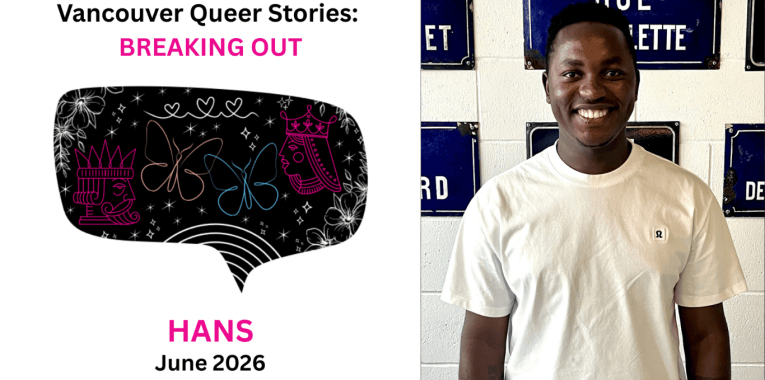
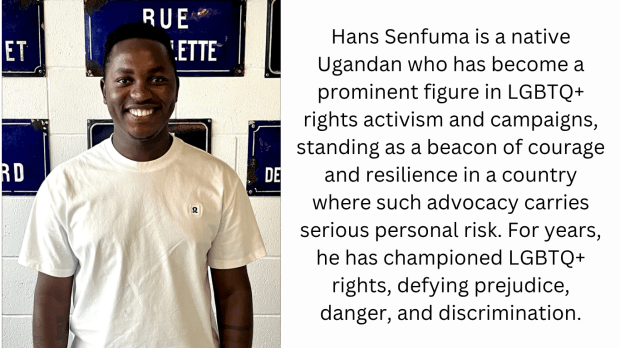
My name is Hans Senfuma, and I am a gay man from Uganda. Writing that sentence still carries weight for me, even today, because for so many years of my life, those words felt like a death sentence — not metaphorically, but literally.
I grew up in a deeply religious household in Uganda, surrounded by people I loved and who loved me, but who I knew would not love this part of me. From a young age, I understood that who I was did not fit the world I had been born into. Uganda is a country where homosexuality is not just socially stigmatized — it is criminalized. And in 2023, the government passed the Anti-Homosexuality Act, one of the harshest anti-LGBTQ laws in the world, with provisions that include the death penalty. Growing up knowing that your existence is punishable by law does something to a person. It teaches you to shrink yourself. It teaches you that survival means silence.
For years, I lived that silence. I smiled at family gatherings when relatives asked when I would get married. I sat through sermons that described people like me as broken, deviant, an abomination. I laughed along with jokes that were made at the expense of queer people, because laughing was safer than flinching. Every single day was a quiet performance of a version of myself that didn’t fully exist. And the exhaustion of that — the loneliness of carrying something so fundamental about yourself completely alone — is something I don’t think I have the words to fully describe.
Coming to terms with my identity was not a single moment. It was slow, painful, and non-linear. There were periods of self-loathing that I am not proud of. There were times I prayed to be different, not because I believed being gay was wrong, but because I desperately wanted to feel safe in my own skin, in my own country, around my own people. Acceptance didn’t arrive like a revelation. It crept in quietly, over time, through stolen moments of honesty with myself — and eventually, with a small circle of people I trusted with my life.
Leaving Uganda was one of the hardest decisions I have ever made. It was also one of the most necessary. The escalating legal climate made it impossible to continue the work I wanted to do from inside the country without putting myself and others at serious risk. When I finally arrived in a place where I could walk down a street without fear, where I could say my name and my truth in the same breath, I cried in a way I hadn’t allowed myself to cry in years. It wasn’t just relief. It was grief — for all the years spent hiding, for the community I left behind, for the Uganda I wished existed.
But leaving didn’t mean stepping away. If anything, it sharpened my sense of purpose. I have dedicated my work to legal advocacy and policy change, fighting for the rights of LGBTQ people in Uganda and across the African continent. I believe deeply that change is possible — not because I am naive, but because I have seen what happens when queer Africans find each other, support each other, and refuse to be erased. I have worked with legal teams challenging discriminatory legislation, contributed to policy frameworks that center the voices of those most at risk, and tried in every way I know how to use whatever platform I have to make noise where there has been silence.
I carry Uganda with me everywhere. I carry its sunsets, and its warmth, and its music, and the faces of people I love who are still there, still navigating a reality I know too well. I carry the responsibility of speaking for those who cannot yet speak for themselves without consequence. That weight is not a burden to me — it is a privilege.
I am sharing my story because visibility matters. Because somewhere right now, there is a young gay boy in Kampala doing exactly what I did — shrinking, hiding, surviving. And I want him to know that survival is not the ceiling. That there is a life beyond silence. That he is not alone, and he is not broken, and he is not an abomination.
He is exactly who he is supposed to be.
And so am I.
 vancouverqueerstories.com