Celebration!: JJ’ Story

“Please report the video. I hate that your faces are on there with no consent. Getting everyone to report it.”

It’s 2023 and I’m at a bar on a first date. He’s in the bathroom when I get the text from my work wife; it’s accompanied by a Twitter link, posted by an account I’ve never heard of, Libs of TikTok, with the caption: “Elementary school in Vancouver held a pride parade today. Homeschool your kids!”

Even before playing the video, I recognize myself in the thumbnail. 

The video starts with me walking by shouting “Happy Pride!” followed by my students and several parents, waving, cheering. A few more clips of students walking by, smiling, waving rainbow flags, before it ends.

My date sits back down, and I show him the video, and proceed to chuckle about some of the comments. 

“Give me an S, Give me an I, Give me an N, SIN!”

“Those boys look “sissified” to me”

“It’s a free for all, next is orgy day”

And my personal favourite, the one that, to this day, I still lowkey want to get tattooed on my body: “Homeschool > homoschool”

Already the video has hundreds of thousands of views. I want to keep reading the comments, but don’t want to be that guy, so I put my phone away, and break the tension with a quip.

“How does it feel, knowing you’re on a date with a queer icon?”

The next day our staffroom is buzzin’. Coworkers tell me they’ve reported the video, my principal checks in to see if I’m okay. The video quickly balloons to 1.4 million views. In the comments, someone posted a screenshot of me from the video, wearing a rainbow cape and shiny cowboy hat, with the caption “Found the groomer!”

Another person comments on my picture, “He’s just a flat-out molester. He doesn’t even bother with grooming.”

My friend at the union reaches out, says there’s a lawyer on staff if I’m interested in trying to have the video taken down. We all report it, but all that does is hide the video on our accounts.

Repeatedly, I say I’m okay. That we’re celebrating Pride for the kids who don’t know they’re queer, or don’t feel comfortable being open about it yet, and if it makes things easier for even one of them, then it’s worth it. 

But writing this story and revisiting that video in 2026—thankfully stalled at paltry 1.7 million views—my whole body still burns.

I scour the video’s comments section for the funniest pull quotes, trying to discern what’s awful in the entertaining-let-me-read-this-out-loud-to-strangers way and what’s awful in the oh-boy-I’ll-probably-have-to-talk-about-this-in-therapy way. The margin between them is narrower than you think.

I was bullied and called gay before I even knew what that word meant, but I knew that I was supposed to vehemently deny being it.

In sixth grade, I received a friend request online from the email account “jjisgay99@hotmail.com,” one of those memories that’s hilarious now, but at the time, felt like someone had ripped the uvula from the back of my throat.

I’d stay in the closet for almost two decades longer, dating women, participating in casual misogyny. Talking about which actresses I thought were “hot,” but really, I probably just thought they had a nice smile. 

It wasn’t until 2020, when, after having my first session of therapy, I knew I was ready to start living authentically. The next day, my 30th birthday, I came out to the majority of my close friends at a socially-distanced pie-themed hang in the park, scrawling “I’M GAY” on the inside of a pie box—the pie was peach-cardamom, obviously.

The atmosphere was one of compounding disasters: sitting on blankets six-feet apart, unknowingly about to embark on the second wave of the pandemic. The sky was muggy and thick with forest fire smoke and a recent looper moth infestation surrounded us with thousands of fluttering bugs.

It was one of the best days of my life. 

After coming out during lockdown, I struggled with how to relate to the queer community I suddenly found myself identifying with: my main connections being gay meme accounts on Instagram and a parade of COVID-safe dates that always ended back at my apartment. Dr. Bonnie Henry would certainly agree our activities involved a curve, though none flattened.

One first date, after a guy spent most of the night talking about how much he wanted a boyfriend, we ended back at my apartment, carnally making out on the couch, before he climbed on top of me, squeezed my cheeks together, and hawk-tuahed a single oblong strand of saliva slowly into my mouth. “Sir, we are in a pandemic here, you can’t just spit in people’s mouths, especially without asking first.” We still had sex, of course.

Fucking this rogues’ gallery of strangers felt necessary at the time. Fleeting connections to the gay community, sharing coming-out-stories with cum still leaking out. Hearing about Internet chatrooms and early cruising. I was a cultural anthropologist, absorbing every detail and mentally cataloguing to better understand where I fit.

Later that school year, I was recruited to help organize my school’s first-ever Pride celebration. Starved from no parties in almost 15 months, I brought a finely-curated selection from my personal tickletrunk for my kindergartens. Flamingo sunglasses, a taco hat, sequined fans, an inflatable telephone.

Suddenly, at 30-years-old, I was marching in my first Pride parade.

For the past six years I’ve helped organize and grow school Pride celebrations, each with their own lil’ moments. After our neighbourhood parade in 2024, we headed to the school’s backfield and performed a flashmob to families, all to the song “Born This Way.”

When I’d talked to my kindergartens about what other Pride celebrations involved, my students globbed onto the idea that people sometimes dress up, and asked if they could wear costumes—which is why, in videos of that flashmob, you can see Disney princesses and superheroes dancing to Lady Gaga.

I want these to be the stories I share about school Pride, but it’s important to know it’s not all rainbows and five-year-old Captain America dancing to Gaga. 

Like when kindergartens from my class are noticeably absent the day of the parade, because their family “doesn’t celebrate Pride.”

A parent’s venomous email to a colleague, calling everyone at the school pedofiles; the same parent who, later that month, smiled and cooed to me about how she hoped her son would be in my class next year.

The idea that schools are somehow brainwashing youths by showing support and normalizing words like “bisexual” and “trans.” 

“I’ve been teaching for decades, and I can barely teach these kids math. And I’m a math specialist!” a colleague shared with me, exasperated. “They think I can somehow influence these kids enough to change their whole ideology or gender?!”

Knowing teachers who’ve been doxxed, received death threats—putting themselves at risk while trying to make things safer for queer youth.

There’s decadent irony that, in tandem with writing this story, I’m helping organize this year’s Pride at my school. 

We’re going bigger, bolder, louder. A coworker designed a Pride 2026 logo with our school’s mascot, and managed to get custom stickers donated. We’re inviting neighbouring schools. We have a whole spirit week planned, a dance party, a photobooth. We’re getting T-shirts made as a fundraiser. I get giddy thinking about how amazing this year will be. Usually that excitement drowns out all the what-ifs. 

I’ve been working on a handout, highlighting statistics about queer youth, for families to help understand the importance of Pride. Pulling from Statistics Canada empirical gut-punches like how queer youth are twice as likely to describe their mental health as being poor; they’re more likely to be targeted for bullying, experience homelessness, and twice as likely to consider suicide; how trans and non-binary youth are twice as likely to experience cyberbullying.

I triple-check my sources with a diligence I wouldn’t have dreamed of during my English undergrad, knowing these stats will be scrutinized with the vigor that only a bored, privileged suburban parent can muster. 

I hate having to take the more thoughtful high road. Having our “We want every kid to feel safe being who they are” met with “You’re all pedofiles,” coming from zealots whose churches, businesses, and governments knowingly protect actual predators. But I digress.  

Progress can sometimes feel small.

The odd joy of when reading a book to my class, a student refers to someone as “gay,” and my body seizes up like they’re using a slur, when in fact, the book has a family with two dads. Gay as a descriptor, not an allegation.

It took until my mid-30s before I saw being gay as a gift. A hard-won title after a lifetime of being teased for liking things I didn’t even know I liked yet; the finally-satiated hunger of someone who spent years eating what they weren’t craving. Let’s hope the next generation gets to feel this lucky some day.

And if you need to contact me or have any questions about this story, you can always reach me at jjisgay99@hotmail.com.

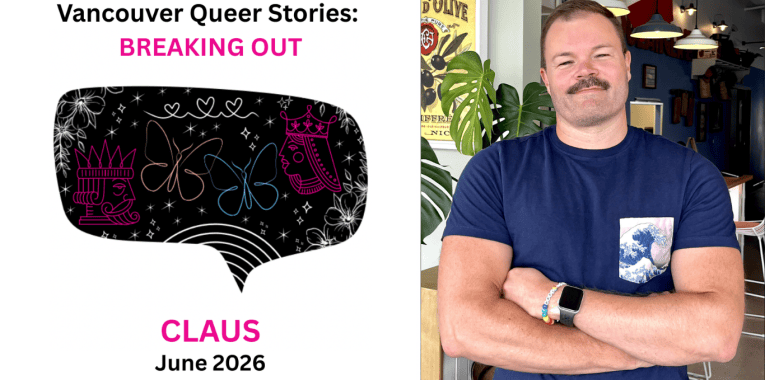
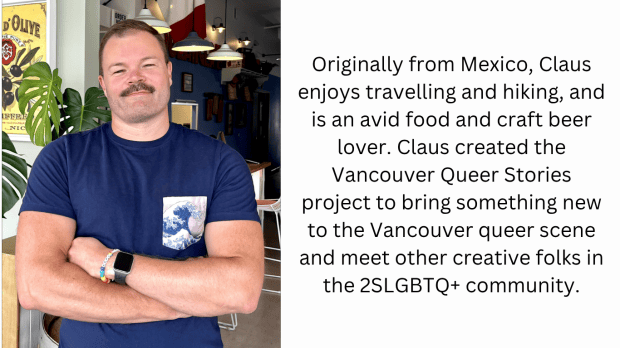
Celebration!: C.’s Story

You know how they say big things always come in threes? On March 31st this year I had three big things to celebrate, which is a nice change of pace from last year’s three big things, which were decidedly less fun. 

March 31st 2026 marked my four-year Van-iversary. 

Four years since my husband and I quit the grown-up jobs that were slowly killing us and invested our theoretical house deposit in two one-way tickets and six months’ worth of rent in one of the most expensive cities in the world. 

Four years since we filled our folks’ sheds with a decade’s worth of hand-me-down furniture, expensive kitchenware, second-hand books and records, and a couple of pricey-but-priceless artworks—all the trappings of a couple in their late twenties who finally graduated from undergrad sharehouses to cosplaying as adults. 

Four years since we farewelled our family and friends at what will likely be the only “retirement party” we’ll ever have, and flew across the world to a city we’d never been to and where we knew one person. Vaguely. 

Four years since we rented the first (and only) place we looked at, a basement suite advertised on Facebook marketplace by a new account with no profile picture. Turned out fine, they were a lovely family, and I’m pretty sure I sealed the deal by complimenting their ugly dog. 

Four years in our 500sq foot flat with two windows and a resident mouse called Jonathan. Four years is the longest I’ve lived in one place since I was a child. 

And each day of those four years, I’ve woken up feeling a bone-deep sense of gratitude. I can walk out my front gate, head four blocks north down our magnolia-lined street to the park with the pollinator meadow and beach access, where you get a flawless view across the inlet to the mountains, where it snowed on our first Christmas, and where I saw the northern lights. Twice! 

Four years that I’ve been able to say I get to live here!

It’s been four years since I looked in the mirror and saw myself buried deep beneath a lifetime of trying. 

Four years of gently prying that moldering heteronormative mask out of fingers stiffened with the effort of clutching it like a lifeline. 

Four years of deep exhales, of space and safety and community and sliding scale counselling. Four years of freedom and finding a happiness I didn’t think was possible for me. 

And that’s just the first big thing to celebrate! 

March 31st is also Trans Day of Visibility, which feels fitting as it’s really only since moving to Vancouver that I’ve been able to become visible to myself, let alone others. It’s a day that highlights Trans JOY, so it’s kinda nice to celebrate the joy I’ve found here.  

The joy of visibility is so much more than being seen, though. 

It’s being asked my pronouns when meeting someone new, or even better, when the other person introduces themself with their pronouns first. 

The joy of visibility is hearing a grownup customer tell their kid “go ask that person, they look like they work here.” It’s working in such an accidentally queer workplace that they/them has become the default until otherwise corrected. 

The joy of visibility is making the conscious effort to “be the me I want to see”, and finding out it’s actually working. It’s being told that you actually are the visible queer person (Cool Gay Elder™) in someone’s life that makes them feel like they, too, are possible. 

But the biggest joy is feeling known and seen by people who just get it. So that means that I get to build my friends’ flatpacks and lift their heavy boxes, and then they call me strong and handsome, and it goes straight to my head. 

It’s dancing at the birdhouse and being hit on so respectfully that you forget for a second that you should probably tell them you’re married… and when you do, they’re so nice about it and say “well, what a lucky person” and they wish you well, and somehow that whole experience is one of the hottest things that’s ever happened to you. 

This year I went all out: maximum visibility, maximum joy. 

On March 31st, I submitted my very trans, intensely personal thesis about nonbinary intelligibility and identity in middle-grade fiction, thereby ensuring that I will remain visibly trans in one pocket of cyberspace for the rest of the internet’s existence. How’s that for something to celebrate!

I am trying to get more comfortable with the idea of celebrating myself. It’s something that doesn’t come naturally, perhaps the result of growing up in Australia, terrified of being the poppy that grows too tall, only to be eviscerated by the same people in charge of doling out the fertiliser.

 After a lifetime of moderating myself to be just enough, never too much, believing that any sort of self-recognition is boastful, I’m re-learning what achievements actually look like, to me. 

So, aside from the big things, like acknowledging the fact that I’m graduating from my second master’s degree tomorrow (entirely paid for by a federal scholarship, which inherently values the importance of my gay little research!), I’ve been celebrating myself in less obvious, more honest ways…

Like the fact that I allow myself space to be bad at (some) things and give myself room to grow.

Despite gaslighting myself for the past three years, I actually can drive in Vancouver.

I can do nearly 2 push-ups. My goal is five—and has been for the past three years—but this time I think I’ll get there. 

I have no idea how much I weigh anymore, and that thought doesn’t panic me. I’m just letting the soft animal of my body love what it loves.

I’m learning to trust my own opinion more instead of being swayed by whoever is talking the loudest at the time, and sometimes I can even sit in the discomfort of holding two different ideas at once.

Sometimes I ask for help when I need it.

Sometimes I am even capable of being deeply honest in therapy. 

My grey hairs are really starting to come in and I’m genuinely thrilled about it because it’s proof that I’m getting older

I am healthy 

I am happy 

I am still here

And I reckon that’s something to celebrate

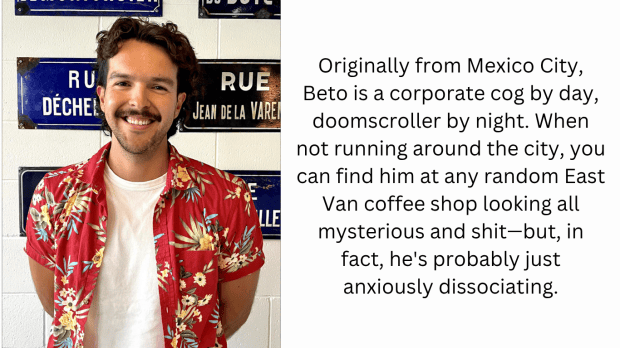
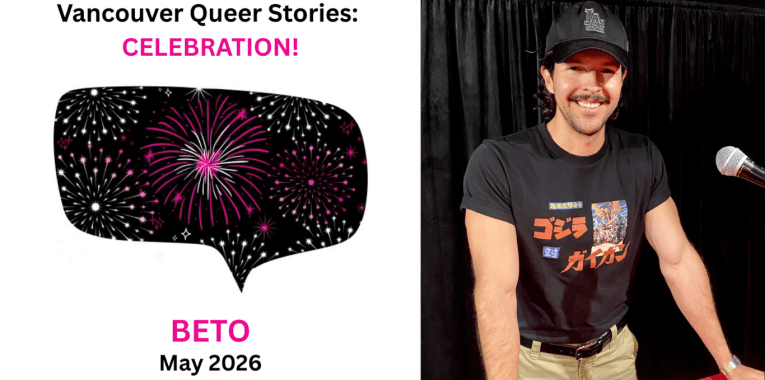
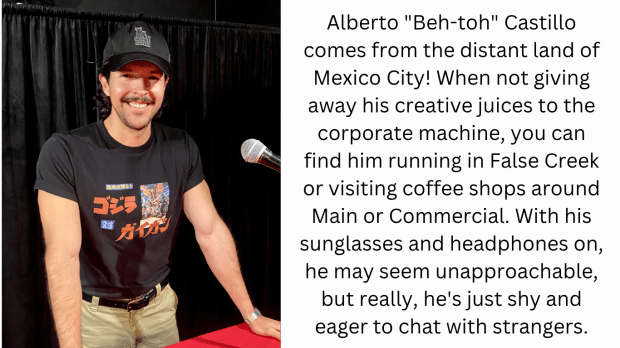
Celebration!: Beto’ Story

SPORTS!

My father was a decorated athlete for a brief period of his life, and like many men his vintage, he wanted his eldest son to be one as well.

That is why, during my early school years, I was arbitrarily enrolled in a new sport at the start of every grade. Each year began with a fresh activity and ended with a full introspective account of the embarrassments I endured and the numerous disappointments I served my father.

The sport of choice for third grade was baseball. Before being enrolled, I had never even touched a bat. My dad, much more excited than I, bought me the full kit: a used mitt, a second-hand bat, and some balls. He then commanded me to join him in the backyard for “practice time.” I suppose I did a decent job; next day my father didn’t feel the need to storm the coach’s office to beg for my removal.

I enrolled late into the season. I know this because that Saturday I set foot on the field—for the first time in my life—I did so without a uniform and with only twenty minutes of prior training with dad. My teammates looked professional. Assigned the New York Yankees uniform, they wore iconic white and navy blue stripes that shone like fresh snow under the morning sun.

I was wearing olive green pants and a gray hoodie.

The coach, a seemingly intuitive man, took one look at me and deduced that I could hardly distinguish between a bat and a mitt, and that I was dying of terror.

“Right field,” he said, pointing to a far corner of the park.

In case you don’t speak “the base-ball”, right field is where the least action happens. Most batters hit right-handed, sending the ball to the left. Balls would only come to me if there was a left-handed batter on the opposing team, or if there was a glitch in the Matrix and the bat hit the ball at the EXACT spot to send it towards my side.

And not to spoil the story for you, but if you’re listening to this, it’s because one of those two fucking things was exactly what happened.

I walked the long trek to practically another country to wait for the two hours of the game to pass without me having to intervene whatsoever. I was there, shifting my body weight between my two legs while my nylon pants made that “FFFT! FFFT!” sound, when I saw the opposing team get into position.

They wore the Tampa Bay Rays uniform. Deep purple shirts with dark gray pants. If our team looked like an elegant albino vixen, they looked like that purple mascot from Mcdonald’s–– menacing, I mean. And the cherry on top of this horror sundae: they were the fourth graders. The bigger, stronger, faster, fourth graders.

The whole scene was too overwhelming for this 8-year-old.

My father? Safe over by the stands, eating some fried pork rinds with Valentina sauce at nine AM. So, perhaps not that safe actually.

For most of the game, I just had to stand on the grass, something I have always been good at. The intense part happened on our turn to bat, when I furtively had to keep telling every kid behind me in line, “Oh, you can go before me,” until our turn was over.

That’s how I passed the time, and I don’t know if it was the mental numbness–because it definitely wasn’t because I was having a great time–but suddenly I realized we were already in the last round. And the Rays were batting.

The mood was tense. As my dad tried to explain on the car ride back home, we were leading by one point. We needed one more “out” to win; a home run for the Rays would mean defeat.

Clearly, all this I semi-understood right up until a couple of minutes ago, when I Googled “How to play baseball” to write this story. On that Saturday in question, I was standing obliviously in my peaceful right field, about 350km from where all the action and excitement was happening, skinny and sun-burnt like a human Slim Jim from all the exposure I was soaking.

Suddenly, a batter with a precocious mustache appeared. This creature went to the plate and hit the ball as if it was the crotch of his absent father.

I watched as the ball rose through the air like a rocket—heading towards me.

I had roughly three seconds to calculate the trajectory of my entire future. My eyes followed the ball like a predator: Velocity, weight, curvature, differential equations, air resistance, and the Coriolis effect. I was teetering on the fine line between glory and total catastrophe.

And finally, when the ball was a few meters above me, I decided to take the best possible strategy: I closed my eyes, stretched out my left arm, and prayed for the best.

THUNK!

The physical and emotional stress of the previous seconds had left me disoriented. My vision was blurry, and in my ears there was silence with a slight, sharp tone.

Gradually, I regained my senses. A steady echo came from my team’s dugout. 

When I finally opened my eyes, I could see blurry white patches running towards me. There was a slight weight shift in my hand, and when I turned to see it, my eyes finally focused: a steaming ball resting inside my mitt.

I didn’t even have half a second to examine it because I was violently rammed by a group of children dressed in white. Then I finally was able to translate the steady echo from a second ago: “BE-TO! BE-TO! BE-TO!” They yelled as they ruffled my hair and patted me on the torso amicably.

I felt on top of the world. I was living in my own Hallmark movie. The game had finished, and my actions had made the team win, my team—The Yankees of the Cristobal Colon Primary School.

Through the chaos, I glimpsed the stands. My dad had gotten up so fast from his seat that his pork rinds were spread all over; he was clapping like never before. Had I been closer, I wouldn’t have been surprised to see a couple of tears running down his face. 

After three years of insatiable searching, we finally found a sport in which I excelled at.

Unfortunately, my delusions of grandeur betrayed us. My teammates quickly forgot that game in which I had been the star when, the following Saturday, I failed to catch a ball that caused an opposing team’s home run. Never again in the entire school year did I catch another ball, and much less hit one. After all, baseball wasn’t my thing either.

And my dad? Despite my excellent debut, after a couple of months, opted to just drop me off at the entrance to the baseball park, and pick me up after the game. The following year, when I decided to try basketball, I don’t remember seeing him at any event.

I don’t blame him. It must be painfully uncomfortable to watch your kid constantly suck at sports. Four years into the failed experiment to have an athletic son would defeat even the most willing.

This is not a childhood trauma or a deep scar in our relationship, though. Years later, he was able to find some solace by cheering on my creative endeavours.

Anyway, I was not born for competitive sports. But while those four years of me dipping my toes in them were incredibly anxiety-inducing and humiliating, I now think they are worth it just for the memory of that cold Saturday morning, when for a brief moment in time, my dad and I were able to share the same passion. 

Celebration!: Nicholas’ Story

I celebrate myself, and sing myself,
And what I assume you shall assume,
For every atom belonging to me as good belongs to you
– Walt Whitman, Song of Myself

Note from the Author:
The following is an old piece I submitted to The Globe and Mail around Mother’s Day last year. It’s a letter to my departed Mother, who died in 2010 after a battle with cancer.

***

The thought of losing you was so staggering and overwhelming that, in tears, I proclaimed that I would make you proud of me. Your last words to me, although in truth I seldom think of them, were that you already were.

I was fifteen when you said that to me. And as this year is the fifteenth since your death, it seems appropriate to reflect. I don’t need to ruminate on whether or not you are proud—you have already said so—but rather, I want to reflect on whether or not I am truly proud of myself; and, by extension, if I bathe in the warmth, light, and love that a mother wants for her child.

When I was thirteen, surly like all teenagers, we often butted heads. You felt I was wasting my life away on the internet, and I thought you should back off and leave me alone. Despite changing logins, hiding keyboards, and unplugging modems, I would always find a way back online. You didn’t know that the internet was the only place I felt comfortable expressing myself, and that I found other nerdy teenagers who loved spending time with me. All I wanted to do was hang out with my friends. Just like any other kid.

Of course, as an adult I can expand my perspective and see myself as a confused parent worrying about their child, not understanding what would attract them about spending their entire day in front of a computer, worrying about the long-term damage it could cause. But I also know that I was miserably depressed and anxious even before you left us, and I wish you could’ve trusted me more.

People often say that mothers know their children better than themselves. For me, you knew I was gay before I was willing to admit it. Remember the day you called me a cocksucker while driving me to my shift at the radio station? That didn’t help things. Did you know I would become a man who, despite choosing to live with no regrets, would always wish that he came out to you before you died? That losing you would unlock a torrential floodgate, give me the courage to come out shortly after when I was sixteen? Probably not, but I’m sure you aren’t surprised.

When I turned eighteen, my loneliness was so turbulent, and the loss of you still so raw that it propelled me with a feverish desire to to be independent and become a grown man. I moved from BC to Nova Scotia, spent a summer in Scotland proper; spent nights upon drunken nights away from home, beer-taps flowing, cajoling with strange men I couldn’t understand, finding myself in their arms, trying to find my place in the world.

I eventually found myself where you were born, Toronto, finishing up the eighth year of a hellish undergraduate experience. I was twenty-five, dealing with COVID lockdowns, and my therapist called me out for never acknowledging your passing. She was right, and the solution was clear: I’d do a shot of tequila on the upcoming anniversary of your death. That was what the family did at the first memorial after all. It was a no-brainer.

I then chose to share that tradition with another family—my rugby family. A group of gay men (and their supporters) who gave me structure and community, allowed me the space to channel my emotions, helped me become the man I am today. One day after practice I gathered everyone together, gave them dingy plastic shot glasses, and poured the tequila. Told them that my mother was watching us and would help us win our upcoming tournament, silently promising that I would pull this off somehow.

My team took the shot for you; shut out a team from Perth, Australia in the finals after they said they’d kick our ass; I won forward of the tournament for leading my pack; your warrior’s spirit shone within me; I fulfilled a promise to myself; we achieved this together.

Winning that championship at twenty-seven is my finest accomplishment so far. It was with profound emotion that I moved back to BC shortly after the tournament, a type of bittersweet that comes from knowing you’re making a responsible decision. It was time to stop running away from you and move back home where I belong.

I’m now thirty years old, and it’s funny how the goals for my life are intersecting more with the goals you had for me. I don’t want to spend time online anymore; I want to engage in the offline world with my friends. But above all, I am a damn proud little cocksucker who’s living authentically in an increasingly challenging world.

Mom, I am happy to say that I am proud of myself. I’m a man who’s confident enough to part the clouds with my bare hands, bathe in the warm rays of the sun as it shines upon me, embrace myself in my entirety, and feel the love of the world as I walk on Wreck Beach with my friends, baring everything for all to see, as the world made me.

Summer Loving: Camille’s Story

This is not your typical steamy summer romance (although trust me, I have tried). My story is more of a love letter. A love letter not to a person, but to a place. This place. Vancouver.And it’s a story that spans almost two decades, from my first visit as a first grader to my moving here just last summer. If you have watched The Summer I Turned Pretty, this is kind of like that. But queer. And hopefully, with better writing. Do it for the plot, as they say.

Now, I haven’t done this sort of thing since university so I’m a little out of practice. In this essay I will… no, I’m just kidding.

A little bit of context. Like some of you, I am not originally from here. I grew up in Belgium. I went to catholic school, sang in the church choir, etc, etc. I can confirm that the catholic school to queer pipeline is real.
And don’t get me wrong, my love for Vancouver is not the same as dislike for Belgium. I love it there and I’m proud to be from there. I talk about it pretty much all the time. The people I miss, the food, the history, and culture. The fact that Belgium was the second country in the world to legalize same-sex marriage in 2003. And yet it’s a perfect example of how different legislation can feel to daily life.
Because. Growing up there for me also meant growing up with a lot of baggage. I lived and went to school with mostly white, cisgender, straight, conservative people. My home life was a crash course in emotional survival. This and other factors made it feel like I was keeping more and more inside as the years went by. Naturally averse to any type of confrontation, I kept my head down, twisted and bent myself so I wouldn’t cause any waves, trying not to catch any attention. It was a survival strategy, something I wasn’t always aware I was doing, but, over time, it shrinks you.
Now, it’s not like Belgium doesn’t have queer people. Trust me, as someone who got a liberal arts degree, sometimes it feels like I have met most of them. And although I attended university with plenty of rainbow merch and queer friends, sometimes it still felt like I was playing a part. My real, true, queer self was starting to make appearances, before I commuted back home at the end of the day and faded into that washed-out version of myself again. I was learning how to use non-binary pronouns in French and then going home to hear how queer people shouldn’t make such a spectacle of themselves.

Something I have left out until now is that me and my sister were lucky enough to spend many summers here in Vancouver while growing up. Something I definitely did not understand or appreciate while it was happening. Why was I being shipped off to the other side of the world every summer to be with people I hardly knew or understood? Why did I have to leave my home, my friends, my language, and everything that was familiar to me? Weirdly enough, these are some of the most vivid memories I have from my childhood and adolescence. They say you can’t remember an actual emotion, only the memory that feeling left behind. Maybe that is why summers in Vancouver are so bright, painted in colorful emotions, happy, sad, and angry. Because there was a lot of anger. There were a lot of tears. But at times, I was also happy.

I had a lot of firsts here:
This is where, as an angry tween in the middle of summer, I watched my first pride parade. Right on Robson Street. I did not know what was happening; I just remember it being loud and bright and colorful.
When I was a little bit older, Vancouver is where I had first dates, best dates. Most memorably the girl who planned a walking date to visit the best independent bookstores in the downtown area. For someone with a literature degree, that’s about as hot as it gets.
I spontaneously booked a walking tour called “The Really Gay History Tour,” diving into the queer history of this city. And I felt it. A hum, a buzz, whatever you want to call it. Something small, brave, vulnerable sitting in my chest, making its presence known. This place felt good, right.

Deciding to move here was not intentionally something I chose to do for myself. It made sense for a bunch of boring legal reasons and like many, I was a bit adrift after finishing university. What do you mean there isn’t anything I’m working towards over the next 4 years? I made the choice, initially for a year, to be closer to my sister, who had been living here for years. Probably the least problematic relationship I have in my life, the person who I have leaned on (sometimes a little too much) since we were 2 lost kids in this city. It was a risk. Once again, I was leaving my home, my friends, everything I knew, but this time it was my own choice, and it was for longer. But even though I was comfortable there, I was still clenching. I was myself, but I could still feel myself purposely not taking up space at times.

So. Since I recently passed my 1-year anniversary of moving here (or my Vaniversary, as I like to call it), I thought it made sense to do a little performance review.

After many many, many job applications, I started working at what I am convinced is the queerest workplace in the greater Vancouver area. If our queer staff members were given the day off for Pride, there would be no one left to keep the place running. The people I have met there, dare I say the friends I have made there, mean more to my little gay heart than I can express.
I have also joined a queer fitness class (yes, that is a thing, and I could not recommend it more). After a fun night out dancing at The Birdhouse, I woke up the next day not with a hangover, but with a hangover and my lower back in spasm. This queer cardio class, pitched to me as “gay line dancing,” seemed like a smart solution and has led to another first. My first time actively, loudly, proudly participating in a pride event earlier this summer.
It definitely hasn’t always been easy, though. In the past year, I have experienced more than one type of heartbreak here. The distance and space have given me a lot, but they have also taken things from me. Missing out on friends’ important life events, not getting the chance to say a final goodbye. Sometimes I feel like I am living a parallel life. It is so hard to fight the urge to regress into who I used to be when my old life comes knocking.

But. There is one memory that I keep going back to. It was August 2024, right after I moved. I packed my book and towel and biked on one of the crappy Mobi bikes to sit at English Bay Beach. The pride parade was going by. I watched the colours. The sun was shining. I could hear the waves on the beach and felt the wind on my face. This memory is so warm and bright in my mind, because I felt so… peaceful. And even though I had no idea what was coming in the year ahead, I felt I could finally, truly exhale.

Summer Loving: Luis’ Story

This is a story about my on-and-off love affair with, metaphorically, the beach, open waters, and the sea. 

My first ever date was in the first post COVID summer, in coastal Victoria.
I ventured out to meet a guy I met online. Through text, he was emotionally available and aware he was avoidant. The hot beach day was the perfect environment to bring any incompatibilities to the surface; looking back, I realize how the sound of crashing waves was a beautiful, soothing sound, but being caught underwater as the currents break was not. Almost immediately, we were in an anxious-avoidant trap, and it would take me two years’ worth of poems, and counting, to learn how to love myself enough to not go into steep shorelines unprepared.

After that, my longest ever relationship, although it is best defined as a situationship, was here in Vancouver with a guy I used to say was the sea, Poseidon himself. If I went with the flow, I had a wonderful time; the best dates, though technically  hangouts, were trips to the beach. Blissful sunny happiness quickly clouded by my capacity to receive love that did not come with any strings attached, and unfortunately, without this clarity of what I needed, intention, I was once again in an anxious trap. A strong cycle manifesting itself like a lunar calendar. Fortunately, through poetry I was able to capture and reflect on the push and pull of the tide through this period of my life, and wonder where and why I was repeating it. Similar to the erred myth that the Aztec calendar was believed to foretell the end of the world, and not that the Aztecs were resetting their seasons, this loop of breakups and reconciliations revealed itself at the beach on January 1st: 

In 2012, my cousins and I went into the sea. 
Before we realized, the high tide took us away. 
We tried to swim as we screamed mayday,
I split from my cousins and tried to get help, 
We all got away, but not the fear that I felt.

I don’t trust the sea like before, 
my sandcastle falls when a wave knocks on the door. 
My comfort zone lays in more stable terrains
I even ask friends to play the water levels in videogames. 
So you could say I am afraid of the sea,
Because I wouldn’t be able to blame it for drowning me. 

The sea did not try to kill us, we ventured too far. 
The sea does not have a memory, we remember the scar. 
The sea will drown you if you let it be guide, 
The sea behaves in a pull and push of the tide. 
I compared you and the sea, and now I don’t know what to do with this commentary.
 

Let me offer my hand and help you down from the pedestal, 
Take a hammer to the columns and pipes and let the water flood my skeletal. 
I lean towards the synchronicity:
It’s the color blue that beacons to me. 
The blue in your eyes, or the blue in your name, 
Or the blue in the way you move.
 

I want to get out of the water, but I don’t know how.
Question the trail dripping from my body, 
Wonder:
If it was an emotionally aggressive father, no, 
If it’s how I process emotion and choose a path to follow, no, 
If it’s how my Mexican blood reacts like oil to Canadian waters, no,
else trying to heal every other part of me when the pipes in my sandcastle are spilling water, yes.

This life isn’t sustainable. 
You can’t heal personality. 
I’m never in reach of the perfect standard of healing every single part of me.
How many rooms do I split myself into before I forget where every part went initially?
 

In this new layout of my castle, where do I fit your memory?
The thought makes the tide in my mind go red, I’ve ventured too far. 
I can reason the sea’s behaviour but not a man’s vocabulary.
For that ethical ambiguity, I have no vacancy.
Not for the men I am unsure if I even “dated”, 
or whatever definition fits from your dictionary.
Not for those whose banter belittle me, 
Make a joke out of me and try to convince me it’s funny. 
Not for the men who cross my boundary, 
And dare to say the walls of my castle are imaginary. 

It’s through time, in each wave that hits the sand. 
That the sea and sand bank resemble each other’s hand.
I lose sight of what works for me and start becoming part of a narrative
That exists only in your mind and what I twist into poetry. 

Only when I focus on what I felt
not what you said does the tide relax.
I know I’ll put the memories, the good ones left,
Not in the sea or the places we spent time in, 
But in a brand new room.
Of people I rode the bus with, whom 
I flirted like we were strangers, 
driving away from Wreck beach, away from the currents and dangers.

Destined to get at different stops.
Dead calm waves, the high tide drops.

The idea that a place can have revealing properties is not a new one. In The Exterminating Angel, by Luis Bunuel, dinner party attendees become trapped in a sociological limbo that eventually reveals all their secrets and unravels their relationships. Robert Östlund’s Triangle of Sadness, Prime Video’s Yellowjackets, William Golding’s Lord of the Flies, break and rebuild social hierarchies after crew and travellers are castawayed. 

I’ve gone to the beach alone, with friends, family too, and have found similar results: an exposition of ideals and compatibility. Do you go to the beach with people who leave trash behind? Do you? How comfortable are they seeing their and other people’s bodies? How comfortable are you? Is their job really “beach” and are they qualified for it? Are you? Do they go to the beach only during summer? Do you?

I love that poetry, like the sandy coast, is as much an external as an internal space. Privacy shared publicly coexists with the secret agenda of knowing, being “in” on personal intimacy of a shared story. Being caught naked or seen in your underwear has a different moral weight than being seen at a beach wearing a range of birthday or bathing suits.

After spending the last day of Vancouver Pride weekend at Oasis in Wreck Beach with a diverse, safe, stable group of friends, I wrote about these conclusions in a poem called The beach:

I love the smell of sunscreen, sand, coconut oil;
Touch hungry, I’m picky as to who I ask for help. 
At a shy distance from the ocean, water, turmoil,
I’ve learnt going to the beach’s Reckoning itself,

Of what is not said but felt: interpersonal health.
Here, where there’s not much to do but connect
We watch, talk, listen, or that’s what I’d expect,
We wear our comfort levels, habits, our neglect:

Wreck/Jurassic/Oasis, SPF, over, under dressed.
By the coastline, waves flirt with the sandbank. 
A touch, a kiss here and there, a look at a chest,
A drift, a rip current wipes the shore prints blank,

Washed it away. Replaced by beautiful patterns.
The tide’s intention revealed in the rill and ripple:
It is Nature, to mix below the surface, “we” aren’t
But an undertow of elements chasing currents is.

As in, not ideal, life at the beach. I’m sunburnt
From a Sun’s hand, the Moon takes over control,
Rising and setting the pace of the ebb and soul.
I head home to myself, entirely made up of sand.

Today, as I visit familiar or new beaches, I am more aware of my qualities and needs, because I’ve been to the beach and continuously see how anxious, shy, body-dysmorphic, sexy, creative, secure I and others can be. 
Today, firstly, I know myself and get a life jacket for open waters, wear a speedo and SPF 50, and trust I am capable of swimming… for survival, probably not for recreation. 
Today, if I am curious about the health of my relationships, with myself or with somebody else, I go to the beach. 

Pride!: Alan’s Story

I was born in Ireland in the eighties, raised in a catholic household, and educated in catholic schools. I was taught that pride was a sin – one of the seven deadly sins, in fact. 
It was painted as arrogance, as vanity. Something to be ashamed of. And shame? Shame was a virtue.
To be clear, I’m not even talking queer pride…we’ll get to that. I’m just talking about regular, good old pride in one’s own self. 

In Ireland, we were taught to reject compliments and diminish our accomplishments so as not to seem too proud. If you ever compliment an Irish person on their outfit, they’ll immediately tell you how cheap it was, or how old it is, and that they look like shit. 
We also judged people for being proud: growing up, discussions about someone else’s success were usually coupled with phrases like “he’s gotten too big for his boots” or “Miss high and mighty in the big city.”
So, before I was even sure I was gay, I was already afraid of being proud of anything. To baby gay Alan, the thought of being proud to be queer was impossible. Why would anyone be proud of that?

So, I learned to hide. I stayed quiet. I didn’t make friends often, and if I did, I didn’t let them get too close. I hid the way I wanted to express myself, the way I wanted to live. 
I was taught, in subtle and not-so-subtle ways, that my existence could make others uncomfortable. And so, I would shrink myself to make others feel safe. 

Pride is hard.

I eventually came out, of course; you can only hide for so long before something has to give. When I was 16, I told my parents and a select few friends that I was gay — and was met with just the right amount of fake surprise.
But if I am being honest with you, dear audience, I only really half came out. 
When I went to college, and when I got a job, I never talked about my boyfriend openly, or said the name of the bars I drank at on the weekend. 
Never talked about the hot guys on TV… but never talked about the hot girls, either. Never lying, but never really being fully truthful.
Even though people probably already knew, I still hid. 

The first time I went to a Pride parade, I was about 16 or 17. I didn’t tell anyone – I just showed up, alone, pulled there by a quiet curiosity I couldn’t ignore. I didn’t wear anything rainbow. I didn’t carry a flag. I stood at the edge of the crowd, heart pounding, scanning every face, terrified that someone I knew would spot me. That someone would recognize me and know… The irony of being ashamed to be seen at a celebration of pride isn’t lost on me. 

Pride is hard.

That moment at the parade stayed with me, even as life moved on. I immigrated to Vancouver about eight years ago. I came with my then-boyfriend. Here, we discovered an amazing queer community — something we’d never really had, back in Ireland. My then-boyfriend has since become my now–husband. We’ve made some of the closest friends we’ve ever had.

A couple of years ago, I joined the board of directors and became chair of the board of Vancouver Pride. 
If I thought pride was hard before,  I don’t think I was prepared for how hard Capital P pride is when you are at the helm of a struggling, underfunded not-for-profit organization, operating in a world with an ongoing genocide, during a time when trans and queer people are under attack globally.

For some people, Pride is impossible.

I had the privilege of being part of the Society and chairing the board through Canada Pride: Vancouver’s biggest pride celebration to date. A truly rewarding, exhausting experience that damn well nearly broke me. We had a record-breaking turnout, our largest parade ever, amazing performances… and threats of violence, budget cuts, and protests.

Friends, I know I’ve mentioned a couple of times now, but:

Pride. Is. Hard.

When I was a kid, and well into my twenties, the idea of wearing nail varnish, or anything even slightly effeminate, was unthinkable. Femininity was something to be feared or hidden.I would worry that I was walking or sitting too “girly” (whatever that means) , I would worry that I wasn’t talking like a “normal” man. All these small things that would consume my brain in an effort to suppress my difference.
But here I am, nearing my 40th birthday and A couple of weeks ago, I debuted as Lady Anal in my first-ever drag performance. I wore a corset, tutu, and 5-inch heels, and danced to Lady Gaga on a stage in front of around 600 people… and let me tell you – DRAG is hard!
I think baby gay Alan would be shocked to see me in a corset and heels—but I also think he’d be proud. Finally.

I often think back to that first parade. Hiding amongst the other spectators, heart racing. I was scared, but there was something else creeping in; something almost indescribable — queer joy. Queer joy isn’t always loud, or even obvious. Sometimes, it’s just the peace of being fully yourself, without apology. I didn’t know it then, but standing at the edge of that parade was the first step toward the centre of it.

Pride is hard… But it’s worth it.

Because every time someone steps up and says who they truly are, the world becomes a better, more interesting place.

Pride!: Ryan’s Story

I grew up Filipino.
Which meant I also grew up Catholic, respectful, and quiet when it mattered.
You didn’t talk back. You didn’t question your elders. You didn’t come home too late. And you definitely didn’t talk about queerness.
In our community, you could suspect. You could joke. But no one ever said it.
Being gay was either a punchline or a shameful rumor that hovered around someone until it stuck. So I learned early: keep it tucked away. Smile. Be helpful. Be successful. And I was. Success became my armour. Good grades. Good manners. A carefully curated version of myself.
If I couldn’t belong by being me, maybe I could belong by being perfect.

It wasn’t that I didn’t know I was queer. I did.
I felt it in the way I watched certain people longer than I should—especially my sister’s guy friends. These boys were always around: loud, confident in that casual way boys are when they’ve never had to question their belonging.
They’d play basketball, all shoulders and jokes and zero personal space.
And there I was, always on the sidelines wondering what it would feel like not having to hide.
I wasn’t just crushing—I was studying.
How they existed around each other without fear. They were soft with each other in ways no one called soft. Their masculinity was never questioned. Mine was something I monitored constantly.
And I’d sit there wondering, Do I want to kiss them? Be them? Or just be allowed
near that kind of ease? Let’s be real—probably all of the above.

That’s why my first Pride felt… surreal. It was in Vancouver. I had just started letting myself live more openly—not just online or in whispers, but out loud. I didn’t know what to expect.
I just remember putting on this yellow polo shirt—something bright, safe, cheerful. I added a rainbow pin, maybe some beads I’d been handed by a volunteer. It felt like putting on armour, but softer. Like permission. I watched from the sidewalk as the parade moved past. Rainbow flags everywhere. Glitter. Music. People cheering and kissing and dancing in the street like the whole city had finally taken a deep breath.
And then I saw it—the TD float, blasting music with half-naked people dancing in the sun. Glistening bodies. Queer joy. Sweat and pride and freedom.

But here’s the thing: I didn’t feel like I was part of it. I felt like a spectator. Like I was watching someone else’s celebration, not mine.
I was smiling, clapping, even laughing—but I was still on the curb. Still unsure. Still asking myself, “Am I queer enough to belong here?
It wasn’t shame exactly. It was distance. Like I had stepped into the world of Pride, but I hadn’t quite arrived in myself yet.

It took me a few more years, and a move across the ocean, before I’d feel anything different. Brussels Pride caught me off guard. I hadn’t even planned to go, but I found myself in the middle of the city, swept up in the energy.
This wasn’t a hyper-produced parade with big floats and barricades. It felt open. Messy. Intimate.
People weren’t just watching—they were walking. The barriers were barely there. Anyone could step off the sidewalk and join the procession. And people did. People of different backgrounds, mingling, dancing and exuberantly celebrating.
Young people marching with their chosen family. Straight friends carrying signs that said, “I’m here because I love someone queer.”

And the soundtrack? Pure Eurovision chaos. From someone blasting “Tattoo” by Loreen like it was church, to a rhythmic chant to “Europapa,” it was enchanting.
Every corner had its own beat. Every queer had a flag. Every moment felt like home—if your home also occasionally served techno with a side of identity crisis.
Honestly, if you’re a Eurovision fan, hit me up, we clearly speak the same emotional language: high drama, bold fashion choices, and the occasional key change that saves lives and after some time I stepped off the sidewalk.
For the first time, I didn’t feel like I had to earn my place.
I wasn’t perfect. I wasn’t loud. I was just present. And that was enough.

When I think about Pride now, I don’t think about the floats or the glitter or the corporations with their rebranded logos. I think about that moment in Brussels—stepping off the sidewalk and into the street.
Because Pride isn’t a performance. It’s a process. It’s the slow unlearning of shame. It’s the decision to stop apologizing. It’s choosing joy even when the world has only taught you fear.

And yet even now, when I walk into certain spaces—queer or not—I still carry that quiet calculation: “Am I too much here? Or not enough?
Because queerness is not a monolith and the mainstream image of Pride still doesn’t always look like me.
There’s a kind of queerness that gets celebrated more easily.
Usually white. Usually cis. Often male. Lean. Loud.
Unapologetic in a way that feels less like protest and more like branding.
And sometimes, in those clubs, those professional events, those “inclusive” queer spaces, I still feel like I’m back on the sidewalk. Watching the parade.
I’ve been the only brown face in a meeting. I’ve had coworkers pull me aside to tell me I’m “so well-spoken,” as if it’s a surprise. I’ve had white queer people talk over me in meetings about diversity.
I’ve been fetishized for my brownness. Othered, even in intimacy.
And I’ve seen how people treat me differently when I show up femme—when I wear non-conforming garments, when my voice softens, when my wrists move too freely. Sometimes, being a queer person of colour means walking into rooms that claim to celebrate you, but only if you come in fragments.
Only if you leave the messiness, the accent, the ancestors, the softness, the trauma, and the realness at the door.

But that’s not who I am anymore. I don’t fragment myself for anyone now.
Because Pride isn’t just about who you love. It’s about how you insist on your wholeness in a world that keeps trying to carve you into pieces.
I once heard someone say:
“We don’t just want to be tolerated—we want to be accepted.” And that hit me.
Because for so long, I’d been satisfied with tolerance.
With not being bullied. With not being the punchline. With being allowed to exist.
But now? I want more. I want room to be joyful. To be complicated. To be brilliant and brown and queer and soft and taken seriously.
I want acceptance. Not as a concession, but as a given.
I’ve found power in taking up space—not always loudly, but fully. In speaking up at work when something feels off, even if I’m the only one who notices. In mentoring other queer folks of colour, so they don’t have to wait as long as I did to feel seen. In holding space for softness, for mess, for nuance.
In telling my story, especially the parts that aren’t tidy.

Because this is Pride, too. Not just rainbow floats and party weekends, but healing. Boundaries. Audacity. The choice to keep showing up, again and again, in rooms that weren’t designed for you, and remaking them in your image.
Now, when I think about my journey, from hiding behind grades in a Filipino household, to staring longingly at sweaty basketball boys, to watching the parade in Vancouver, to marching through a sea of techno and tears in Brussels—I realize I was never chasing a performance.
I was building a relationship with myself. One where I could love all of who I am.
Brown. Queer. Soft. Strategic. Sensual.
Not half of anything. Not apologizing anymore.

So if you’ve ever felt like Pride wasn’t made for you—too brown, too quiet, too complicated—I hope you know this:
You don’t have to wait for someone to invite you in. You belong here.
Even if you don’t wear glitter. Even if your pride looks like staying in.
Even if your anthem is Loreen and you cry to “Europapa” once a week.

Because Pride is not a moment.
It’s a practice. A rhythm. A reclamation.
And it’s yours.

Pride!: C.’s Story

When I was 30, I came out to my parents via Facebook Messenger. Not my finest moment, but it seemed like a good idea at the time. In my defense, my track record for coming out is pretty abysmal.

The first time I ever came out, I didn’t even realise I was doing it. I grew up in a very conservative town, went to youth group on Fridays and church on Sundays. The chaplain at my all-girls school regularly told us we were going to hell for some reason or other. Being queer simply wasn’t an option. But, there were signs. Like, developing instant, deep and intense “friendship” feelings for the first cool girl to pay you a lick of attention, and then lovebomb her with handwritten letters and super platonic mixtapes full of Death Cab for Cutie and Maps by the Yeah Yeah Yeahs. Yeah. Subtle. I also spent a lot of time lamenting the fact that I couldn’t go to the boy’s school because “their music program was better,” and backing that up by taking any chance I could to steal my brother’s uniform. For drama class. Or a costume party. Or, you know, just because.

It took me a few more years to identify what was going on there; I grew almost naturally into my understanding of self, and my little neurodivergent brain thought everyone else felt this way too. Shout out to Tumblr for the confirmation bias, turns out that everyone DOES just want to kiss pretty girls and wear dapper suits and experience the deeply intense yearning that comes from being in love with your best friend! Bolstered by this echo chamber of acceptance, I slowly became more open about my identity: subtly dropping easter eggs into sober conversations, and then aggressively shoehorning my horny gay ramblings into unrelated conversations while drunk. As a millennial bisexual in a straight-passing relationship, I was deeply uncomfortable with being perceived as heterosexual. It was like walking around with a rock in my shoe.

It wasn’t until nearly a decade later, after putting a hemisphere of distance between myself and my hometown, that I actually had the space to sit down, take a breath, and take off my shoe. When I shook it out, I was left with a pile of gravel. I began to realise that I was deeply uncomfortable with being perceived as a woman. When I told my spouse that I wasn’t a girl, in what was essentially a very dramatic, queer rendition of “would you still love me if I was a worm”, he said “I love you for who you are” and wiped my snot off his shoulder. What a guy. When I told my best friends, they were mostly relieved I wasn’t calling to say I was pregnant. I put my pronouns in my work email and that was that. I’ve only ever existed as myself in Vancouver. And then my parents came to visit.

We’d been settled here for almost a year, and I was still sifting through the gravel, but I decided that I couldn’t let my parents go back to Australia thinking how nice it was to see their daughter. I wanted to be open and honest about my identity and allow them to know the real me for the first time in my life. Put the ball in their court, so to speak. And we dropped plenty of hints, or so I thought. I mean, there was significantly more body hair and gender neutral language in our house than they’d come to expect.

I spent many sleepless nights planning my grand coming-out speech. I told myself I was waiting for the right moment. I’d know it when it came. And a couple did come, but I couldn’t do it. While they were visiting family in Quebec, my spouse and I ran various plays during dinner, considering all the angles and possible outcomes. My parents came back, we spent more time together, more moments came and went. And then all of a sudden, they were leaving.

As we drove down Granville Street, I tried to will the panic away while my knees bounced and my heart pounded in the front seat. At the drop-off area, we hopped out to help with their suitcases. They said I love you. I said I hope you can see how happy I am here. Then we got back in the car, drove around the corner, and I had a very dignified little breakdown.

Which brings us to the Facebook message, meticulously crafted with the help of a stiff gin and sent an hour before they were due to board a 16-hour flight. So, a little less ball in their court, a little more lobbing a grenade into their heteronormative worldview, and then forcing them to sit with it in a metal tube with no wifi for half a day. On reflection, I probably should’ve waited. I wanted them to know, but I wasn’t ready to talk about it.

Mum replied a little while later. She said they were surprised and confused, that they loved me, and they needed time to understand. A few days later, mum emailed with some reasonable questions which I tied myself in knots trying to answer. How could I put into words for others what I’d spent the better part of a year trying to explain to myself? I typed out some stream of consciousness, accompanied by some resources and recommended reading, hoping that they’d magically understand everything, or be willing to do the work. But in the moment, my mum’s response of “well, I was a tomboy in high school too” felt less like connection and more like dismissal. So I didn’t reply. And we haven’t really addressed it since. That was two years ago.

In those two years, I’ve never heard them use my pronouns. My dad still hasn’t acknowledged my identity at all. Not once. And it’s not like we haven’t spoken in that time. I’ve been back to Australia, we’ve seen each other in person. I’m writing my Masters thesis on nonbinary children’s literature. It’s not a secret. But, we don’t talk about it. They still refer to me as their daughter. For two years, we’ve been dancing around this big genderless elephant in the room. And I’m tired of dancing.

What they don’t know is that over the past two years, I’ve only become more certain of my identity. I’ve only become more proud, more loud, more outspoken. I spend each day trying to be who I needed to see back when I was 13 and didn’t have the words to explain myself, and I’ve seen the impact that my overt queerness has on others. I know who I am, and I love who I am. But, it’s also really hard. I’ve spent so long reshaping my own worldview that the thought of having to do that work all over again, for people who I know love a version of me, but I can’t guarantee love this version of me, it’s exhausting.

But I know that if I want to be seen, I have to let them see me. I’ve done enough therapy over the past two years to know that this is, unfortunately, the only way. So I think I’m gonna have to come out to my family again. Or maybe I’ll just send them this story. Maybe then they’ll see me, and maybe they could be as proud of me as I am.

Pride!: Bryce’s Story

Growing up gay in a small town is like learning to whisper when all you want to do is sing. You get really good at editing yourself; at shrinking. I grew up in a town of 5,000 people, where most people knew each other, or at least thought they did. You learn quickly how to blend in, when the cost of standing out is being left out entirely. And so, I did what a lot of queer kids do: I said I wasn’t. I hid.

I knew I was different early on, but I didn’t have the language for it, or the confidence to claim it. In a place like that, being gay wasn’t something you admitted. It was something you denied, or joked about, before anyone else could weaponize it. I learned how to pass. How to act. How to keep one part of myself tucked away so well that sometimes even I forgot where I put it.

Then I met someone who had hidden just as well as I had. Someone from an even smaller town—500 people, if you can believe it! I used to joke that if I had it bad, he had it worse. But the truth is, we had something in common: we both grew up thinking we had to be less to be loved.

At first, being together was like finding a mirror. Not just in the obvious way—both of us boys, both of us figuring it out—but in how deeply we understood the effort it took to make ourselves palatable to the world. We didn’t just fall in love; we fell into safety. Into understanding. Into survival.

But we also fell into habits that mirrored our upbringing. We stayed quiet. We didn’t talk about our relationship in certain spaces. And even though our families knew we were gay, and knew we were together, we kept things toned down. We didn’t call each other “boyfriend” around them. We didn’t show affection. To them, I think we were just… neutral. Not hiding, exactly, but not fully seen either. We weren’t straight, but somehow, we still managed to look it.

For a long time, we didn’t feel like Pride was for us. It felt like something other people did: louder people, braver people. People who had figured it out. People with less to lose. It wasn’t shame, exactly. It was just… caution.

Then in 2019, we finally went to our first Pride event. Not in Canada. Not even in North America. It was in Manchester, England. And to be honest, one of the biggest reasons we went was because Ariana Grande was headlining the closing show. We had already seen her in April that same year… but Ariana at Pride? That felt like something different. It felt iconic. It felt like a good enough excuse to finally show up.
We booked the trip half for her, and half, I think, for ourselves, though we wouldn’t have admitted that then.

I remember walking down the street and hearing the music before we even saw the crowd. There were rainbow flags everywhere. Drag queens, couples holding hands, kids in rainbow tutus, protestors with signs, allies cheering. It was colourful and chaotic, and so beautifully alive. It was everything we weren’t used to. Everything we had quietly denied ourselves.

And for the first time, we didn’t feel like we were borrowing space. We felt seen. Not just tolerated. Not just allowed. Seen.

It was overwhelming, in the best way. We danced. We laughed. We kissed, even. Right there in the street, surrounded by strangers who clapped and cheered, and kept on dancing. I had never felt more free; or more aware of just how tightly I’d been holding myself.

That was the year Pride stopped being a word and became a feeling.

Since then, we’ve been to more Pride events, but not dozens. Just a few that mattered. Vancouver Pride has become a bit of a tradition for us. And this year, we went to Winnipeg Pride with the biggest group of gays I think I’ve ever travelled with. It was loud, joyful, chaotic, in the best way. A complete contrast to how we first learned to be gay: quietly, cautiously, carefully.

Every time, we let go a little more. Not just in public, but with ourselves. We let ourselves be soft. We let ourselves be loud. We remind ourselves that we don’t have to earn our space. We just get to be.

And here’s the thing: it’s not always perfect. Sometimes Pride is corporate. Sometimes it’s messy. Sometimes, it doesn’t represent everyone the way it should. But at its core, when you strip away the noise and the politics, Pride is about the right to exist fully. Without apology. Without compromise.

It’s a reminder that joy is resistance. That celebration is healing. That there is room for every kind of queer story, even the quiet ones. Even the ones like mine.

Because the truth is, I don’t have a dramatic coming out story. I didn’t run away. I didn’t get kicked out. I didn’t have to fight tooth and nail for acceptance. But I did fight. Quietly. Internally. For years, I fought for the right to be honest about who I am. I fought to believe that I didn’t have to shrink to be loved.

And that’s what Pride gave me. It gave me back the parts of myself I thought I had to hide. It showed me that visibility isn’t just about being seen by others. It’s about being seen by yourself.

So now, twelve years later, I get to stand next to the same man I met when we were both still scared. We’ve grown together. We’ve healed together. We’ve learned that the world is big enough for love like ours, and that we don’t have to water it down.

We still hold hands in some places, and not others. We still measure our surroundings before we kiss in public. The world isn’t perfect. But we are no longer pretending we’re something we’re not. And that matters.

Pride, to me, means hope.
Hope that someone else growing up in a small town—someone who’s hiding, someone who’s scared—can see people like us and feel just a little less alone.
Hope that the next generation won’t have to learn how to whisper.
Hope that one day, we won’t just be accepted—we’ll be celebrated.
Not because we’re exceptional, or brave, or resilient. But because we’re here.
And that’s enough.