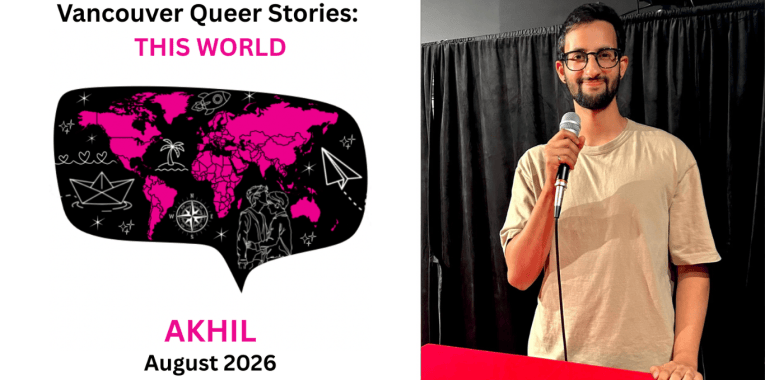
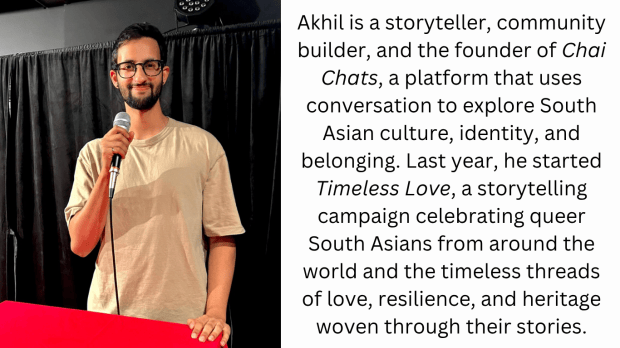
This World: Akhil’s Story

If you met me today, you’d probably never guess there was a time I could barely get a few words out. I was painfully shy. If someone simply asked me, “How are you?”, I’d rehearse the answer in my head over and over before stumbling through the words, grasping at air for support. I was terrified of saying the wrong thing.

School felt like a hunting ground..
I was picked on constantly for having what people called a “gay voice.” My classmates mocked the way I walked, the sway of my hips, the softness in my voice. Some days, groups of boys would surround me in the hallway like a pack of wolves, laughing while I stood there wishing I could disappear from the world.
I had spent years wanting nothing more than to fly away.
Then, in one moment of vulnerability, someone mistook my silence for permission. They reached for something that was never theirs, and when they left, it felt as though they had stripped away the very feathers that made me whole.
They stole my voice.
I stopped trusting my body. I stopped trusting my instincts. I convinced myself that the safest way to move through the world was to be as small and invisible as possible.
Silence felt safer than speaking.

But there’s something curious about silence. If you sit with it long enough, it begins to make room for other voices.
For me, it happened to be the voices of my ancestors.

I remember it so vividly. It was half past 9pm and my mother and I were nestled in blankets sitting together with cups of adharak chai and nankhatai biscuits, watching youtube videos exploring ancient Indian temples. I wasn’t expecting my life to change that night.

But then a strange sculpture appeared on the screen. I remember leaning forward, perplexed.
One half was unmistakably Shiva—matted locks, a strong jaw, broad shoulders, a trident resting beside him.
The other half was Parvati—soft features, flowing jewellery, a graceful curve through the waist.
They weren’t standing beside each other.
They were one.
One body.
One face.
One divine form.
Ardhanarishvara.

I couldn’t stop looking. How had I never seen this before? This image had been carved into stone more than a thousand years ago, yet in that moment, I felt like it was waiting for me.

For years I’d believed I had to choose which parts of myself the world would find acceptable. To be more masculine. Speak differently. Walk differently. Tone myself down.

Yet here, in one of the most sacred images of my culture, masculinity and femininity weren’t in conflict.
They weren’t competing.
They were in harmony.
Neither half diminished the other.
They were whole.

That night became the beginning of a journey I never expected to take.
One story led to another. One temple led to another. And before I knew it, I wasn’t simply learning about history anymore.
I was seeking refuge in my ancestors.

I came across the ancient chronicles of Shikhandi, A transgender warrior who was a central figure in the Mahabharata, one of India’s greatest epics.
I saw carvings of queer love etched into the stone walls of Khajuraho temple.
Two women.
Two men.
Lovers in embrace.
These weren’t hidden away in some forgotten text.
They were carved into the walls of temples for the world to see.

For years, I tangled intimacy with shame.
Yet here were my ancestors telling a completely different story.
Not with words.
With stone.
Love wasn’t hidden.
It was celebrated, honored and part of Prakriti–nature.

One discovery led to another.
I learned about Bhagiratha, born from two mothers.
I read translations of the Kama Sutra. There was one specific passage that I could never forget. It was two male lovers exchanging flower garlands, petals embracing each other as their first shared touch.
I had never seen queer love described with such tenderness.
Maybe because it was the first time I saw intimacy without shame.

The more I searched, the more I realized something.
The world I thought had rejected me was much older—and much kinder—than I’d ever been taught.
I hadn’t just been learning about history.
I’d been finding my way home.
The stories my ancestors left behind weren’t asking me to become someone new.
They were reminding me of something I’d forgotten—that I belonged.

Today, I tell stories. Stories of my ancestors. Stories of queer south asians. Stories that remind us we’ve always belonged.

I often think about how badly sixteen-year-old me needed to see something like that.
Back then, I thought I was the only one.
Now I stand beside queer South Asians from different faiths, languages, cultures, and backgrounds. I listen to their stories. We laugh together. We cry together.
And every single time i think about that lonely kid who believed there wasn’t space in the world for him,
I tell him… he was never alone.

When people ask me what changed my world, I tell them it wasn’t one story, or one sculpture or one temple.
It was realizing my ancestors had already made room for me long before I was born.
I spent years searching the world for somewhere I belonged.
In the end, I found it by looking back.
I found it in my ancestors.
I found it in my community.

And somewhere along the way, I found refuge in myself. 
Breaking Out: Sam’s Story

How could I have thought that the days of youthful innocence were the worst of it? Looking back now, it was easy. Life was full of the simple pleasures of childhood freedom: the smell of fresh-cut grass, the lingering haze that followed a midday shower before us kids took to the streets again, running amok with sun-licked shoulders, torn denim, and imaginations still in overdrive. Then Sundays would roll around, and my mother would force me to put on the freshly ironed clothes draped over the side of my bed for church. The image of my family was very important to her. Those little stints of angelic performance taught me how to wear different masks. I would present one way while feeling entirely different within. Much like the Gemini, June stood beneath the sun with two heads, one looking forward and one looking back. This was the month I was born.

Maybe that is why memory has always felt split to me. A collection of Polaroids carried around in my pocket like souvenirs: tangible reminders of moments I survived and experiences I would eventually grow from. But with enough time, like anything, those pictures fade. The edges blur. Eventually, even the person staring back at me became hard to recognize.

It can take a lot of courage to break free from certain parts of our lives. After constantly being labelled and dismissed as too sensitive and too emotional, I gravitated toward the other side of the spectrum: avoidance. Cramming my pain and fears into every nook and cranny. I easily confused escapism and the outward appearance of independence with genuine freedom.

My hometown was a small suburban community saturated in white privilege. With no visible examples of queer love, I never felt safe to express myself. I was a lanky kid who would cower in masculine, heteronormative settings. I wanted to peel off my skin and disappear like a shadow beneath a streetlight, barely present, wandering aimlessly.

It was only a matter of time before I found ways to cope. I am human, after all, inherently wired for survival. By the age of fourteen, I had built up walls, brick by brick, with every drink and every drug. My secret life became one of isolation and self-hatred. I was a master of disguise, portraying a life of fearless adventure when deep down, I was just running away from the queer kid I never wanted to be. I denied that kid love and connection, not just from others, but more importantly, from myself.

For nearly two decades, my addiction ebbed and flowed between multiple lives, geographical cures, absolute chaos, and blissful self-loathing. I risked it all in search of oblivion. Staggering through the alleys of the DTES, chasing the moonlight in meth-infested slums of the Philippines, or bruising my fists on a prison wall in Australia. I had found something that felt like a solution: comfort wrapped in the delicate lie of temporary relief. In reality, there was a consequence waiting on either side of that next drink or drug.

Convinced I was unworthy of love and unable to give it, I kept running. With every unfamiliar country, I hoped that maybe this time I could become myself and begin again. By the last few years of my addiction, I had ended up in a place I never want to return to. I had given up, completely defeated, carrying around a note in my wallet bearing the words “I’m sorry, I love you” scribbled in black Sharpie. I couldn’t find anything else to write.

I was exhausted; the weight of the guilt and shame had become unmanageable. Leaving me to believe that death was my only way out.

Just when I thought I was at the end of my rope, something washed through me. A flash flood of hope coursed through my veins, short-lived, yet it was still a feeling I hadn’t experienced in years. Seeing my sisters get married, start families, and build homes filled with Love and kindness made a part of me want to know what my life could be like. Could I face the pain from which I had been running? Did I have the strength to work through the guilt and shame? Did I deserve to have a life full of love? Could I accept my true, authentic self? These questions ruminated in my head for many sleepless nights, strung together like the beads of a
cursed rosary.

Thanks to the gift of desperation, surrender finally became possible. The prison I had created was one I longed to break free from. Starting with my older sister, whose relationship I cherish deeply, I began to tell my family and close friends that I was going to seek help. Three months in a treatment centre gave me the safe space to address the demons I’d been dragging across the globe. I learned healthy coping skills, laid the stones for a new foundation, and grew by shedding my old skin.

Here we are back in June, where the story started. I recently celebrated my fortieth birthday. Since getting sober, I have been living my life openly as a queer man, reaching a place of self-love and acceptance. Navigating new experiences, I have been able to let others in, form intimate relationships, build trust, and show up as my caring, vulnerable self.

Over the last eight years, life has handed me some of my most challenging lessons and led me down paths I never could have imagined. Facing one of my greatest fears, I went back to finish high school so I could get into college. In a month, I will graduate from psychiatric nursing. Never in my wildest dreams did I think this is where my life would end up or that my past would become one of my greatest strengths. It has given me the ability to relate to those who are struggling and to offer them a safe, empathetic, and compassionate space.

That imagination I abandoned in my youth has also returned in the role I now get to play with my nieces and nephew. I feel incredibly fortunate to be their gay uncle, someone who can show up honestly and help answer their questions about addiction, identity, and the queer community.

Every version of myself I tried to outrun has become part of me. They are what allow me to sit beside someone in their darkness and remind them they are not alone. Maybe this is what the two-headed June was trying to teach me all along, how to look back without turning away and how to move forward without leaving myself behind. My life feels like it is just beginning, and let me tell you, I have already lived many lives.

Breaking Out: Hans’ Story

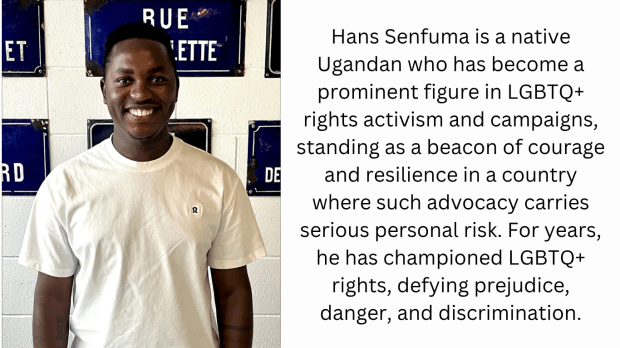
My name is Hans Senfuma, and I am a gay man from Uganda. Writing that sentence still carries weight for me, even today, because for so many years of my life, those words felt like a death sentence — not metaphorically, but literally.

I grew up in a deeply religious household in Uganda, surrounded by people I loved and who loved me, but who I knew would not love this part of me. From a young age, I understood that who I was did not fit the world I had been born into. Uganda is a country where homosexuality is not just socially stigmatized — it is criminalized. And in 2023, the government passed the Anti-Homosexuality Act, one of the harshest anti-LGBTQ laws in the world, with provisions that include the death penalty. Growing up knowing that your existence is punishable by law does something to a person. It teaches you to shrink yourself. It teaches you that survival means silence.

For years, I lived that silence. I smiled at family gatherings when relatives asked when I would get married. I sat through sermons that described people like me as broken, deviant, an abomination. I laughed along with jokes that were made at the expense of queer people, because laughing was safer than flinching. Every single day was a quiet performance of a version of myself that didn’t fully exist. And the exhaustion of that — the loneliness of carrying something so fundamental about yourself completely alone — is something I don’t think I have the words to fully describe.

Coming to terms with my identity was not a single moment. It was slow, painful, and non-linear. There were periods of self-loathing that I am not proud of. There were times I prayed to be different, not because I believed being gay was wrong, but because I desperately wanted to feel safe in my own skin, in my own country, around my own people. Acceptance didn’t arrive like a revelation. It crept in quietly, over time, through stolen moments of honesty with myself — and eventually, with a small circle of people I trusted with my life.

Leaving Uganda was one of the hardest decisions I have ever made. It was also one of the most necessary. The escalating legal climate made it impossible to continue the work I wanted to do from inside the country without putting myself and others at serious risk. When I finally arrived in a place where I could walk down a street without fear, where I could say my name and my truth in the same breath, I cried in a way I hadn’t allowed myself to cry in years. It wasn’t just relief. It was grief — for all the years spent hiding, for the community I left behind, for the Uganda I wished existed.

But leaving didn’t mean stepping away. If anything, it sharpened my sense of purpose. I have dedicated my work to legal advocacy and policy change, fighting for the rights of LGBTQ people in Uganda and across the African continent. I believe deeply that change is possible — not because I am naive, but because I have seen what happens when queer Africans find each other, support each other, and refuse to be erased. I have worked with legal teams challenging discriminatory legislation, contributed to policy frameworks that center the voices of those most at risk, and tried in every way I know how to use whatever platform I have to make noise where there has been silence.

I carry Uganda with me everywhere. I carry its sunsets, and its warmth, and its music, and the faces of people I love who are still there, still navigating a reality I know too well. I carry the responsibility of speaking for those who cannot yet speak for themselves without consequence. That weight is not a burden to me — it is a privilege.

I am sharing my story because visibility matters. Because somewhere right now, there is a young gay boy in Kampala doing exactly what I did — shrinking, hiding, surviving. And I want him to know that survival is not the ceiling. That there is a life beyond silence. That he is not alone, and he is not broken, and he is not an abomination.

He is exactly who he is supposed to be.

And so am I. 

Breaking Out: Claus’ Story

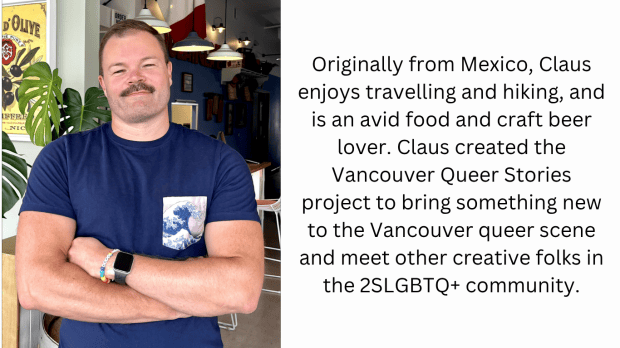
In 1990, my teacher warned my best friend’s mom not to let her daughter, Daniella, hang out with me, because I was rarito – a Spanish word that directly translates to “queer.” Like its English counterpart, rarito means “a little strange,” or “a little peculiar.” In Mexico, it specifically refers to men who appear to be gay.

It probably wasn’t hard to see that I was gay: I never enjoyed playing rough games or sports with the other boys, opting instead to play house with the girls at my school. My teacher knew I was gay before I realized it myself. And, rather than choosing to provide support or guidance, she tried to isolate me—an already painfully shy and very socially awkward little boy— by separating me from the one person that I connected with fully at the time. As if a rarito, a queer, didn’t deserve acceptance.

I was seven-years-old.

As the years progressed, so did the insults. If I thought rarito was bad… I had it coming. When I moved to another state at the age of 10, I spent one year in an all-boys school. The insults there became more pointed – maricon, marica, joto, puto (all words for fag — we seem to have a lot of them in Mexico). I then moved to Canada at the age of 14, and was introduced to the English variants of these insults.

When I look at photos of my childhood, I see a naive little queer boy who smiled widely, unaware of the way others perceived me — when teachers called me queer behind my back, but not to my face. But in photos from my teenage years, I see sadness. Not the typical teenage angst, but something deeper. The sorrow of someone who sometimes wondered if life would ever get better.

At 42, I can look back at these snippets of my life with clearer eyes. To my teenage self, I can truthfully say (as cliché as it sounds): it does get better. But it also gets difficult in new ways, because self-acceptance, and pride, and queerdom, isn’t always linear:

In 1992, I had my first crush. His name was Mathias, a German classmate with golden hair… which is odd, because I’m not typically attracted to blonde men.

In 1996, I had a platonic bromance with my friend Jorge. I moved away the next year, and he came out as gay in our 20s. We kept in contact, but never saw each other again, and he died of Covid. I sometimes wonder if I hadn’t moved away, if he might have been my first kiss. 

In 2000, I had a crush on a girl from high school. But at the same time, I was deeply attracted to so many of my male classmates. It was a very confusing time. I was repressing my sexuality so much, that when one of the guys I was crushing on slapped my ass during PE class — not sure if he was flirting or bullying me — I responded by slamming a hockey stick to his stomach. Hard.
A week later, he returned the favour, slamming a hockey stick against my shins, which fucked up my legs for years to come.

In 2002, at the ripe age of 19, I went on my first date… with a girl from university. Sarah was also my first kiss, which I didn’t enjoy at all. That same year, I went on my first date with a guy. His name was Danny. My name was “Nick…” yes, I used a fake name, because I was still terrified that someone I knew would find out I was gay! Danny was my second “first kiss,” which was more like it. He went on to become my first of many, (many… many) boyfriends

❖ ❖ ❖

When I came out to my friends at 19, their response was mostly positive, but I did lose some friendships over it. When I told my friend Nelda, she responded by asking me: “So what, you like it from behind?,” as if that is the only thing that makes a man gay. I was a virgin at the time… but to answer your question, Nelda – Yes, I do like it from behind.

A year later, in 2003, I came out to my brothers and then my parents. My middle brother had softened the blow by coming out the year before, which simultaneously made things better and worse. I didn’t know at the time that having multiple queer children in one household is actually very common.

In 2009, while holding hands with my boyfriend at the time, someone inside a passing car yelled “faggots,” and threw a jawbreaker at the back of my head. This was on Davie Street. During Pride weekend.

In 2014, I met Eamonn, and we got engaged five years later. When I got engaged, a woman who had worked in the same office as me for four years asked, after seeing my engagement ring, “Where did you propose to her?” I thought it was funny at the time. Then I realized how much of my life I still kept private from non-queer people I saw every day. It seems I’m allegedly “straight-passing” in some circles and find the constant “coming out” exhausting. 

❖ ❖ ❖

My relationship with Pride has also had its ups and downs. 

In 2004, I went to my first Vancouver Pride, and over the following two decades, I’ve been to many prides and queer-centric events throughout the world. London, Cape Town, Reykjavik, Buenos Aires, Guadalajara… even exotic Winnipeg — searching for queer joy in every time zone.

In 2022, I marched in a Pride parade for the first time, with the Vancouver Queer Irish group, and then again the following year. Yet, since last year, I’ve fallen out of love with Pride parades. With sponsor pullbacks, corporate and government support of an ongoing genocide, and the rights of trans and non-binary folks under attack, I’m feeling disconnected. I know we need visibility… but I keep wondering if we need to change the method. “The first Pride was a Riot,” they say… maybe it’s time we go back to marching on the streets, rather than parading on them.

In 2063, when I’m 80 years old, I’ll hopefully look back at today, and realize how good we had it. But I also hope that things will get much better for queer people over that time, because this, still isn’t it.

❖ ❖ ❖

In 1990, when I was 7-years old, my teacher called me Queer as an insult for the first time… behind my back, of course… Cabrona.

In 1998, someone wrote ‘faggot’ on the back of my sweatshirt in high school… and I wore it that way all day, because I didn’t notice until I got home.

In 2002, I came out as gay to my friends. A year later, I came out to my family.

In 2016, I began using the word Queer as an umbrella term to refer to myself, my friends, and other 2SLGBTQ+ people, in a positive light.

In 2022, I married Eamonn in two wonderful celebrations of the most immense queer joy, surrounded by so many of our friends and family.

Today, in 2026, I stand here, in a room full of queer people, telling our stories. And I finally realize: being a little strange, a little peculiar… a little rarito, if you will, is actually something to be proud of.

Celebration!: JJ’ Story

“Please report the video. I hate that your faces are on there with no consent. Getting everyone to report it.”

It’s 2023 and I’m at a bar on a first date. He’s in the bathroom when I get the text from my work wife; it’s accompanied by a Twitter link, posted by an account I’ve never heard of, Libs of TikTok, with the caption: “Elementary school in Vancouver held a pride parade today. Homeschool your kids!”

Even before playing the video, I recognize myself in the thumbnail. 

The video starts with me walking by shouting “Happy Pride!” followed by my students and several parents, waving, cheering. A few more clips of students walking by, smiling, waving rainbow flags, before it ends.

My date sits back down, and I show him the video, and proceed to chuckle about some of the comments. 

“Give me an S, Give me an I, Give me an N, SIN!”

“Those boys look “sissified” to me”

“It’s a free for all, next is orgy day”

And my personal favourite, the one that, to this day, I still lowkey want to get tattooed on my body: “Homeschool > homoschool”

Already the video has hundreds of thousands of views. I want to keep reading the comments, but don’t want to be that guy, so I put my phone away, and break the tension with a quip.

“How does it feel, knowing you’re on a date with a queer icon?”

The next day our staffroom is buzzin’. Coworkers tell me they’ve reported the video, my principal checks in to see if I’m okay. The video quickly balloons to 1.4 million views. In the comments, someone posted a screenshot of me from the video, wearing a rainbow cape and shiny cowboy hat, with the caption “Found the groomer!”

Another person comments on my picture, “He’s just a flat-out molester. He doesn’t even bother with grooming.”

My friend at the union reaches out, says there’s a lawyer on staff if I’m interested in trying to have the video taken down. We all report it, but all that does is hide the video on our accounts.

Repeatedly, I say I’m okay. That we’re celebrating Pride for the kids who don’t know they’re queer, or don’t feel comfortable being open about it yet, and if it makes things easier for even one of them, then it’s worth it. 

But writing this story and revisiting that video in 2026—thankfully stalled at paltry 1.7 million views—my whole body still burns.

I scour the video’s comments section for the funniest pull quotes, trying to discern what’s awful in the entertaining-let-me-read-this-out-loud-to-strangers way and what’s awful in the oh-boy-I’ll-probably-have-to-talk-about-this-in-therapy way. The margin between them is narrower than you think.

I was bullied and called gay before I even knew what that word meant, but I knew that I was supposed to vehemently deny being it.

In sixth grade, I received a friend request online from the email account “jjisgay99@hotmail.com,” one of those memories that’s hilarious now, but at the time, felt like someone had ripped the uvula from the back of my throat.

I’d stay in the closet for almost two decades longer, dating women, participating in casual misogyny. Talking about which actresses I thought were “hot,” but really, I probably just thought they had a nice smile. 

It wasn’t until 2020, when, after having my first session of therapy, I knew I was ready to start living authentically. The next day, my 30th birthday, I came out to the majority of my close friends at a socially-distanced pie-themed hang in the park, scrawling “I’M GAY” on the inside of a pie box—the pie was peach-cardamom, obviously.

The atmosphere was one of compounding disasters: sitting on blankets six-feet apart, unknowingly about to embark on the second wave of the pandemic. The sky was muggy and thick with forest fire smoke and a recent looper moth infestation surrounded us with thousands of fluttering bugs.

It was one of the best days of my life. 

After coming out during lockdown, I struggled with how to relate to the queer community I suddenly found myself identifying with: my main connections being gay meme accounts on Instagram and a parade of COVID-safe dates that always ended back at my apartment. Dr. Bonnie Henry would certainly agree our activities involved a curve, though none flattened.

One first date, after a guy spent most of the night talking about how much he wanted a boyfriend, we ended back at my apartment, carnally making out on the couch, before he climbed on top of me, squeezed my cheeks together, and hawk-tuahed a single oblong strand of saliva slowly into my mouth. “Sir, we are in a pandemic here, you can’t just spit in people’s mouths, especially without asking first.” We still had sex, of course.

Fucking this rogues’ gallery of strangers felt necessary at the time. Fleeting connections to the gay community, sharing coming-out-stories with cum still leaking out. Hearing about Internet chatrooms and early cruising. I was a cultural anthropologist, absorbing every detail and mentally cataloguing to better understand where I fit.

Later that school year, I was recruited to help organize my school’s first-ever Pride celebration. Starved from no parties in almost 15 months, I brought a finely-curated selection from my personal tickletrunk for my kindergartens. Flamingo sunglasses, a taco hat, sequined fans, an inflatable telephone.

Suddenly, at 30-years-old, I was marching in my first Pride parade.

For the past six years I’ve helped organize and grow school Pride celebrations, each with their own lil’ moments. After our neighbourhood parade in 2024, we headed to the school’s backfield and performed a flashmob to families, all to the song “Born This Way.”

When I’d talked to my kindergartens about what other Pride celebrations involved, my students globbed onto the idea that people sometimes dress up, and asked if they could wear costumes—which is why, in videos of that flashmob, you can see Disney princesses and superheroes dancing to Lady Gaga.

I want these to be the stories I share about school Pride, but it’s important to know it’s not all rainbows and five-year-old Captain America dancing to Gaga. 

Like when kindergartens from my class are noticeably absent the day of the parade, because their family “doesn’t celebrate Pride.”

A parent’s venomous email to a colleague, calling everyone at the school pedofiles; the same parent who, later that month, smiled and cooed to me about how she hoped her son would be in my class next year.

The idea that schools are somehow brainwashing youths by showing support and normalizing words like “bisexual” and “trans.” 

“I’ve been teaching for decades, and I can barely teach these kids math. And I’m a math specialist!” a colleague shared with me, exasperated. “They think I can somehow influence these kids enough to change their whole ideology or gender?!”

Knowing teachers who’ve been doxxed, received death threats—putting themselves at risk while trying to make things safer for queer youth.

There’s decadent irony that, in tandem with writing this story, I’m helping organize this year’s Pride at my school. 

We’re going bigger, bolder, louder. A coworker designed a Pride 2026 logo with our school’s mascot, and managed to get custom stickers donated. We’re inviting neighbouring schools. We have a whole spirit week planned, a dance party, a photobooth. We’re getting T-shirts made as a fundraiser. I get giddy thinking about how amazing this year will be. Usually that excitement drowns out all the what-ifs. 

I’ve been working on a handout, highlighting statistics about queer youth, for families to help understand the importance of Pride. Pulling from Statistics Canada empirical gut-punches like how queer youth are twice as likely to describe their mental health as being poor; they’re more likely to be targeted for bullying, experience homelessness, and twice as likely to consider suicide; how trans and non-binary youth are twice as likely to experience cyberbullying.

I triple-check my sources with a diligence I wouldn’t have dreamed of during my English undergrad, knowing these stats will be scrutinized with the vigor that only a bored, privileged suburban parent can muster. 

I hate having to take the more thoughtful high road. Having our “We want every kid to feel safe being who they are” met with “You’re all pedofiles,” coming from zealots whose churches, businesses, and governments knowingly protect actual predators. But I digress.  

Progress can sometimes feel small.

The odd joy of when reading a book to my class, a student refers to someone as “gay,” and my body seizes up like they’re using a slur, when in fact, the book has a family with two dads. Gay as a descriptor, not an allegation.

It took until my mid-30s before I saw being gay as a gift. A hard-won title after a lifetime of being teased for liking things I didn’t even know I liked yet; the finally-satiated hunger of someone who spent years eating what they weren’t craving. Let’s hope the next generation gets to feel this lucky some day.

And if you need to contact me or have any questions about this story, you can always reach me at jjisgay99@hotmail.com.